Estimated reading time: 6 minutes
Recovering from injuries has always challenged athletes, healthcare professionals, and researchers. Whether healing a torn tendon, repairing damaged muscle, or recovering from surgery, the body relies on a remarkable network of biological signals to coordinate tissue repair. Among these signaling molecules are healing peptides—short chains of amino acids that help regulate inflammation, cell communication, blood vessel formation, collagen production, and tissue regeneration.
In recent years, healing peptides have gained significant attention in sports medicine and regenerative medicine. Laboratory studies have produced encouraging findings, but much of the excitement has outpaced the available human evidence. While some peptide-based therapies have become established medical treatments, many healing peptides remain experimental and have not received FDA approval.
Understanding where the science currently stands is essential before considering any peptide-based therapy.
What Are Healing Peptides?
Healing peptides are naturally occurring or synthetic chains of amino acids that influence biological processes involved in tissue repair.
Rather than directly rebuilding damaged tissue, they act as signaling molecules that help regulate:
- inflammation
- collagen production
- blood vessel formation (angiogenesis)
- stem cell activity
- immune responses
- cellular communication
Scientists continue investigating whether these biological signals can improve healing following injury or surgery.
How Does the Body Naturally Heal?
Healing occurs in several overlapping stages.
1. Inflammation
The immune system removes damaged tissue and protects against infection.
2. Cell Proliferation
New blood vessels develop.
Fibroblasts begin producing collagen.
New tissue starts forming.
3. Remodeling
Collagen fibers reorganize.
Scar tissue matures.
Strength gradually improves.
Healing peptides are being studied because they may influence one or more of these phases.
What Is BPC-157?
Body Protection Compound-157 (BPC-157) is one of the most widely discussed healing peptides.
It is a synthetic fragment derived from a naturally occurring protective protein found in gastric juice.
Researchers became interested because laboratory studies suggested possible effects on:
- tendon healing
- ligament repair
- muscle injuries
- intestinal healing
- nerve regeneration
What Does the Research Show?
Animal studies have reported improvements in:
- tendon repair
- ligament healing
- muscle recovery
- gastrointestinal injury
However, high-quality human clinical trials remain extremely limited.
Much of what is claimed online is based on laboratory or animal research rather than large randomized clinical trials.
FDA Status
BPC-157 is NOT FDA approved.
It has not completed the clinical trial process required for approval as a prescription medication.
What Is TB-500?
TB-500 is the synthetic version of a naturally occurring peptide called Thymosin Beta-4.
Thymosin Beta-4 naturally occurs throughout the body and plays a role in:
- cell migration
- tissue remodeling
- wound healing
- blood vessel formation
Current Research
Researchers continue studying Thymosin Beta-4 for:
- corneal injuries
- cardiac repair
- skin wounds
- tendon injuries
Animal studies have shown encouraging results.
Human evidence remains limited and continues to evolve.
FDA Status
TB-500 is not FDA approved.
Although naturally occurring Thymosin Beta-4 continues to be investigated in clinical research, synthetic TB-500 has not received approval for routine medical use.
What Is GHK-Cu?
GHK-Cu is a naturally occurring copper-binding peptide discovered in human plasma.
Unlike BPC-157 and TB-500, GHK-Cu naturally declines with age.
Scientists have studied it because it appears to influence:
- collagen synthesis
- wound healing
- skin repair
- hair growth
- anti-inflammatory responses
Current Research
Published studies have demonstrated potential effects on:
- skin remodeling
- collagen production
- antioxidant activity
- tissue regeneration
Because of these findings, GHK-Cu is increasingly studied in dermatology and regenerative medicine.
FDA Status
GHK-Cu has not been approved by the FDA as a prescription medication for tissue repair, although it appears in some cosmetic products under different regulatory pathways.
Why Are Healing Peptides So Popular?
Healing peptides have attracted attention because they may influence multiple biological pathways simultaneously.
Researchers are investigating whether they can affect:
- angiogenesis
- collagen formation
- inflammatory signaling
- stem-cell activation
- extracellular matrix remodeling
If these effects translate into meaningful clinical outcomes, they could become valuable tools in regenerative medicine.
However, scientific investigation is still ongoing for many compounds.
What Are the Potential Benefits?
Early research has explored possible improvements in:
- tendon recovery
- ligament healing
- muscle injuries
- skin wounds
- gastrointestinal repair
- nerve regeneration
- joint health
The strength of evidence varies considerably depending on the peptide.
Most proposed applications still require larger human clinical trials.
What Are the Risks?
Because many healing peptides remain investigational, long-term safety has not been fully established.
Potential concerns include:
- injection-site reactions
- allergic responses
- contamination from unregulated products
- uncertain dosing
- unknown long-term effects
Products sold outside regulated medical systems may also vary in purity and quality.
Should Athletes Use Healing Peptides?
Athletes should be cautious.
Some peptide compounds may violate the rules of competitive sports organizations, and the regulatory status differs by substance.
Additionally, because many healing peptides remain experimental, athletes should carefully weigh the potential risks and benefits with qualified healthcare professionals.
Frequently Asked Questions
💪 FaithnFit Recommended Gear
Support your recovery through proven training, nutrition, and recovery habits.
Recovery begins with adequate protein, quality sleep, progressive rehabilitation, and patience—peptides are still an evolving area of research.
Are healing peptides FDA approved?
Most healing peptides discussed online, including BPC-157 and TB-500, have not received FDA approval for routine medical use.
Do healing peptides repair injuries faster?
Laboratory and animal studies have shown encouraging findings for several compounds, but high-quality human clinical evidence remains limited.
Are healing peptides steroids?
No.
Healing peptides are short chains of amino acids that influence biological signaling pathways.
They are completely different from anabolic steroids.
Why are researchers excited about healing peptides?
Because they may regulate multiple stages of tissue repair simultaneously, making them promising candidates for future regenerative medicine research.
Key Takeaways
Healing peptides represent one of the most exciting frontiers in regenerative medicine. Compounds such as BPC-157, TB-500, and GHK-Cu are being studied for their potential roles in tissue repair, collagen production, inflammation, and recovery from injury.
While laboratory and animal research has produced encouraging findings, most healing peptides remain investigational and have not received FDA approval for routine medical use. Larger human clinical trials are still needed to determine whether these promising biological effects translate into safe and effective treatments.
For now, evidence-based recovery continues to rely on proven fundamentals: appropriate medical care, progressive rehabilitation, adequate protein intake, quality sleep, and patience. As research advances, healing peptides may eventually become valuable additions to regenerative medicine, but clinical evidence—not marketing claims—should guide healthcare decisions.
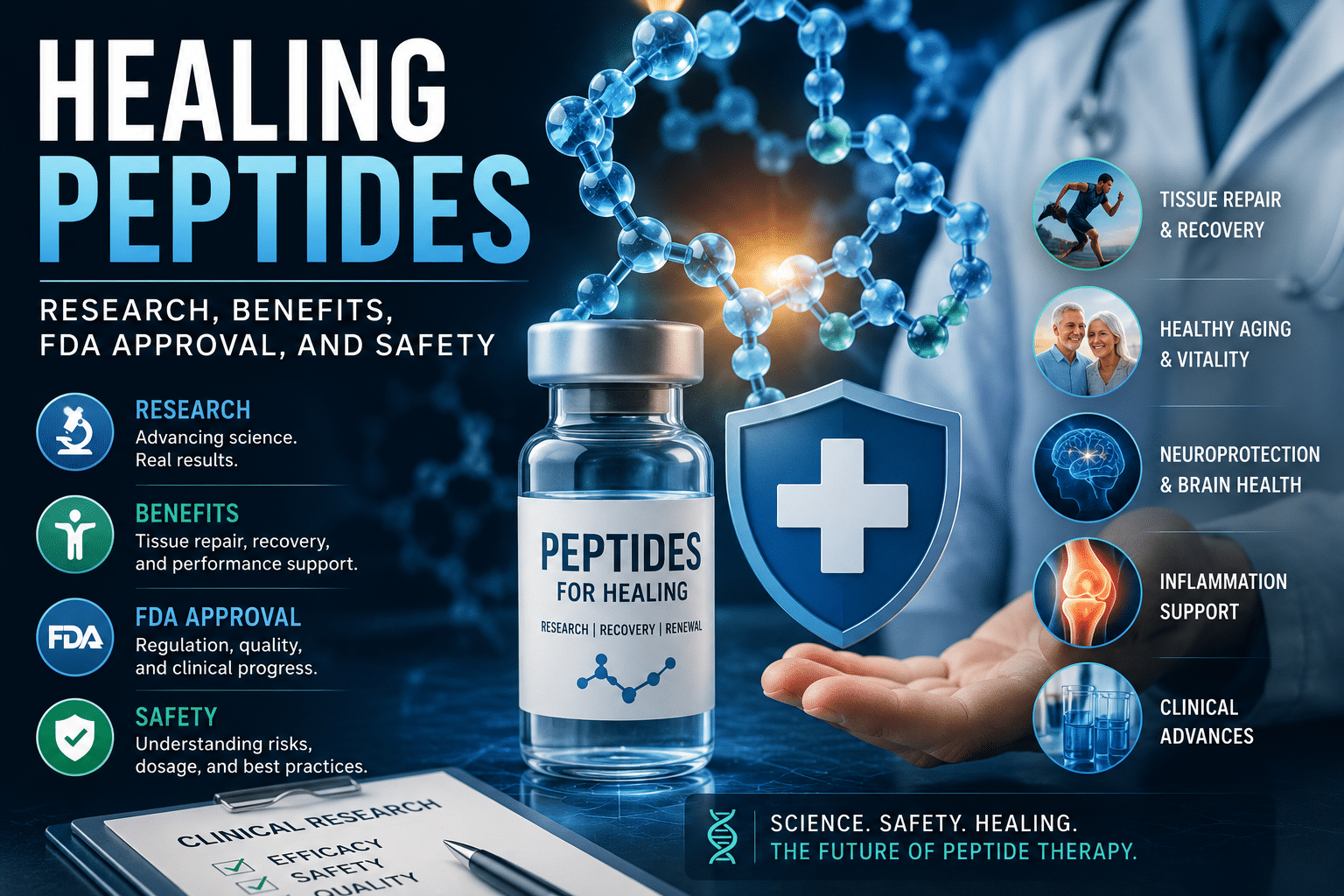
Read more: Healing Peptides: Research, Benefits, FDA Approval, and Safety- Anti-Aging Peptides: What the Science Really Says About Longevity and Healthy Aging
- Peptides: The Science, Benefits, Risks, and Performance Edge
- Peptides Explained: Benefits, Research, Safety, and Future Medicine
- Amino Acids, Peptides, and Protein for Muscle Growth
- FDA Approved Peptides: How Peptide Medicines Go From the Laboratory to Your Doctor
🌿 Natural Daily Support for Men and Women
I like Divine Bounty supplements because they use natural ingredients instead of synthetic formulas. For people who want a cleaner option for everyday wellness support, Divine Bounty offers quality supplements designed to fit a healthy lifestyle.
Their lineup includes the popular Men’s Multivitamin, plus other supplements for men and women such as Vitamin B Complex, Digestive Enzymes, Berberine, Magnesium Citrate, Vitamin K2 + D3, and Acetyl L-Carnitine.
The Men’s Multivitamin features 24 essential vitamins and minerals plus 5 additional blends for men, all in convenient vegetarian capsules. It is also promoted as GMO free, soy free, dairy free, wheat free, and gluten free.
🛒 Shop Divine Bounty on AmazonSponsored by Terry Clark • Amazon Affiliate Partner