Walk into almost any health clinic, fitness forum, or medical conference today, and you’re likely to hear the word peptides. They are being studied for weight loss, muscle preservation, diabetes, wound healing, aging, heart disease, cognitive function, and even mitochondrial health. Some peptide-based medicines have transformed modern healthcare, while others remain experimental and are only available through clinical research.
Despite their growing popularity, peptides are often misunderstood. Many people assume they are simply another type of supplement or steroid. In reality, peptides are naturally occurring biological molecules that your body produces every second of every day. They help regulate hormones, metabolism, immune function, digestion, tissue repair, appetite, and countless other physiological processes.
Understanding peptides begins with understanding how the body builds proteins and communicates between cells. Once you understand that foundation, the rapidly growing field of peptide medicine becomes much easier to understand.
What Are Peptides?
Peptides are short chains of amino acids linked together by peptide bonds.
Think of amino acids as individual building blocks.
When two or more amino acids join together, they form a peptide.
When much longer chains fold into complex three-dimensional structures, they become proteins.
The relationship looks like this:
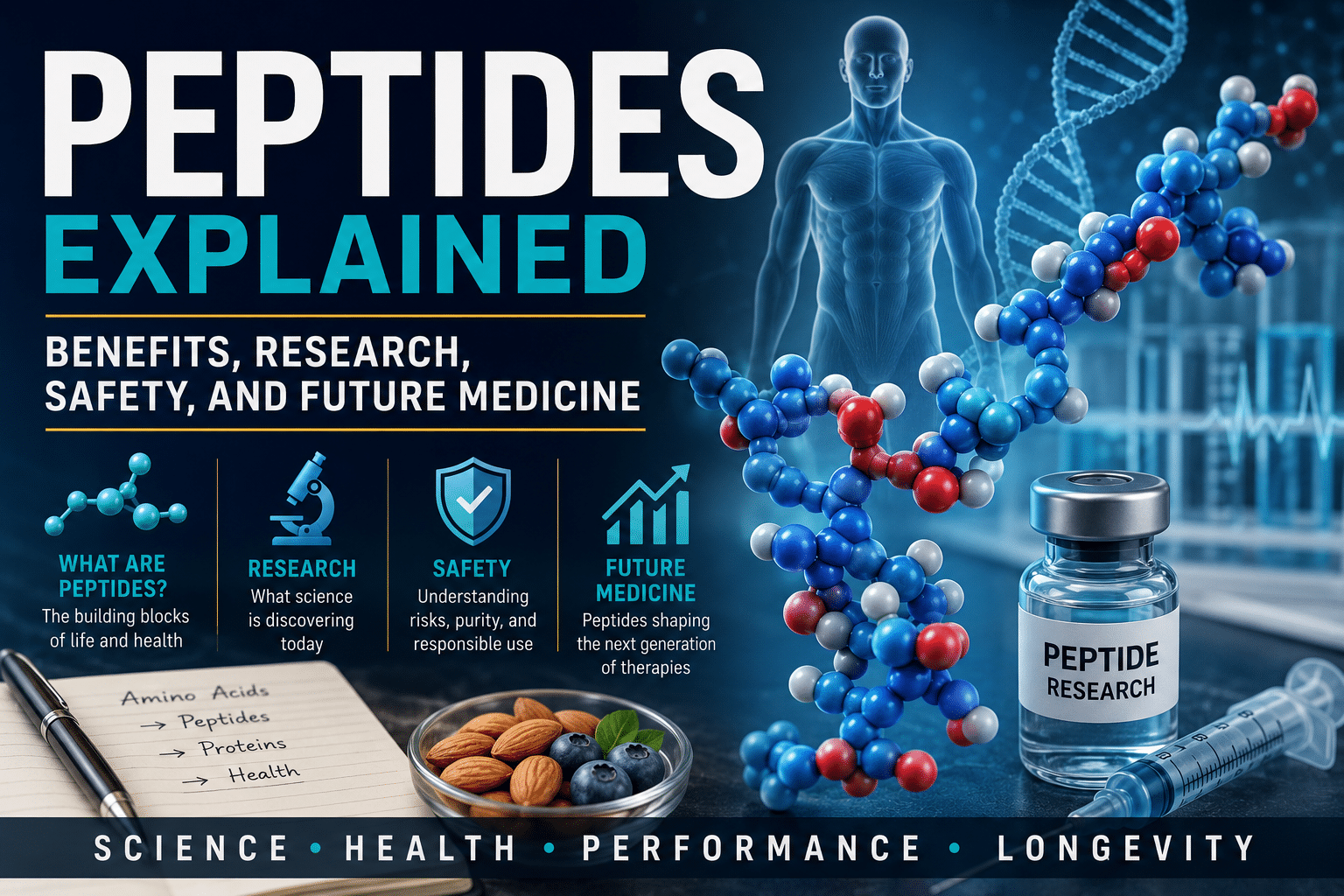
Amino Acids → Peptides → Proteins
This progression is one of biology’s most fundamental building processes.
Generally:
- Amino acid: one building block
- Dipeptide: two amino acids
- Tripeptide: three amino acids
- Oligopeptide: about 2–20 amino acids
- Polypeptide: about 20–50 amino acids
- Protein: usually more than 50 amino acids folded into a functional structure
Although these definitions overlap somewhat in biology, peptides are generally shorter and simpler than proteins.
Why Are Amino Acids So Important?
Proteins begin with amino acids.
Humans use 20 standard amino acids to build nearly every protein in the body.
These amino acids are classified into three groups.
Essential Amino Acids
Essential amino acids cannot be made by the body and must come from food.
Examples include:
- Leucine
- Lysine
- Methionine
- Phenylalanine
- Tryptophan
- Valine
These are critical for muscle protein synthesis, tissue repair, hormone production, and enzyme function.
Nonessential Amino Acids
These can be produced naturally by the body.
Examples include:
- Alanine
- Aspartate
- Asparagine
Conditionally Essential Amino Acids
Normally, the body can make these amino acids, but during illness, injury, or periods of rapid growth, dietary intake may become important.
Examples include:
- Arginine
- Glutamine
- Glycine
- Tyrosine
How Do Peptides Differ From Proteins?
Although peptides and proteins are both made from amino acids, they serve different purposes.
Proteins often provide structure or perform complex biological functions.
Examples include:
- collagen
- hemoglobin
- antibodies
- actin
- myosin
Peptides often function as biological messengers.
Instead of becoming structural components, many peptides tell cells what to do.
Think of peptides as text messages sent throughout your body.
They deliver instructions that regulate countless biological processes.
What Do Naturally Occurring Peptides Do?
Your body already produces hundreds of peptides.
Many are essential for life.
Some of the most important include:
Insulin
Produced by the pancreas, insulin regulates blood sugar by helping glucose move from the bloodstream into cells for energy.
Without insulin, survival is impossible.
Glucagon
Glucagon works opposite insulin by increasing blood glucose when levels become too low.
Together, insulin and glucagon maintain stable blood sugar.
GLP-1 (Glucagon-Like Peptide-1)
GLP-1 is released from the intestines after eating.
It:
- increases insulin secretion
- slows stomach emptying
- reduces appetite
- helps regulate blood sugar
Modern medications such as semaglutide mimic this naturally occurring peptide.
Ghrelin
Often called the “hunger hormone,” ghrelin signals the brain that it’s time to eat.
Levels typically rise before meals and decrease afterward.
Leptin
Leptin is produced primarily by fat tissue.
It communicates energy stores to the brain and helps regulate hunger and long-term energy balance.
Oxytocin
Sometimes called the “bonding hormone,” oxytocin influences childbirth, breastfeeding, trust, and social connection.
Vasopressin
Also known as antidiuretic hormone (ADH), vasopressin helps regulate water balance and blood pressure.
Angiotensin II
This peptide helps regulate blood pressure through constriction of blood vessels and stimulation of aldosterone release.
Why Are Scientists So Interested in Peptides?
Researchers are attracted to peptides because they can target specific biological pathways with greater precision than many traditional drugs.
Potential advantages include:
- high biological specificity
- lower off-target effects
- naturally occurring mechanisms
- ability to mimic the body’s own signaling molecules
However, peptides also present challenges.
Many break down quickly in the digestive tract, making oral delivery difficult. Others require injections or specialized formulations to remain effective.
How Are Peptides Used in Medicine Today?
Peptide-based medicines are already used to treat several medical conditions.
Examples include:
- diabetes
- obesity
- osteoporosis
- hormone deficiencies
- infertility
- certain cancers
These therapies have undergone rigorous testing and regulatory review before approval.
At the same time, many other peptides promoted online for muscle growth, anti-aging, or tissue repair remain investigational and have not been approved for those uses.
Distinguishing between established treatments and experimental research is essential for making informed decisions.
💪 FaithnFit Recommended Gear
Support your health and fitness journey with these trusted essentials.
Understanding your body’s biology is the first step toward making informed health decisions.
Are Peptides Safe?
Safety depends on the specific peptide, its intended use, dose, route of administration, and the quality of the supporting evidence.
FDA-approved peptide medications have been evaluated for safety and effectiveness for specific medical conditions.
Investigational peptides may show promise in laboratory or early clinical studies but often lack sufficient evidence to establish long-term safety or effectiveness. Products marketed outside regulated medical settings may also vary in quality and purity.
Anyone considering peptide therapy should discuss potential benefits and risks with a qualified healthcare professional.
Frequently Asked Questions
Are peptides steroids?
No. Peptides are chains of amino acids, whereas anabolic steroids are synthetic compounds related to testosterone. They work through different biological mechanisms.
Are peptides proteins?
Not exactly. Peptides are shorter chains of amino acids, while proteins are generally longer, folded chains with more complex structures.
Does the body naturally make peptides?
Yes. The human body produces hundreds of peptides that regulate metabolism, hormones, appetite, immune function, blood pressure, and tissue repair.
Why are peptide medicines growing in popularity?
Because they can mimic natural signaling molecules and target specific biological pathways, peptide-based therapies have become an important area of pharmaceutical research.
Key Takeaways
Peptides are short chains of amino acids that serve as essential biological messengers throughout the body. They bridge the gap between individual amino acids and larger proteins, helping regulate metabolism, hormones, appetite, immune function, tissue repair, and many other physiological processes.
Some peptide-based medicines are already transforming the treatment of conditions such as diabetes, obesity, and hormone deficiencies. Others remain in clinical development as researchers explore their potential for muscle preservation, cardiovascular disease, mitochondrial function, healthy aging, and tissue repair.
Understanding what peptides are—and separating established medical evidence from ongoing research—provides the foundation for evaluating the exciting advances that will be explored in the articles that follow in this series.
Read more: Peptides Explained: Benefits, Research, Safety, and Future Medicine- Peptides: The Science, Benefits, Risks, and Performance Edge
- Amino Acids, Peptides, and Protein for Muscle Growth
- COVID-19: Experimental Peptide Help to Avoid the Virus
- Amino Acids – Unlocking the Power, Health and Fitness Benefits
- The Role of Functional Medicine in Enhancing Athletic Performance and Recovery
🌿 Natural Daily Support for Men and Women
I like Divine Bounty supplements because they use natural ingredients instead of synthetic formulas. For people who want a cleaner option for everyday wellness support, Divine Bounty offers quality supplements designed to fit a healthy lifestyle.
Their lineup includes the popular Men’s Multivitamin, plus other supplements for men and women such as Vitamin B Complex, Digestive Enzymes, Berberine, Magnesium Citrate, Vitamin K2 + D3, and Acetyl L-Carnitine.
The Men’s Multivitamin features 24 essential vitamins and minerals plus 5 additional blends for men, all in convenient vegetarian capsules. It is also promoted as GMO free, soy free, dairy free, wheat free, and gluten free.
🛒 Shop Divine Bounty on AmazonSponsored by Terry Clark • Amazon Affiliate Partner