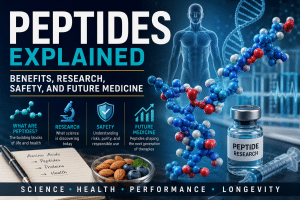
Every year, new peptides make headlines as potential treatments for obesity, diabetes, muscle loss, aging, wound healing, and other medical conditions. Some eventually become FDA-approved medications that transform healthcare. Others show promise in laboratory experiments but never reach patients because they fail to demonstrate safety or effectiveness.
Understanding how peptide medicines are developed is essential for separating scientific evidence from marketing claims. The fact that a peptide exists or is discussed online does not mean it has been proven to work or approved for medical use.
This article explains how peptide therapies move from discovery to FDA approval, what the different clinical trial phases mean, and why understanding the evidence matters before considering any peptide-based treatment.
What Does FDA Approval Mean?
The U.S. Food and Drug Administration (FDA) regulates medications sold for medical use in the United States.
FDA approval means that researchers have provided sufficient scientific evidence showing that a medication’s benefits outweigh its risks for a specific medical condition.
Approval does not mean a drug is perfect.
It means the available evidence demonstrates an acceptable balance between effectiveness and safety for approved uses.
Why Are Peptides Different From Supplements?
Many people confuse peptides with dietary supplements.
They are very different.
Dietary supplements generally contain vitamins, minerals, herbs, or naturally occurring nutrients.
Therapeutic peptides are biological molecules designed to influence specific physiological pathways.
Most peptide medications require prescriptions because they directly affect hormone signaling, metabolism, or other complex biological systems.
How Are New Peptides Discovered?
Most peptide research begins in the laboratory.
Scientists first identify naturally occurring peptides or create synthetic versions that may interact with specific receptors inside the body.
Researchers ask questions such as:
- Does this peptide bind to a receptor?
- Does it improve cell function?
- Does it influence inflammation?
- Does it regulate metabolism?
- Could it improve healing?
If laboratory results appear promising, research progresses to animal studies.
Most potential drugs never advance beyond this stage.
What Happens Before Human Studies?
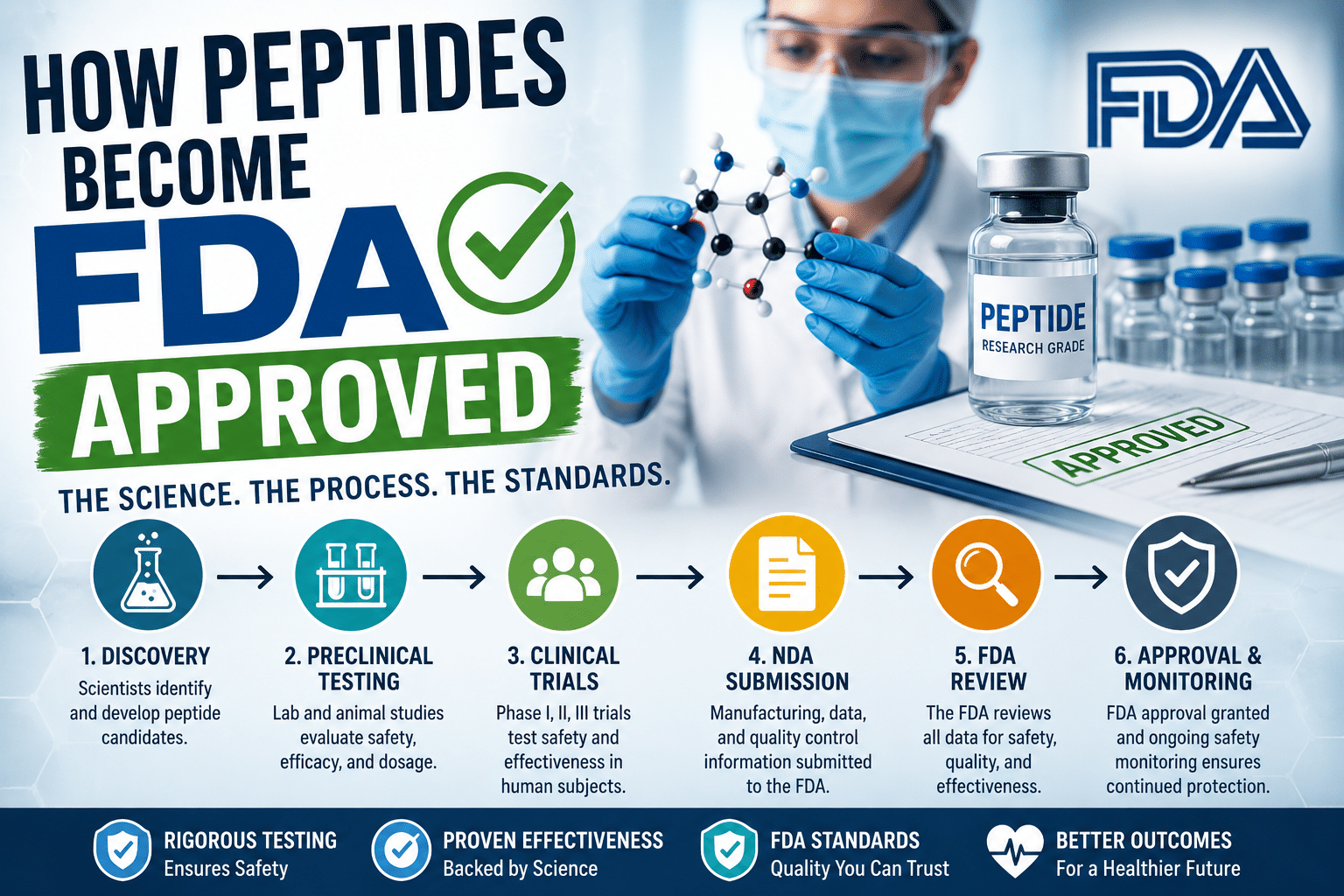
Before testing begins in people, researchers perform preclinical studies.
These studies evaluate:
- biological activity
- toxicity
- dosage
- metabolism
- potential side effects
Animal models help scientists identify serious safety concerns before exposing human volunteers.
Only a small percentage of investigational compounds move beyond preclinical research.
What Are the Clinical Trial Phases?
Every new peptide medicine follows a structured development process before approval can be considered.
Phase 1: Safety
Participants: 20–100 healthy volunteers or patients
Researchers evaluate:
- safety
- dosing
- absorption
- metabolism
- early side effects
Primary question:
Is it reasonably safe to continue studying?
Phase 2: Effectiveness
Participants: Approximately 100–300 patients
Researchers begin determining:
- whether the peptide works
- optimal dosage
- common side effects
Many investigational peptides fail during this phase because they do not produce meaningful clinical benefits.
Phase 3: Large Clinical Trials
Participants often exceed 1,000 individuals.
Researchers compare the peptide against:
- placebo
- standard treatments
- current medications
This phase produces much of the evidence reviewed by regulatory agencies.
Successful Phase 3 trials are often required before submitting an application for FDA approval.
Phase 4: Post-Marketing Surveillance
Approval is not the end of research.
Even after approval, scientists continue monitoring:
- long-term safety
- rare side effects
- effectiveness in larger populations
- interactions with other medications
Some drugs receive updated warnings or expanded indications based on these findings.
Why Do Most Peptides Never Reach the Market?
Drug development is extremely challenging.
Approximately 90% of drug candidates entering clinical trials never receive FDA approval.
Common reasons include:
- lack of effectiveness
- unacceptable side effects
- manufacturing challenges
- commercial limitations
- better competing therapies
This is why early laboratory studies should never be interpreted as proof that a peptide works in humans.
Which Peptides Are Already FDA Approved?
Several peptide-based medications have become important medical therapies.
Examples include:
GLP-1 Receptor Agonists
Examples include semaglutide and liraglutide.
Approved uses include:
- type 2 diabetes
- chronic weight management (specific products and patient populations)
Insulin
Although insulin is technically a peptide hormone, it remains one of the most important peptide medicines ever developed.
Millions of people rely on insulin therapy every day.
Teriparatide
A synthetic fragment of parathyroid hormone.
Approved for certain patients with osteoporosis at high risk of fracture.
Calcitonin
Used in selected situations involving calcium regulation and bone disorders.
Gonadotropin-Releasing Hormone (GnRH) Analogs
These peptide-based medicines help treat several hormone-related conditions, including certain cancers, endometriosis, and infertility.
💪 FaithnFit Recommended Gear
Support your fitness journey with trusted essentials while staying informed about evidence-based health.
Evidence-based decisions are just as important as consistent training.
Which Peptides Are Still Experimental?
Many peptides discussed online remain investigational.
Examples include:
- BPC-157
- TB-500 (Thymosin Beta-4)
- MOTS-c
- Humanin
- Epitalon
- FOXO4-related peptides
- AOD-9604 (for uses beyond approved research contexts where applicable)
These compounds continue to be studied for potential applications such as tissue repair, mitochondrial function, muscle preservation, and healthy aging.
However, being studied does not mean they are FDA approved or proven effective for those purposes.
Future clinical trials will determine whether these investigational therapies eventually become standard medical treatments.
Why Does Clinical Research Take So Long?
Developing a medication often requires 10 to 15 years.
Researchers must answer important questions:
- Does it work?
- Is it safe?
- What dose is appropriate?
- Which patients benefit most?
- Are there long-term risks?
Skipping these steps could expose patients to treatments that are ineffective or harmful.
The lengthy approval process exists to protect public health.
Frequently Asked Questions
Are all peptides FDA approved?
No. Only a limited number of peptide-based medications have received FDA approval for specific medical conditions. Many other peptides remain investigational.
Can doctors prescribe investigational peptides?
Some peptides may be available through clinical trials or other regulated pathways, while others are not approved for routine medical use. Availability depends on local regulations and the specific compound.
Why are peptides so promising?
Peptides can target specific biological pathways with high precision, making them attractive candidates for treating a wide range of diseases.
Does research guarantee approval?
No. Most investigational drugs fail during development because they do not demonstrate adequate safety or effectiveness.
Key Takeaways
The journey from laboratory discovery to FDA approval is long, expensive, and grounded in rigorous scientific evaluation. Peptide medicines must progress through preclinical testing, multiple phases of human clinical trials, and comprehensive regulatory review before they can be approved for specific medical conditions.
While approved peptide therapies have already transformed the treatment of diseases such as diabetes and osteoporosis, many peptides promoted for muscle growth, anti-aging, healing, or fat loss remain investigational. Understanding where a peptide sits in the research pipeline helps separate established medical evidence from early scientific promise.
As peptide research continues to advance, new therapies may emerge for conditions that currently have limited treatment options. Until then, the strongest evidence should guide healthcare decisions, and experimental findings should be viewed with cautious optimism rather than certainty.
Read more: FDA Approved Peptides: How Peptide Medicines Go From the Laboratory to Your Doctor- Peptides: The Science, Benefits, Risks, and Performance Edge
- Peptides Explained: Benefits, Research, Safety, and Future Medicine
- Amino Acids, Peptides, and Protein for Muscle Growth
- How to Use Fitness Journeys to Improve Spiritual Life According to the Bible
- COVID-19: Experimental Peptide Help to Avoid the Virus
🌿 Natural Daily Support for Men and Women
I like Divine Bounty supplements because they use natural ingredients instead of synthetic formulas. For people who want a cleaner option for everyday wellness support, Divine Bounty offers quality supplements designed to fit a healthy lifestyle.
Their lineup includes the popular Men’s Multivitamin, plus other supplements for men and women such as Vitamin B Complex, Digestive Enzymes, Berberine, Magnesium Citrate, Vitamin K2 + D3, and Acetyl L-Carnitine.
The Men’s Multivitamin features 24 essential vitamins and minerals plus 5 additional blends for men, all in convenient vegetarian capsules. It is also promoted as GMO free, soy free, dairy free, wheat free, and gluten free.
🛒 Shop Divine Bounty on AmazonSponsored by Terry Clark • Amazon Affiliate Partner