Estimated reading time: 6 minutes
Every heartbeat, every step, every muscle contraction, and every thought depends on energy. That energy comes from microscopic structures inside nearly every cell in your body called mitochondria. Often referred to as the “powerhouses of the cell,” mitochondria convert nutrients into adenosine triphosphate (ATP), the molecule that powers life.
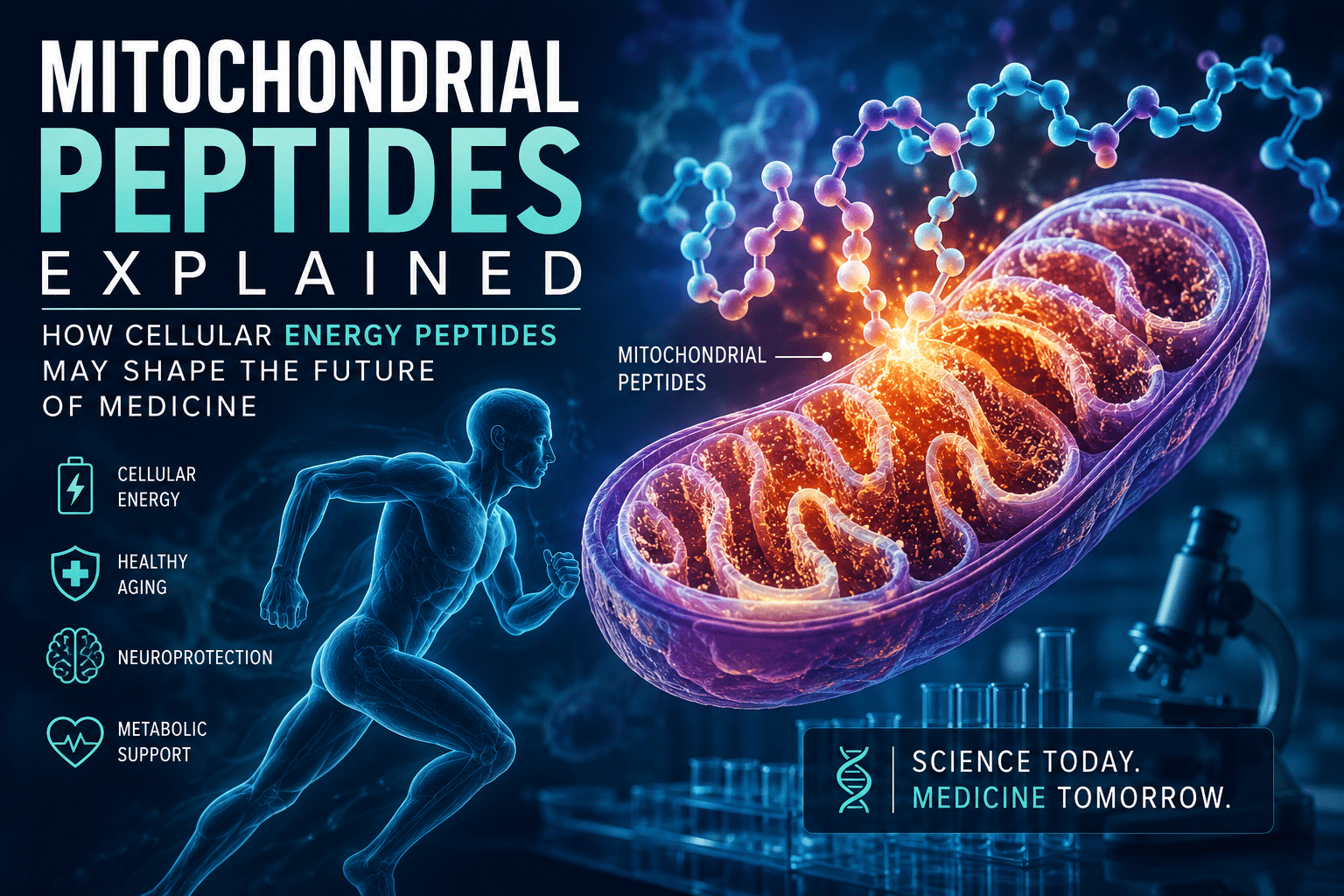
For decades, scientists believed mitochondria served primarily as energy factories. Today, research has revealed a much more complex role. Mitochondria also communicate with the rest of the body through tiny signaling molecules known as mitochondrial peptides. These naturally occurring peptides may influence metabolism, exercise adaptation, inflammation, aging, insulin sensitivity, and cellular stress responses.
Although mitochondrial peptide research is still in its early stages, these molecules are rapidly becoming one of the most exciting areas of regenerative medicine and longevity science.
What Are Mitochondrial Peptides?
Mitochondrial peptides are short chains of amino acids produced inside mitochondria.
Unlike most proteins, which are encoded by DNA in the cell nucleus, mitochondrial peptides originate from the small amount of DNA contained within mitochondria themselves.
Scientists refer to many of these compounds as mitochondrial-derived peptides (MDPs).
Instead of producing cellular energy directly, they function as biological messengers that help cells adapt to stress and maintain metabolic balance.
Why Are Mitochondria So Important?
Every human cell requires ATP.
Mitochondria generate ATP through oxidative phosphorylation, using oxygen and nutrients to produce usable energy.
Without healthy mitochondria, cells struggle to function efficiently.
Mitochondria influence:
- energy production
- exercise performance
- fat metabolism
- insulin sensitivity
- muscle function
- brain health
- heart function
- immune responses
- aging
As people grow older, mitochondrial efficiency gradually declines.
Researchers believe this decline contributes to many chronic diseases associated with aging.
What Are Mitochondrial-Derived Peptides?
Scientists have identified several naturally occurring peptides encoded by mitochondrial DNA.
The best studied include:
- Humanin
- MOTS-c
- SHLPs (Small Humanin-Like Peptides)
These peptides appear to help cells respond to stress by improving communication between mitochondria and the cell nucleus.
What Is Humanin?
Humanin was the first mitochondrial-derived peptide discovered.
Researchers identified it while studying Alzheimer’s disease.
Since then, Humanin has become one of the most extensively studied mitochondrial peptides.
What Does Humanin Do?
Laboratory research suggests Humanin may help:
- reduce oxidative stress
- protect nerve cells
- improve insulin sensitivity
- reduce inflammation
- support cardiovascular health
Humanin appears to protect cells from programmed cell death (apoptosis), particularly during periods of stress.
Current Research
Scientists continue investigating Humanin for potential roles in:
- Alzheimer’s disease
- Parkinson’s disease
- cardiovascular disease
- diabetes
- age-related muscle loss
Most evidence currently comes from laboratory studies and animal research.
Large human clinical trials remain limited.
What Is MOTS-c?
MOTS-c (Mitochondrial Open Reading Frame of the 12S rRNA-c) is another naturally occurring mitochondrial peptide.
Unlike many signaling molecules, MOTS-c appears to respond directly to exercise and metabolic stress.
This has generated tremendous interest among exercise physiologists.
What Does MOTS-c Do?
Laboratory studies suggest MOTS-c may:
- improve glucose metabolism
- increase insulin sensitivity
- influence fat metabolism
- improve exercise capacity
- activate AMPK (the body’s metabolic master switch)
AMPK helps regulate:
- energy balance
- glucose uptake
- fat oxidation
- mitochondrial function
Because exercise also activates AMPK, researchers are studying whether MOTS-c may mimic some exercise-induced cellular responses.
Current Research
Animal studies have demonstrated:
- improved exercise performance
- improved metabolic health
- greater insulin sensitivity
- improved physical endurance
Human studies remain relatively small.
Further clinical trials are necessary before determining therapeutic applications.
What Are SHLPs?
Small Humanin-Like Peptides (SHLPs) represent a family of mitochondrial peptides closely related to Humanin.
Scientists continue investigating whether SHLPs influence:
- metabolism
- cell survival
- inflammation
- aging
- insulin sensitivity
Research remains primarily experimental.
What Is Elamipretide (SS-31)?
Unlike Humanin and MOTS-c, Elamipretide is a synthetic peptide designed to target mitochondrial membranes.
Rather than replacing naturally occurring peptides, it helps stabilize mitochondrial function.
Current Research
Researchers have studied Elamipretide for:
- mitochondrial diseases
- heart failure
- kidney disease
- skeletal muscle disorders
- age-related mitochondrial dysfunction
Several clinical trials have been completed or are ongoing.
FDA Status
Elamipretide has not received FDA approval.
Research continues to evaluate its safety and effectiveness across multiple diseases.
Why Are Exercise Scientists Excited?
Exercise naturally stimulates mitochondrial adaptations.
Research consistently demonstrates that regular aerobic and resistance exercise:
- increases mitochondrial density
- improves ATP production
- enhances insulin sensitivity
- reduces oxidative stress
- improves endurance
Scientists are studying whether mitochondrial peptides may enhance or mimic some of these beneficial adaptations.
Importantly, current evidence does not support replacing exercise with peptide therapies.
Instead, researchers hope these compounds may eventually help individuals who cannot fully benefit from physical activity because of disease or disability.
Could Mitochondrial Peptides Slow Aging?
This is one of the most exciting—and most misunderstood—areas of peptide research.
Healthy aging depends partly on maintaining mitochondrial function.
As mitochondria become less efficient with age, cells produce less energy and accumulate more oxidative damage.
Laboratory studies suggest mitochondrial-derived peptides may help protect cells during aging.
However, there is currently no FDA-approved mitochondrial peptide proven to slow or reverse aging in humans.
What Are the Potential Risks?
Because mitochondrial peptide therapies remain largely investigational, long-term safety has not yet been established.
Potential concerns include:
- injection-site reactions
- immune responses
- unknown long-term effects
- dosing uncertainty
- product purity outside regulated clinical settings
Future clinical trials will help define their safety profile.
Frequently Asked Questions
💪 FaithnFit Recommended Gear
Healthy mitochondria depend on consistent exercise, quality nutrition, and recovery.
Regular exercise remains one of the most effective evidence-based ways to support healthy mitochondrial function.
Are mitochondrial peptides naturally produced?
Yes.
Humanin, MOTS-c, and SHLPs are naturally produced from mitochondrial DNA.
Are mitochondrial peptides FDA approved?
Currently, no mitochondrial-derived peptide has received FDA approval for routine medical use.
Can mitochondrial peptides replace exercise?
No.
Exercise remains the most effective proven intervention for improving mitochondrial health.
Why are scientists interested in mitochondria?
Because mitochondrial dysfunction contributes to many chronic diseases, including diabetes, cardiovascular disease, neurodegenerative disorders, and age-related muscle loss.
Key Takeaways
Mitochondrial peptides represent an exciting frontier in modern medicine. Naturally occurring molecules such as Humanin and MOTS-c help coordinate communication between mitochondria and the rest of the cell, influencing metabolism, cellular stress responses, insulin sensitivity, and exercise adaptation.
Although laboratory studies have produced promising results, much of the research remains in the early stages. Larger human clinical trials are needed before determining whether these peptides can safely and effectively treat age-related diseases, metabolic disorders, or mitochondrial dysfunction.
For now, the strongest evidence continues to support healthy lifestyle habits—including regular exercise, nutritious eating, restorative sleep, and stress management—as the most reliable ways to maintain mitochondrial health. As research progresses, mitochondrial peptides may one day become valuable tools in regenerative medicine, but their role is still being defined through rigorous scientific investigation.
Read more: Mitochondrial Peptides Explained: How Cellular Energy Peptides May Shape the Future of Medicine- Anti-Aging Peptides: What the Science Really Says About Longevity and Healthy Aging
- 5 Powerful Plants That Help Reverse Aging (From the Inside Out)
- 12 Major Anti-Aging Pathways That Support Longevity and Youthful Vitality
- Peptides: The Science, Benefits, Risks, and Performance Edge
- Peptides Explained: Benefits, Research, Safety, and Future Medicine
🌿 Natural Daily Support for Men and Women
I like Divine Bounty supplements because they use natural ingredients instead of synthetic formulas. For people who want a cleaner option for everyday wellness support, Divine Bounty offers quality supplements designed to fit a healthy lifestyle.
Their lineup includes the popular Men’s Multivitamin, plus other supplements for men and women such as Vitamin B Complex, Digestive Enzymes, Berberine, Magnesium Citrate, Vitamin K2 + D3, and Acetyl L-Carnitine.
The Men’s Multivitamin features 24 essential vitamins and minerals plus 5 additional blends for men, all in convenient vegetarian capsules. It is also promoted as GMO free, soy free, dairy free, wheat free, and gluten free.
🛒 Shop Divine Bounty on AmazonSponsored by Terry Clark • Amazon Affiliate Partner