Estimated reading time: 4 minutes
Learn how gluttony affects your spiritual life, what the Bible teaches about self-control, and practical ways to honor God through healthy habits.
Have you ever eaten until you were uncomfortable, even though you knew you were already full?
Most of us have.
The Bible doesn’t condemn enjoying food. In fact, Scripture describes food as one of God’s good gifts. The concern comes when food—or any appetite—begins to control us instead of us exercising self-control.
That’s where gluttony enters the conversation.
Understanding how gluttony affects your spiritual life isn’t about guilt or shame. It’s about recognizing when an appetite begins to replace obedience, gratitude, and self-control.
God calls us to freedom, not to be mastered by our cravings.
What Is Gluttony According to the Bible?
Many people define gluttony simply as eating too much.
The Bible presents a broader picture.
Gluttony is an attitude of excessive self-indulgence where physical desires begin to control our choices.
Food is often the example, but the underlying issue is a lack of self-control.
Proverbs 23:20–21 warns against joining “those who gorge themselves on meat,” connecting overindulgence with destructive habits.
The issue isn’t enjoying a meal.
The issue is allowing appetite to become a master.
Why Does Gluttony Affect Your Spiritual Life?
Every spiritual discipline teaches us to place God above our desires.
Prayer.
Fasting.
Generosity.
Serving.
All require self-control.
When our appetites consistently override wisdom, we train ourselves to say “yes” to immediate pleasure instead of long-term obedience.
That’s why gluttony becomes more than a nutrition issue.
It becomes a discipleship issue.
Food Is a Gift, Not a God
God created food for nourishment, celebration, and fellowship.
Jesus shared meals with people throughout His ministry.
The Bible celebrates feasts and thanksgiving.
Food itself isn’t sinful.
Problems begin when food becomes:
- Comfort instead of Christ.
- Entertainment instead of nourishment.
- Escape instead of prayer.
- Identity instead of stewardship.
Anything that takes God’s rightful place deserves our attention.
What Does Self-Control Have to Do With It?
Self-control is listed as one of the fruits of the Spirit in Galatians 5:22–23.
Notice something important.
The fruit isn’t perfection.
It’s growth.
Developing self-control isn’t about never enjoying dessert.
It’s about learning to make choices instead of letting impulses make them for us.
Healthy habits strengthen both our bodies and our character.
The Math of Small Choices
I often tell people that our lives are built by repeated decisions.
Imagine eating just 150 extra calories every day beyond what your body needs.
150 × 365 = 54,750 calories each year.
Small choices add up.
The same principle applies spiritually.
A few minutes of daily prayer.
A few verses of Scripture.
Choosing gratitude over excess.
Small acts of obedience compound over time.
Faith grows through consistency, not perfection.
Practical Ways to Overcome Gluttony
Victory rarely comes from willpower alone.
Instead, build habits that make healthy choices easier.
Try these practices:
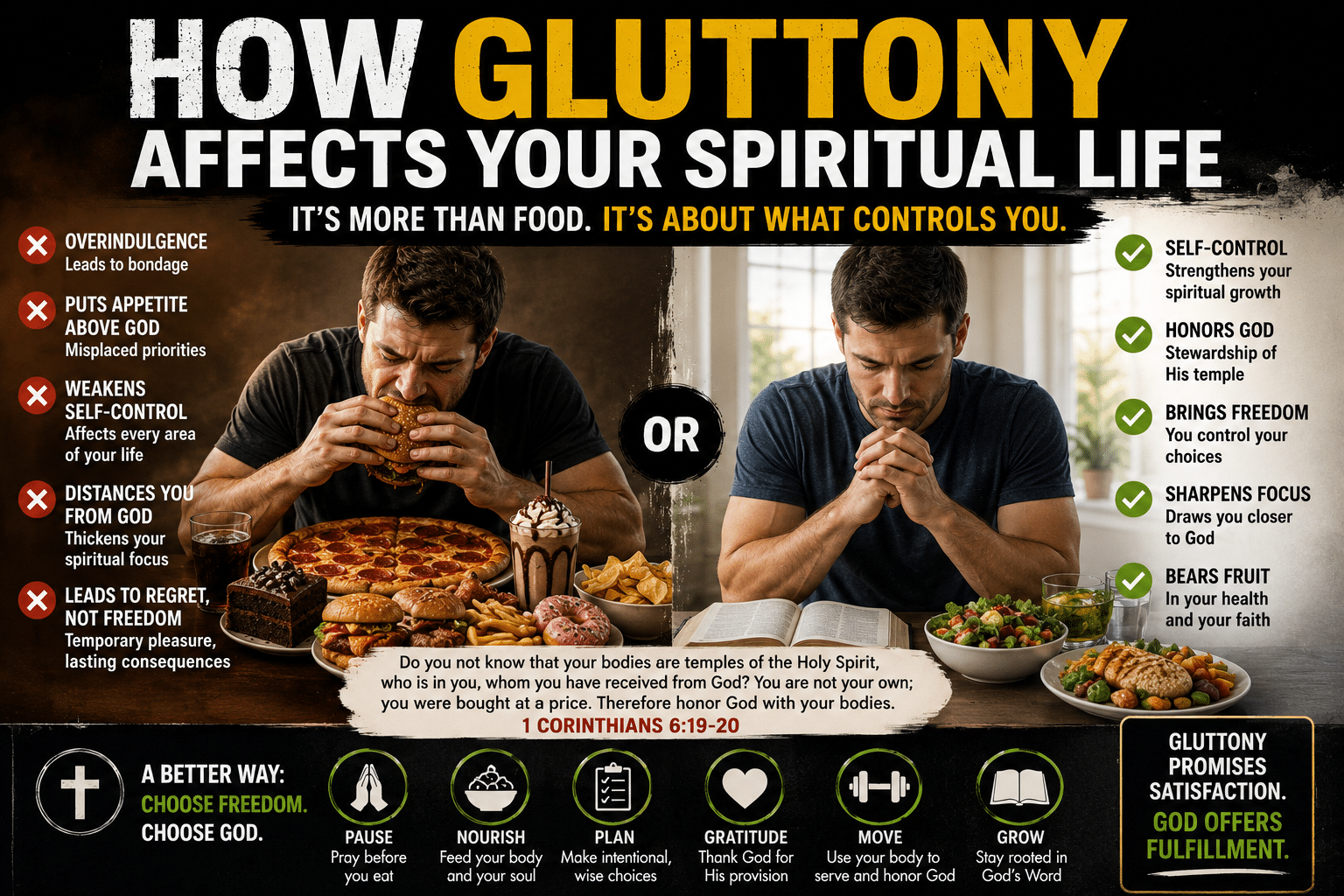
- Pause and pray before eating.
- Eat slowly and pay attention to hunger and fullness.
- Plan balanced meals instead of relying on impulse.
- Practice gratitude for God’s provision.
- Identify emotional triggers that lead to overeating.
- Replace mindless snacking with activities that nourish your faith, such as prayer, walking, or reading Scripture.
The goal isn’t restriction.
The goal is freedom.
Grace Is Greater Than Failure
If you’ve struggled with overeating or other forms of self-indulgence, remember this:
God’s grace isn’t limited by yesterday’s choices.
Conviction draws us toward Christ.
Shame pushes us away from Him.
When we fail, we confess, receive forgiveness, and keep growing.
Christian maturity is marked by repentance and progress, not flawless performance.
Common Questions
Is enjoying food a sin?
No.
The Bible celebrates food as one of God’s good gifts.
Gluttony is about losing self-control, not enjoying a meal.
Can Christians struggle with gluttony?
Yes.
Like other temptations, gluttony is an area where believers are called to grow in wisdom and self-control.
Does fasting help?
Biblical fasting can teach dependence on God and strengthen spiritual discipline, but it should be practiced with the right motives and, for some people, with appropriate medical guidance.
Key Takeaways
Learning how gluttony affects your spiritual life isn’t about becoming fearful of food.
It’s about placing God above every appetite.
Remember this simple equation:
Faith + Self-Control + Gratitude + Healthy Habits = Freedom
Food is one of God’s blessings.
Don’t let a blessing become a master.
Choose habits that strengthen both your body and your relationship with Christ.
Read more: How Gluttony Affects Your Spiritual Life- What the Bible Says About Gluttony and Overeating
- What the Bible Says About Gluttony and Physical Discipline
- What the Bible Teaches About Food and Self-Control
- Is It a Sin to Be Overweight? What the Bible Really Says
- Why Christians Should Include God in Their Fitness Goals
🌿 Natural Daily Support for Men and Women
I like Divine Bounty supplements because they use natural ingredients instead of synthetic formulas. For people who want a cleaner option for everyday wellness support, Divine Bounty offers quality supplements designed to fit a healthy lifestyle.
Their lineup includes the popular Men’s Multivitamin, plus other supplements for men and women such as Vitamin B Complex, Digestive Enzymes, Berberine, Magnesium Citrate, Vitamin K2 + D3, and Acetyl L-Carnitine.
The Men’s Multivitamin features 24 essential vitamins and minerals plus 5 additional blends for men, all in convenient vegetarian capsules. It is also promoted as GMO free, soy free, dairy free, wheat free, and gluten free.
🛒 Shop Divine Bounty on AmazonSponsored by Terry Clark • Amazon Affiliate Partner