Estimated reading time: 4 minutes
Have you ever finished a workout, woke up the next morning feeling completely sore, and thought, does muscle soreness lead to growth?
“That workout must have been amazing.”
Now let me ask you something else.
Have you ever gotten much stronger after a workout that barely made you sore?
Most experienced lifters have.
That’s because muscle soreness and muscle growth are not the same thing.
One is a feeling.
The other is an adaptation.
Understanding the difference can help you stop chasing pain and start chasing progress.
What Causes Muscle Soreness?
That ache you feel one or two days after training is called Delayed Onset Muscle Soreness (DOMS).
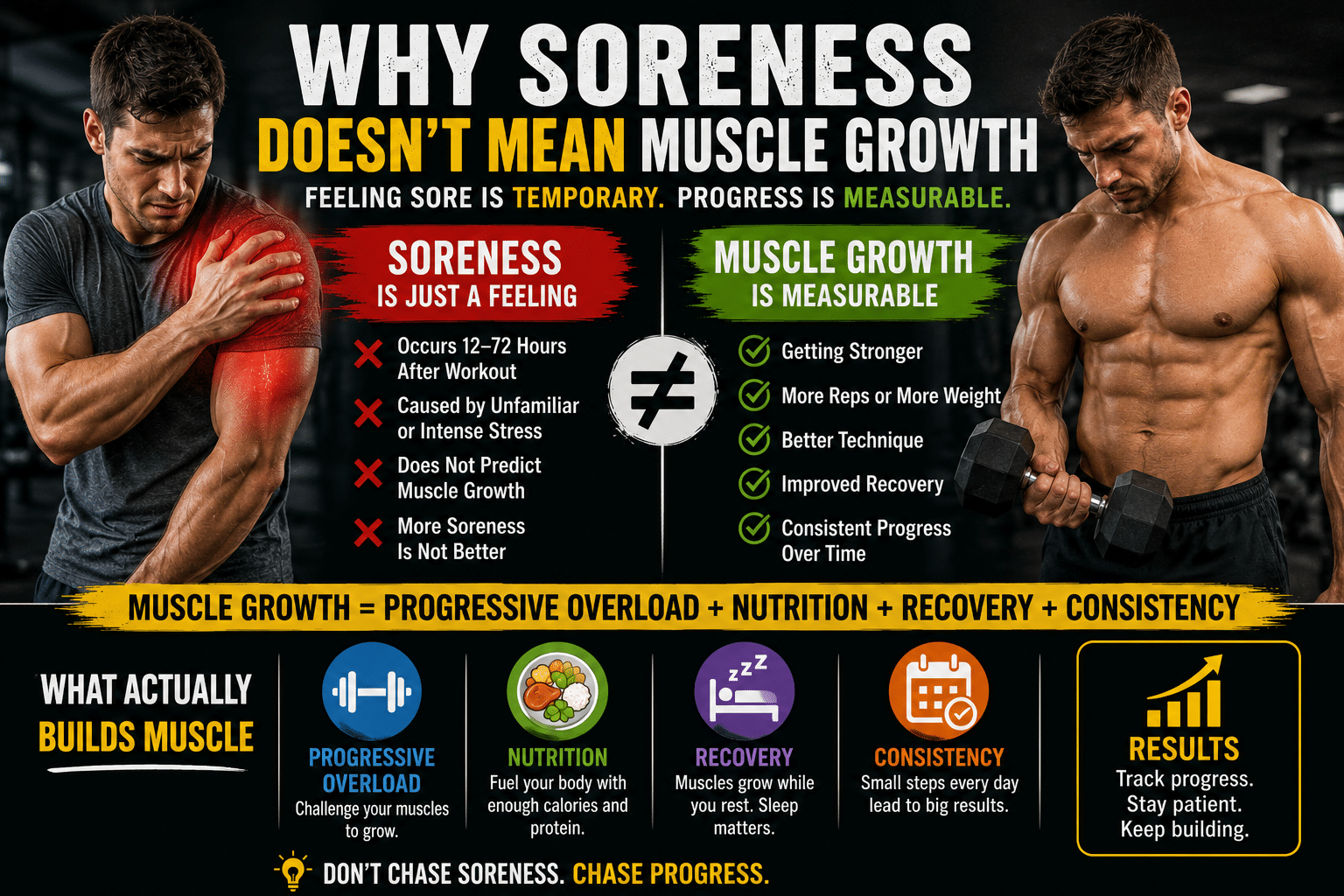
DOMS usually appears:
- 12–24 hours after training
- Peaks around 24–72 hours
- Gradually disappears
It happens because your muscles experience microscopic stress, especially during unfamiliar exercises or movements with a strong lowering (eccentric) phase.
Soreness is your body’s response to something new.
It isn’t proof that muscles are growing.
Why Do Beginners Get So Sore?
Imagine someone performs squats for the first time.
Their legs may stay sore for four days.
A month later they perform the exact same workout.
Much less soreness.
Did they stop building muscle?
No.
Their body simply adapted.
The nervous system became more efficient.
The muscles became accustomed to the movement.
Growth can continue even as soreness decreases.
The Biggest Muscle Growth Myth
Many people believe this equation:
More Soreness = More Muscle
The real equation looks different.
Muscle Growth = Progressive Overload + Recovery + Nutrition + Consistency
Notice what’s missing.
Soreness.
You can have:
- High soreness
- Little progress
Or:
- Very little soreness
- Excellent muscle growth
The 100-Point Muscle Equation
Let’s use the FaithnFit math.
Building muscle is worth 100 points.
Progressive overload = 40
Calories = 25
Protein = 20
Recovery = 10
Consistency = 5
Soreness?
Zero.
Soreness tells you how your body feels.
Progressive overload tells you how your muscles adapt.
Better Signs You’re Building Muscle
Instead of asking:
“Am I sore?”
Ask:
✅ Did I lift more weight?
✅ Did I complete another repetition?
✅ Did my technique improve?
✅ Am I recovering faster?
✅ Are my measurements increasing?
These predict muscle growth far better than soreness.
Can Too Much Soreness Hurt Progress?
Absolutely.
If you’re so sore that you can’t train again for several days, you’re reducing training frequency.
More soreness isn’t always better.
In many cases it’s worse.
Great programs allow you to recover quickly enough to train consistently.
Recovery Is Where Growth Happens
Think about construction workers.
The workout tears down the old structure.
Recovery builds the new one.
Recovery includes:
- Sleep
- Protein
- Calories
- Hydration
- Rest
Without recovery, soreness lasts longer and growth slows.
The Math of Recovery
Imagine two lifters.
Lifter A
Gets extremely sore.
Misses workouts.
Sleeps poorly.
Eats inconsistently.
Lifter B
Gets mildly sore.
Trains four times every week.
Sleeps eight hours.
Hits protein goals.
After six months, who builds more muscle?
Almost always Lifter B.
Consistency beats intensity over time.
Common Questions
Should I try to get sore every workout?
No.
Focus on improving performance.
Soreness will naturally come and go.
Is it bad if I’m never sore?
Not necessarily.
If you’re getting stronger and progressively overloading your muscles, you’re likely making progress.
Does stretching reduce muscle growth?
No.
Stretching may improve mobility and help you feel better, but it doesn’t prevent muscle growth.
💪 FaithnFit Recommended Fitness Essentials
“Don’t chase soreness. Chase progress.”
Key Takeaways
Stop judging your workouts by how sore you feel.
Instead, judge them by measurable progress.
Remember:
Muscle Growth = Progressive Overload + Nutrition + Recovery + Consistency
Pain is temporary.
Progress is measurable.
Your muscles don’t grow because they’re sore.
They grow because you consistently give them a reason to adapt.
Read more: Why Soreness Doesn’t Mean Muscle Growth
- How Many Days a Week Should You Workout Without Being Sore?
- 4 Relaxing Ways To Recover From Sore Muscles
- Can Exercise Prevent Cold Sores?
- A Simple Guide to Building Muscle Mass Through Your Diet
- 7 Secrets to Avoid Muscle Soreness Post-Workout
🌿 Natural Daily Support for Men and Women
I like Divine Bounty supplements because they use natural ingredients instead of synthetic formulas. For people who want a cleaner option for everyday wellness support, Divine Bounty offers quality supplements designed to fit a healthy lifestyle.
Their lineup includes the popular Men’s Multivitamin, plus other supplements for men and women such as Vitamin B Complex, Digestive Enzymes, Berberine, Magnesium Citrate, Vitamin K2 + D3, and Acetyl L-Carnitine.
The Men’s Multivitamin features 24 essential vitamins and minerals plus 5 additional blends for men, all in convenient vegetarian capsules. It is also promoted as GMO free, soy free, dairy free, wheat free, and gluten free.
🛒 Shop Divine Bounty on AmazonSponsored by Terry Clark • Amazon Affiliate Partner