
Estimated reading time: 5 minutes
Most people think fat loss happens during sweaty workouts. However, there are benefits to walking after meals that might surprise you.
It doesn’t.
Some of the biggest improvements in your metabolism happen after something much simpler: a short walk after eating.
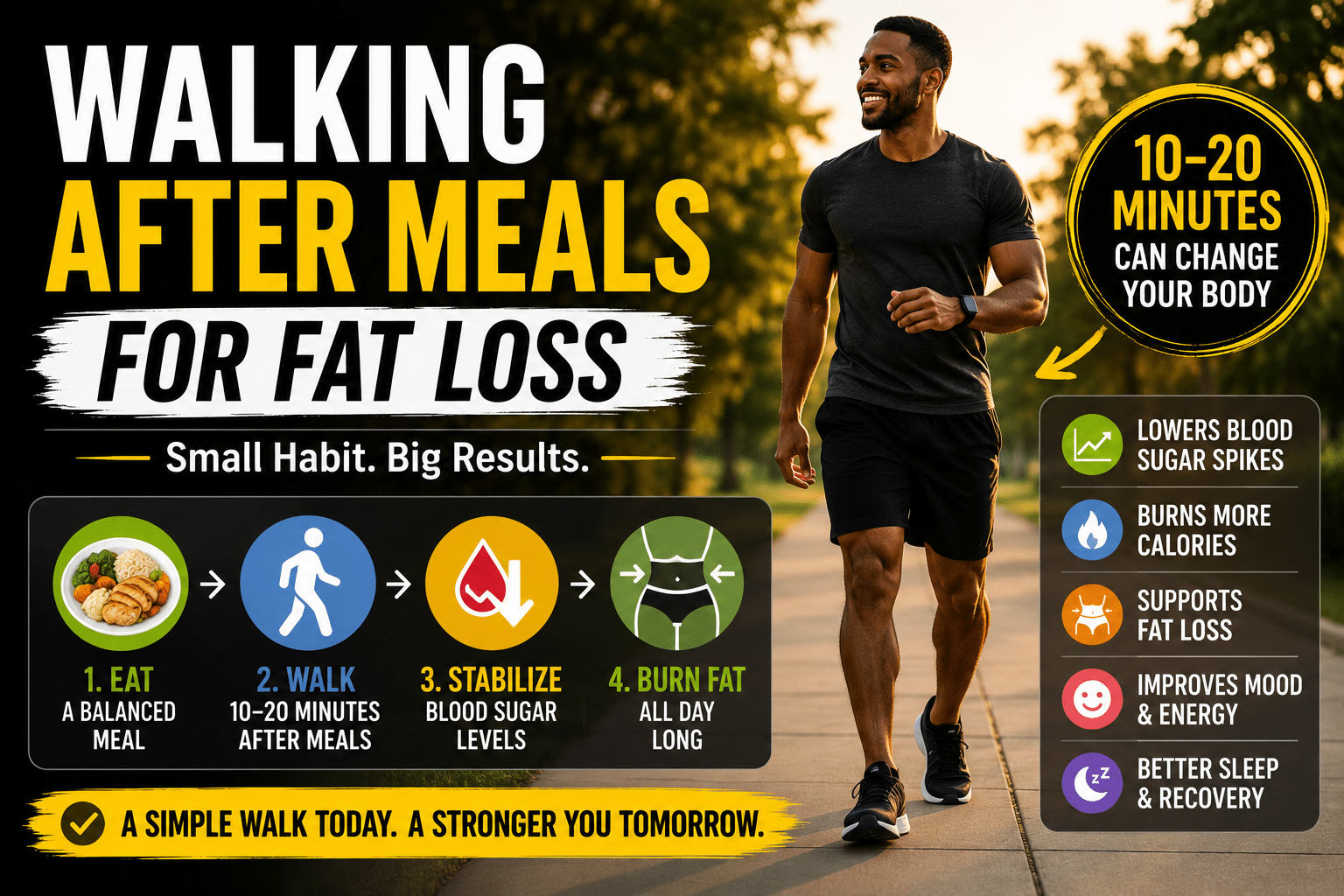
You don’t need to run five miles or spend an hour on the treadmill. In fact, a 10 to 20-minute walk after meals may improve blood sugar control, reduce hunger later in the day, and help create the calorie deficit needed for fat loss.
Walking after meals isn’t magic.
It’s math.
Every meal presents your body with energy. What you do immediately afterward influences how efficiently your body uses that energy.
Why Does Walking After Meals Work?
Every time you eat carbohydrates, your digestive system breaks them into glucose.
That glucose enters your bloodstream, causing your blood sugar to rise.
Your pancreas responds by releasing insulin, a hormone that helps move glucose into your muscles and other tissues.
When you go for a walk after eating, your muscles immediately begin using glucose for fuel.
Instead of allowing glucose to remain elevated in your bloodstream, your muscles act like sponges, absorbing it to produce movement.
The result?
Lower blood sugar spikes.
More stable energy.
Less likelihood of storing excess calories over time.
Why Is Walking Better Than Sitting?
Imagine eating a 700-calorie dinner.
Then imagine two different people.
Person A
- Eats dinner.
- Watches television for two hours.
Person B
- Eats dinner.
- Walks for 20 minutes.
- Watches television afterward.
Both consumed the same calories.
But Person B burned additional calories, activated more muscle fibers, improved circulation, and reduced the blood sugar spike from the meal.
The difference might only be 70 to 120 calories burned during the walk.
That sounds small.
Now multiply it.
100 calories × 365 days = 36,500 calories
That’s roughly equivalent to more than 10 pounds of body fat over a year, assuming dietary intake stays the same.
That’s the power of consistency.
Walking After Meals Improves Blood Sugar
Blood sugar spikes don’t just affect people with diabetes.
Large swings in blood sugar often lead to energy crashes, increased cravings, and hunger a few hours later.
A short walk helps smooth out those highs and lows.
Instead of feeling sleepy after lunch, many people notice steadier energy throughout the afternoon.
Your muscles become the storage tank instead of your bloodstream doing all the work.
Walking Supports Fat Loss Without Increasing Hunger
One challenge with high-intensity cardio is that it sometimes increases appetite.
Many people finish a tough workout and reward themselves with enough calories to erase the energy they burned.
Walking is different.
It burns calories without dramatically increasing hunger for most people.
That’s why walking is one of the easiest ways to increase your daily energy expenditure while maintaining a calorie deficit.
NEAT: The Secret Most People Ignore
One of my favorite concepts in fat loss is NEAT.
NEAT stands for Non-Exercise Activity Thermogenesis.
It’s the calories you burn doing everything that isn’t structured exercise.
Examples include:
- Walking the dog
- Grocery shopping
- Cleaning the house
- Gardening
- Standing while working
- Walking after meals
For many people, increasing NEAT burns more calories each week than adding another intense cardio session.
That’s why walking is so powerful.
How Long Should You Walk?
The good news is you don’t need an hour.
Research suggests even 10 to 15 minutes can improve blood sugar after meals.
If your goal is fat loss, try:
- Breakfast: 10 minutes
- Lunch: 10 to 15 minutes
- Dinner: 20 minutes
That’s approximately 40 minutes of low-stress movement spread throughout the day.
It feels much easier than one long workout.
Does Pace Matter?
Yes.
But not as much as consistency.
Walk briskly enough that your breathing increases slightly while still allowing you to hold a conversation.
You shouldn’t feel exhausted.
Think sustainable, not punishing.
If you can walk tomorrow and the next day, you’re moving at the right pace.
The Math Behind Fat Loss
Many people think weight loss requires dramatic changes.
Instead, think about the numbers.
Suppose you:
- Burn 90 extra calories walking after dinner.
- Walk six days each week.
That’s:
90 × 6 = 540 calories each week
540 × 52 = 28,080 calories annually
That’s roughly 8 pounds of fat without changing your workout routine.
Now combine those walks with:
The results compound over time.
Small daily habits produce big yearly outcomes.
Who Benefits Most?
Walking after meals is especially useful for:
- Adults over 40
- Office workers
- Beginners starting a fitness journey
- Individuals trying to reduce body fat
- Anyone looking to improve blood sugar management
- People who dislike traditional cardio
It’s simple, accessible, and requires no gym membership.
💪 FaithnFit Recommended Fitness Essentials
“The easiest workout is the one you’ll actually do every day.”
Common Questions
Should I walk after every meal?
If possible, yes.
Even one daily walk after dinner provides benefits.
Can I walk indoors?
Absolutely.
A treadmill, shopping mall, office hallway, or even walking laps around your house all count.
Is walking enough for weight loss?
Walking supports fat loss, but nutrition remains the biggest factor.
A calorie deficit still determines whether you lose weight.
Walking simply helps create and maintain that deficit more comfortably.
Key Takeaways
Walking after meals may be one of the most underrated fat-loss habits available.
Instead of chasing harder workouts, consider becoming more consistent with easier movement.
Remember this equation:
Fat Loss = Calorie Deficit + High Satiety Foods + Daily Walking + Strength Training + Consistency
You don’t have to suffer to lose fat.
Sometimes the best solution is simply putting one foot in front of the other after dinner.
Read more: Walking After Meals for Fat Loss: Science Explained
- Walking Your Way to Health: The Power of Small Steps
- The Range of Glucose Levels Throughout the Day
- Walking for Fat Loss and Muscle Definition
- Glucose Monitors for Weight Loss: Do They Actually Help You Burn Fat?
- Walking After Meals for Weight Loss
🌿 Natural Daily Support for Men and Women
I like Divine Bounty supplements because they use natural ingredients instead of synthetic formulas. For people who want a cleaner option for everyday wellness support, Divine Bounty offers quality supplements designed to fit a healthy lifestyle.
Their lineup includes the popular Men’s Multivitamin, plus other supplements for men and women such as Vitamin B Complex, Digestive Enzymes, Berberine, Magnesium Citrate, Vitamin K2 + D3, and Acetyl L-Carnitine.
The Men’s Multivitamin features 24 essential vitamins and minerals plus 5 additional blends for men, all in convenient vegetarian capsules. It is also promoted as GMO free, soy free, dairy free, wheat free, and gluten free.
🛒 Shop Divine Bounty on AmazonSponsored by Terry Clark • Amazon Affiliate Partner