
Estimated reading time: 8 minutes
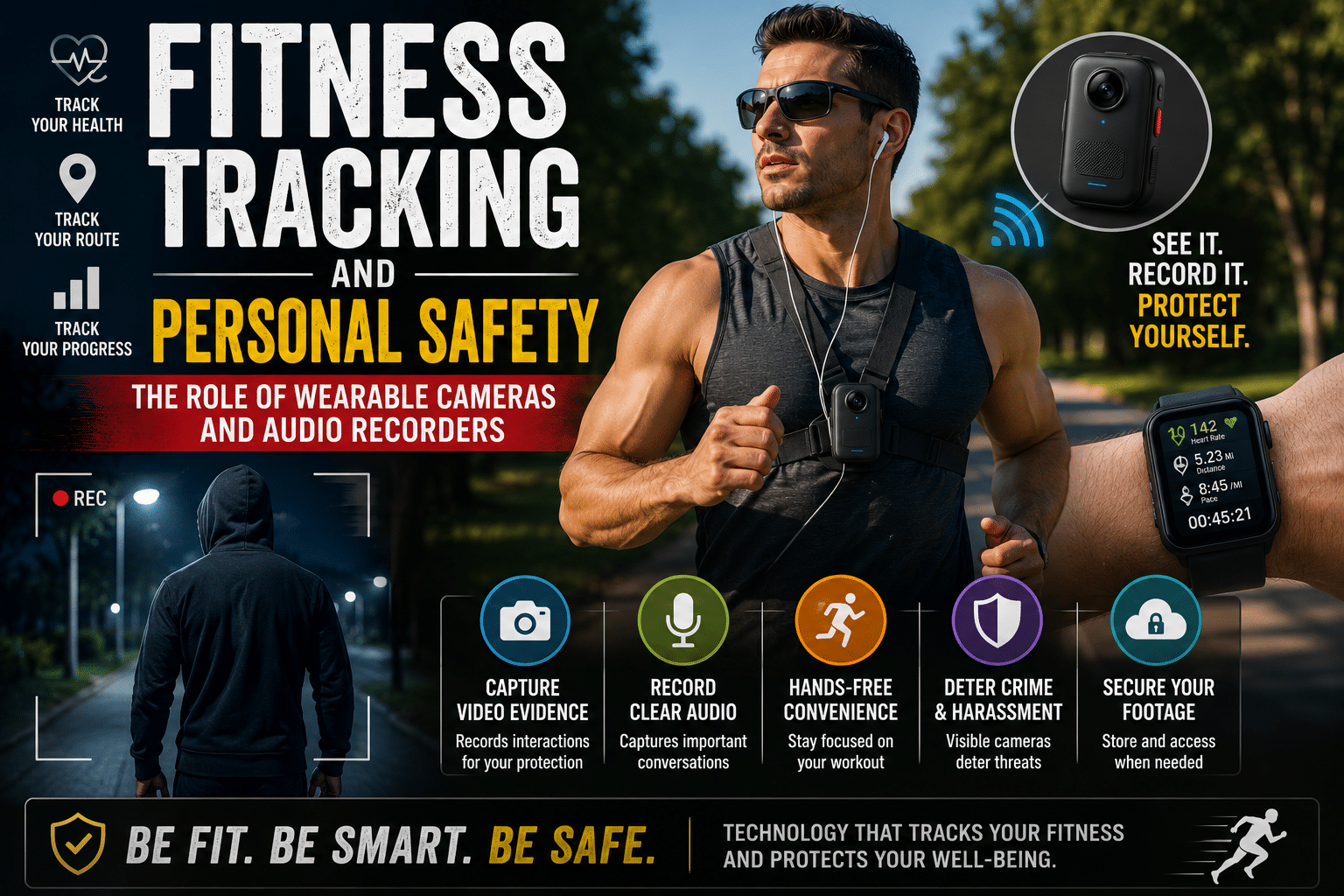
Fitness tracking has steadily evolved from simple step counting and heart-rate monitoring into systems that attempt to understand the full context of physical activity. This evolution also highlights the growing importance of Fitness Tracking and Personal Safety, as modern wearables expand their capabilities. Instead of only measuring output, modern wearables are increasingly focused on interpreting conditions: what the athlete is doing, where they are doing it, and what external factors influence performance in real time.
This shift has introduced a new category of tools into fitness ecosystems—wearable cameras and audio recorders. These devices do not replace traditional metrics but expand them, adding environmental and situational layers that conventional sensors cannot capture, extending even into emerging approaches like audio surveillance used in controlled performance and safety-focused training environments.
A heart-rate spike or pace drop provides numerical insight, but it does not explain the cause. Whether it was uneven terrain, an external interruption, or a technical movement breakdown remains unclear without contextual input. Wearable cameras and audio capture systems address this limitation by recording the lived conditions behind performance data, turning isolated metrics into structured training narratives.
Wearable Cameras in Training Environments
Wearable cameras are increasingly moving beyond niche use in extreme sports and security applications into mainstream fitness contexts. Their role in training is becoming more functional than observational, focusing on documentation, review, and situational awareness.
For cyclists, helmet- or chest-mounted cameras offer a continuous visual record of road interaction. In urban environments where traffic behavior is unpredictable, this recording serves as both a reference point for reviewing incidents and a tool for understanding environmental risk patterns during rides. The value lies not in constant surveillance but in capturing critical moments that influence safety and performance outcomes.
For runners, particularly those training alone in early mornings or low-traffic zones, wearable cameras provide a visual record of environmental conditions during a session. This can include terrain variation, lighting conditions, and unexpected interruptions that may affect rhythm or pacing.
Beyond safety, these devices are increasingly used for post-session technical review. Coaches and athletes can examine posture alignment, stride mechanics, and fatigue-related movement changes that are difficult to identify in real time. Unlike numerical tracking systems, video reveals how movement unfolds within real space, including external influences that shape performance quality.
This visual layer adds clarity to training analysis, transforming subjective recall into observable evidence.
Audio Recording as a Training and Environmental Layer
Audio capture introduces a different dimension to fitness tracking by documenting the immediate experience of training sessions. While cameras show movement and environment, audio reflects interaction, effort, and external conditions in real time.
In solo training environments, audio recordings capture contextual signals such as wind intensity, traffic proximity, and environmental disturbances that can directly influence pacing or focus. These elements often explain performance fluctuations that cannot be interpreted through physiological data alone.
In structured coaching settings, audio also functions as a temporal feedback layer. Verbal cues delivered during training—such as adjustments in stride length, breathing rhythm, or pacing—can later be synchronized with performance metrics. This allows athletes to connect instruction with execution at precise moments rather than relying on memory after the session.
Audio additionally captures physiological expression. Breathing patterns, cadence-related sounds, and self-directed verbal cues provide insight into effort levels and fatigue states that are not fully represented in numerical metrics. When reviewed alongside other data, this creates a more complete representation of training intensity and response.
Integration of Visual, Audio, and Physiological Data
The most significant development in wearable fitness technology is not the use of cameras or audio individually, but their integration with traditional tracking systems such as GPS, heart rate monitoring, and motion sensors.
When these data streams are synchronized, training sessions can be analyzed as continuous timelines rather than isolated datasets. A slowdown in pace, for example, is no longer just a statistical drop but a moment that can be examined in context—whether caused by terrain changes, external interruptions, or physiological fatigue.
This integrated approach allows performance analysis to move beyond surface-level interpretation. Instead of reviewing metrics in isolation, athletes and coaches can observe relationships between environment, movement, and physical response.
In technical sports and endurance disciplines, this level of contextual mapping is particularly valuable. Small changes in form, timing, or environmental interaction can significantly influence performance outcomes, and these relationships become more visible when multiple data types are combined.
Safety Considerations in Outdoor Training
Outdoor training environments introduce variables that are difficult to predict or control. Runners, cyclists, and solo athletes often operate in spaces where environmental and situational risks exist without warning.
Wearable cameras and audio devices provide documentation of these conditions, offering a recorded account of what occurred during a session. This includes environmental context, movement patterns, and external interactions leading up to or during an incident.
In some situations, the visible presence of recording devices may also influence external behavior, particularly in isolated or low-traffic environments. However, their primary function remains documentation rather than prevention.
Understanding this distinction is essential. These tools do not eliminate risk, but they provide structured evidence that can be reviewed after an event to better understand what occurred and why.
Performance Analysis and Training Feedback
Wearable recording systems are increasingly being used as tools for performance refinement rather than simple documentation.
Athletes often struggle to accurately recall technical errors during high-intensity training. Video playback enables direct observation of movement patterns such as stride length, body alignment, cycling posture, or timing inconsistencies that are difficult to perceive in real time.
Audio complements this analysis by preserving coaching instructions and self-directed cues delivered during training. When aligned with visual data and performance metrics, these elements allow a full reconstruction of the training session with far greater accuracy than memory alone.
This combined feedback loop is especially useful in skill-based sports where coordination, timing, and repeatability determine performance quality. Reviewing synchronized data helps athletes identify recurring inefficiencies and adjust technique more precisely over time.
Privacy and Ethical Implications of Recording Wearables
The integration of cameras and audio recording into fitness environments introduces clear privacy considerations that extend beyond traditional wearable technology.
Unlike standard biometric tracking, visual and audio recordings may inadvertently capture bystanders, conversations, or private environments. This creates a responsibility for users to understand recording boundaries within different contexts, such as gyms, public spaces, or shared training environments.
Data security is equally important. Recorded content often contains sensitive personal and environmental information, including location patterns, training habits, and behavioral routines. Without proper protection, this data can expose more than just performance metrics.
To address these concerns, modern systems are increasingly adopting on-device processing, encrypted storage, and user-controlled activation. These measures aim to ensure that contextual fitness data remains accessible to the user while minimizing unnecessary exposure.
Technical and Practical Constraints
Despite their functional advantages, wearable cameras and audio recorders face several practical limitations in fitness applications.
Battery consumption remains one of the most significant constraints. Continuous recording requires substantially more power than traditional tracking functions, often limiting duration during extended training sessions or endurance activities.
Device ergonomics also plays a critical role. Wearables must remain lightweight and stable to avoid interfering with natural movement. Poorly positioned devices can disrupt form or create distractions that negatively affect performance.
Another challenge lies in data management. Continuous recording produces large volumes of visual and audio information that require filtering and structured review to be useful. Without efficient organization, much of this contextual data may remain unused.
Finally, there is a behavioral consideration. While recording tools enhance analysis, they can also create over-reliance if users assume they replace real-time awareness during training. Their role is supportive, not substitutive.
The Evolution of Integrated Fitness Systems
Fitness technology is gradually moving toward integrated ecosystems where biometric data, environmental recording, and contextual analysis coexist within unified platforms.
Rather than treating tracking, recording, and analysis as separate functions, newer systems aim to combine them into a single synchronized training record. This allows athletes to revisit sessions not only as performance outputs but as complete environmental experiences.
The emphasis in this evolution is shifting from passive measurement to structured interpretation. The focus is no longer solely on what happened during a workout, but on the conditions that shaped each moment of performance.
This approach represents a broader transition in fitness technology toward contextual intelligence, where training is understood as an interaction between physiology, environment, and behavior.
Conclusion: Fitness Tracking as Contextual Performance Understanding
Wearable cameras and audio recorders extend fitness tracking beyond traditional numerical measurement by introducing environmental and experiential context into performance analysis.
They allow athletes to connect physical output with real-world conditions, creating a more complete understanding of training sessions. This includes movement quality, environmental influence, and situational variability.
At the same time, their use requires awareness of privacy boundaries, technical constraints, and realistic expectations regarding their function. They enhance understanding but do not replace fundamental training awareness, or decision-making.
As fitness technology continues to evolve, the most significant advancement is not simply in data collection, but in how different forms of data are combined and interpreted. The future of training lies in contextual understanding—where performance is evaluated not only by numbers, but by the conditions under which those numbers are produced.
Read more: Fitness Tracking and Personal Safety: The Role of Wearable Cameras and Audio Recorders- Exploring the Types of 3D Body Scanning Technologies: Advancements in Precision Imaging
- V Shred Programs Analysis – Results and User Experiences
- Calculate Calories – What, When, Where, How, And Why?
- What’s New with Wearable Trackers in 2025?
- Count Calories – How to Reach Your Fitness Goal Faster
🌿 Natural Daily Support for Men and Women
I like Divine Bounty supplements because they use natural ingredients instead of synthetic formulas. For people who want a cleaner option for everyday wellness support, Divine Bounty offers quality supplements designed to fit a healthy lifestyle.
Their lineup includes the popular Men’s Multivitamin, plus other supplements for men and women such as Vitamin B Complex, Digestive Enzymes, Berberine, Magnesium Citrate, Vitamin K2 + D3, and Acetyl L-Carnitine.
The Men’s Multivitamin features 24 essential vitamins and minerals plus 5 additional blends for men, all in convenient vegetarian capsules. It is also promoted as GMO free, soy free, dairy free, wheat free, and gluten free.
🛒 Shop Divine Bounty on AmazonSponsored by Terry Clark • Amazon Affiliate Partner