Estimated reading time: 5 minutes
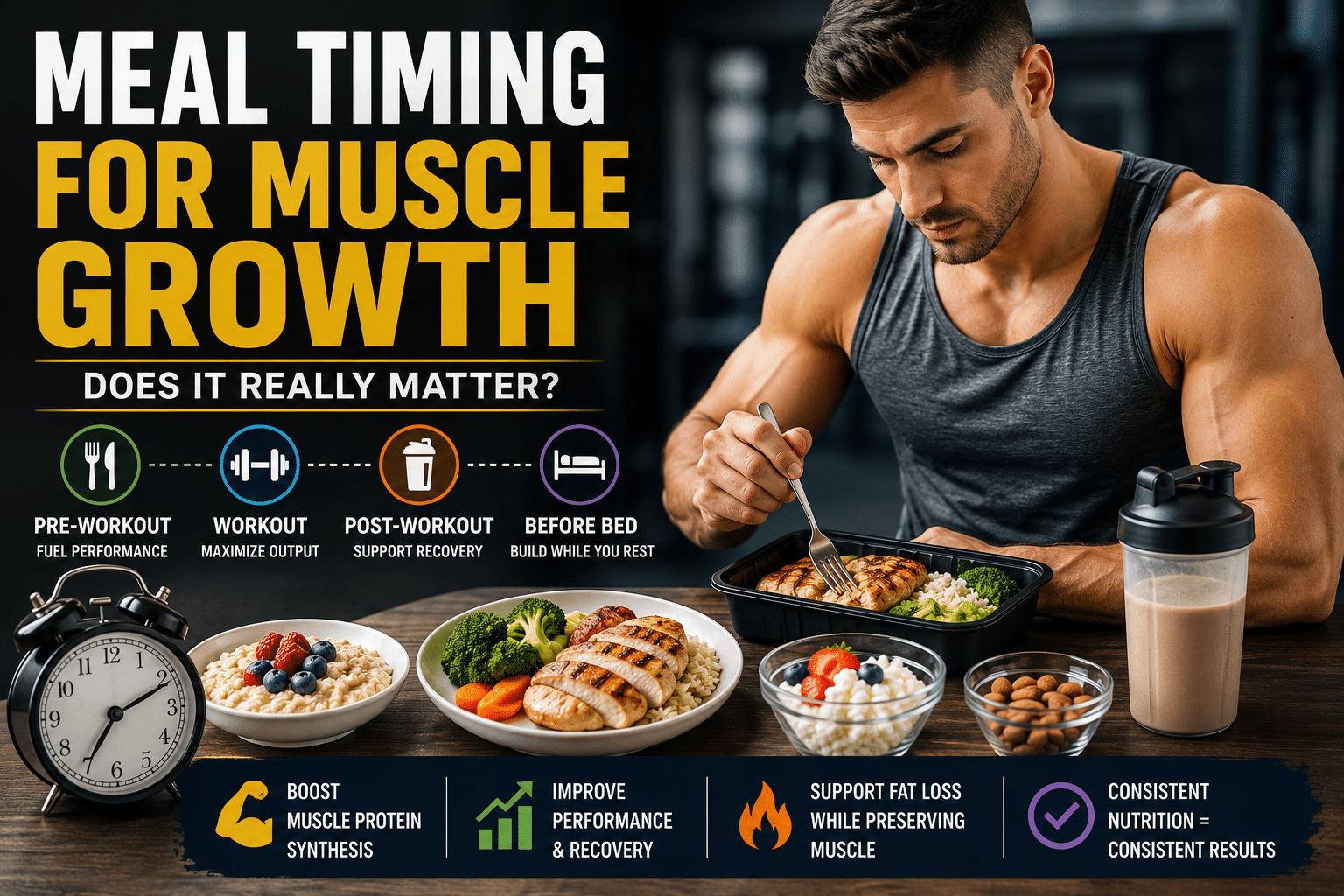
If you’ve spent any time in the gym, you’ve probably heard that you need to eat every two or three hours or drink a protein shake within 30 minutes after your workout. While these ideas have been popular for years, the science behind meal timing for muscle growth has become much clearer. The truth is that timing matters—but not nearly as much as total calories, protein intake, and consistent training.
Think of building muscle like solving a math equation. Your daily calorie intake, protein consumption, training volume, recovery, and sleep all add together to determine your results. Meal timing simply improves the efficiency of that equation.
For most people, mastering meal timing for muscle growth can improve recovery, support better workouts, and maximize muscle protein synthesis without making nutrition overly complicated.
Why Does Meal Timing for Muscle Growth Matter?
Muscles are constantly breaking down and rebuilding. Resistance training increases muscle protein breakdown while also signaling your body to build new muscle tissue.
To maximize this process, your body needs two things:
- Resistance training
- Adequate protein
The timing of protein helps stimulate Muscle Protein Synthesis (MPS), which is the process responsible for repairing and building muscle fibers.
Instead of eating all your protein at dinner, spreading protein throughout the day creates multiple opportunities for muscle growth.
How Much Protein Should You Eat?
Current research suggests that most people trying to build muscle should consume approximately:
- 1.6–2.2 grams of protein per kilogram of body weight
- Around 25–40 grams of protein per meal
- Four to six protein-rich meals each day
Here’s an example:
A 180-pound (82 kg) individual should consume roughly 130–180 grams of protein daily.
Instead of eating:
- Breakfast: 10g
- Lunch: 20g
- Dinner: 120g
A better approach would be:
- Breakfast: 35g
- Lunch: 35g
- Post-workout: 35g
- Dinner: 35g
- Evening snack: 30g
Each meal stimulates another round of muscle protein synthesis.
Should You Eat Before Your Workout?
Yes.
Training requires energy.
Eating one to three hours before training helps provide:
- Glycogen for performance
- Amino acids for recovery
- Better strength
- Improved endurance
A balanced pre-workout meal might include:
- Chicken and rice
- Greek yogurt with fruit
- Oatmeal and whey protein
- Turkey sandwich
The goal isn’t to eat a massive meal but to fuel performance.
Is the Anabolic Window Real?
The famous 30-minute anabolic window has largely been exaggerated.
Research now shows that the “window” is much larger.
If you ate a balanced meal before your workout, your muscles still have amino acids available during and after training.
However, if you trained fasted, eating protein soon after exercise becomes more important.
A practical guideline is to consume protein within one to two hours after training.
What Should You Eat After Training?
Recovery meals should focus on:
- Protein
- Carbohydrates
- Hydration
Example meals include:
- Grilled chicken with potatoes
- Lean beef and rice
- Protein shake with banana
- Cottage cheese and fruit
- Salmon with sweet potatoes
Protein repairs muscle tissue while carbohydrates replenish glycogen stores used during exercise.
Does Eating Before Bed Help?
One strategy often overlooked is consuming protein before sleep.
Your body repairs muscle tissue throughout the night.
Eating 30–40 grams of slow-digesting protein such as cottage cheese or casein protein before bed can increase overnight muscle protein synthesis.
For people trying to gain muscle, this can provide another opportunity for recovery without adding unnecessary complexity.
What About Fat Loss?
Interestingly, meal timing for muscle growth also helps preserve muscle while dieting.
During a calorie deficit:
- Muscle protein breakdown increases.
- Even protein distribution becomes more important.
- Strength training helps preserve lean mass.
The combination of:
- Calorie deficit
- High protein
- Resistance training
- Daily movement (NEAT)
creates the best environment for losing fat while maintaining muscle.
Does Meal Frequency Matter?
Not necessarily.
Whether you eat:
- Three meals
- Four meals
- Five meals
the most important factor is hitting your daily nutrition targets.
Someone eating three perfectly balanced meals can build just as much muscle as someone eating six meals.
Meal frequency mainly becomes a matter of convenience.
What Is the Best Daily Meal Schedule?
Here’s a practical example.
7:30 AM
Breakfast
- Eggs
- Oatmeal
- Fruit
11:30 AM
Lunch
- Chicken
- Rice
- Vegetables
3:30 PM
Pre-workout snack
- Greek yogurt
- Banana
6:00 PM
Workout
7:15 PM
Dinner
- Lean steak
- Potatoes
- Vegetables
9:30 PM
Evening protein
- Cottage cheese
- Berries
This schedule provides multiple opportunities for muscle protein synthesis while supporting energy throughout the day.
💪 Build Muscle Faster Toolkit
Support your training and nutrition with these FaithnFit recommendations.
“Consistency beats perfection. Every properly timed meal is another opportunity to build muscle.”
Frequently Asked Questions
Is meal timing more important than protein intake?
No. Total daily protein intake has a greater impact on muscle growth than precise meal timing. Timing simply helps optimize muscle protein synthesis.
Can I build muscle eating only three meals?
Yes. As long as you consume enough calories and protein, three well-balanced meals can support excellent muscle growth.
Should I drink a protein shake immediately after working out?
Not necessarily. If you’ve eaten a protein-rich meal within a couple of hours before training, you don’t need to rush. Aim to consume protein within one to two hours after your workout.
Is intermittent fasting bad for muscle growth?
Not inherently. It can work if you still consume enough calories and protein during your eating window, though some people may find it harder to distribute protein optimally.
Key Takeaways
- Total calories and protein are the foundation of muscle growth.
- Spread protein across four to six meals when possible.
- Eat a balanced meal before training for better performance.
- Consume protein within one to two hours after exercise.
- Consider a slow-digesting protein before bed.
- Focus on consistency rather than chasing a narrow anabolic window.
- What Is the Best Post-Workout Nutrition for Lifestyle Bodybuilders?
- Day 32 of My Weight Loss Challenge: The Power of Rest, Diet, and Intermittent Fasting
- How to Use Protein for Muscle Growth and Fat Loss Simultaneously
- How Protein Timing Can Maximize Your Muscle Growth
- How to Best Hydrate Muscles for Maximum Growth
🌿 Natural Daily Support for Men and Women
I like Divine Bounty supplements because they use natural ingredients instead of synthetic formulas. For people who want a cleaner option for everyday wellness support, Divine Bounty offers quality supplements designed to fit a healthy lifestyle.
Their lineup includes the popular Men’s Multivitamin, plus other supplements for men and women such as Vitamin B Complex, Digestive Enzymes, Berberine, Magnesium Citrate, Vitamin K2 + D3, and Acetyl L-Carnitine.
The Men’s Multivitamin features 24 essential vitamins and minerals plus 5 additional blends for men, all in convenient vegetarian capsules. It is also promoted as GMO free, soy free, dairy free, wheat free, and gluten free.
🛒 Shop Divine Bounty on AmazonSponsored by Terry Clark • Amazon Affiliate Partner