Estimated reading time: 3 minutes
Have you ever heard someone say, or wondered yourself, why is protein not building muscle?
“I eat 200 grams of protein every day, but I still can’t build muscle.”
The problem usually isn’t protein.
It’s everything else.
Protein is one ingredient in the muscle-building recipe.
Without the other ingredients, it can’t do its job.
Think of protein like bricks.
Bricks don’t build a house by themselves.
You still need workers, blueprints, tools, and time.
Muscle works the same way.
Why Isn’t Protein Building Muscle?
Protein provides amino acids that repair damaged muscle fibers.
But those muscle fibers must first be challenged.
Without resistance training, your body has little reason to build additional muscle tissue.
Protein doesn’t tell muscles to grow.
Training does.
Protein simply provides the materials.
The Muscle Growth Equation
Most people think:
Protein = Muscle
The real equation looks like this:
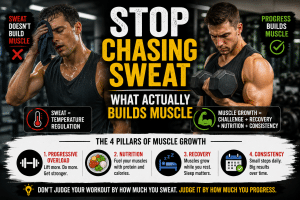
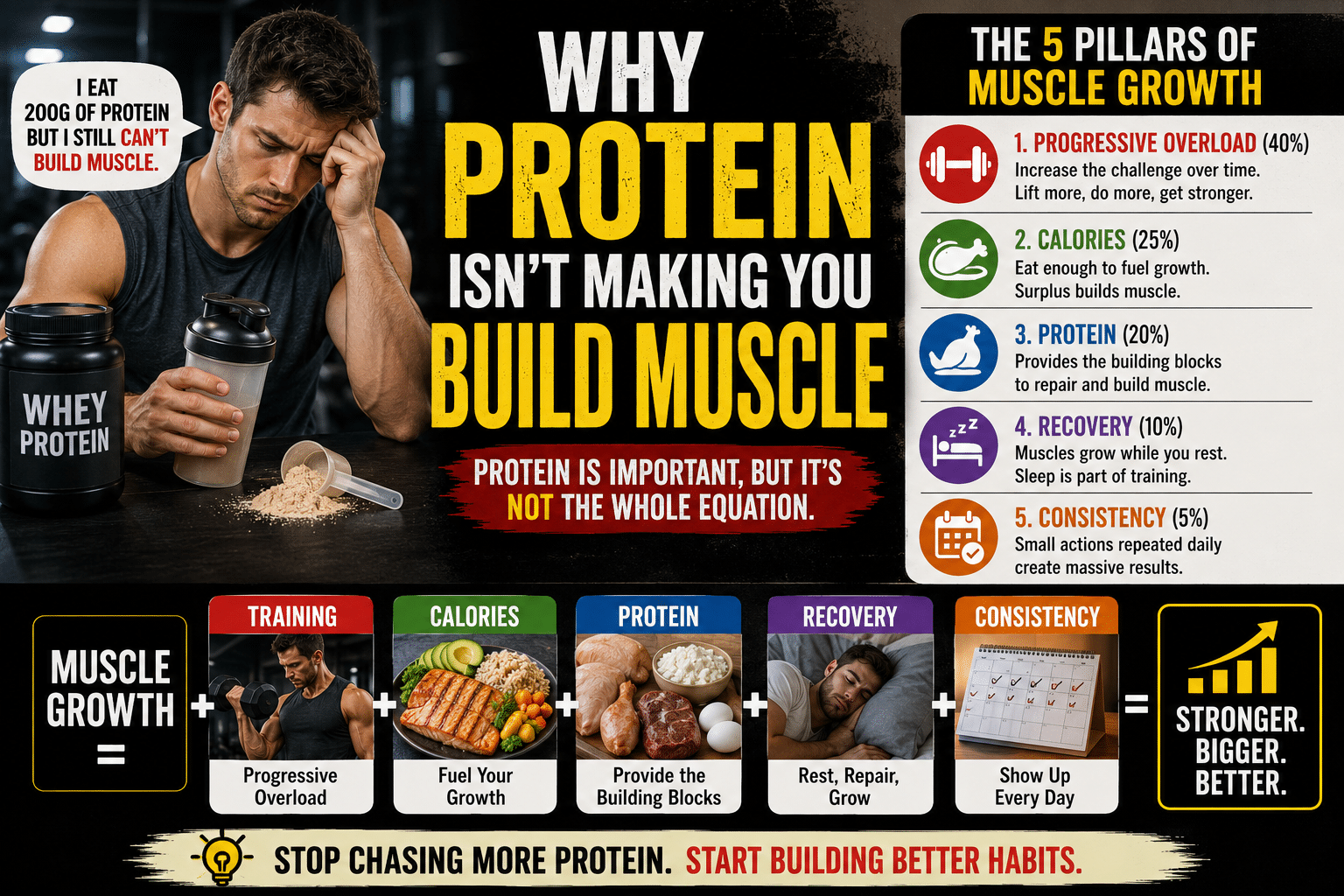
Muscle Growth = Progressive Overload + Calories + Protein + Recovery + Time
Remove any one of those variables and results slow down dramatically.
The Five Muscle-Building Pillars
1. Progressive Overload (40%)
Your muscles must experience increasing demand.
Lift heavier.
Do more reps.
Improve technique.
Without overload, protein has nowhere to go.
2. Calories (25%)
Building muscle requires energy.
If you’re eating below maintenance every day, your body prioritizes survival instead of growth.
Protein cannot overcome a severe calorie deficit.
3. Protein (20%)
Protein repairs muscle tissue.
Aim for roughly:
0.7–1 gram per pound of goal body weight.
More isn’t always better.
Enough is what matters.
4. Recovery (10%)
Muscles don’t grow in the gym.
They grow while you recover.
Sleep is part of training.
5. Consistency (5%)
Building muscle isn’t about one perfect day.
It’s about hundreds of good days.
The House Analogy
Imagine building a house.
Protein is the bricks.
Training is the construction crew.
Calories provide electricity to the job site.
Recovery is the time workers need to finish the project.
Consistency is showing up every morning.
Missing any one of those slows construction.
The Math
Suppose you eat:
220 grams of protein
But you:
- Skip workouts
- Sleep five hours
- Never increase weight
- Eat too few calories
Expected muscle growth:
Almost zero.
Now imagine another person eating:
160 grams of protein
Training hard
Sleeping eight hours
Progressively overloading
Eating enough calories
Who grows faster?
Almost always the second person.
Why People Blame Protein
Because it’s easy.
Buying protein powder feels productive.
Adding another scoop doesn’t require effort.
Progressive overload does.
Tracking workouts does.
Sleeping eight hours does.
The boring fundamentals usually win.
Signs Your Protein Isn’t the Problem
Ask yourself:
- Am I getting stronger?
- Am I training close to failure?
- Am I eating enough calories?
- Am I sleeping enough?
- Have I gained any body weight over the last month?
If the answer is “no” to several of these, protein probably isn’t your limiting factor.
Common Questions
Should I eat more protein?
Only if you’re below your daily target.
Beyond that, focus on training quality.
Can too much protein build extra muscle?
Not by itself.
Extra protein cannot replace progressive overload.
Is protein powder necessary?
No.
It’s convenient.
Whole foods work just as well.
💪 FaithnFit Recommended Fitness Essentials
“Protein provides the bricks. Your workouts build the house.”
Key Takeaways
Protein doesn’t build muscle by itself.
It supports the muscle-building process.
Think of muscle growth like solving an equation:
Challenge + Nutrition + Recovery + Consistency = Growth
Miss one variable, and the equation changes.
Stop chasing more protein.
Start chasing better habits.
Read more: Why Protein Isn’t Making You Build Muscle- House Activities – 5 Best Chores that Burn the Most Fat
- A Simple Guide to Building Muscle Mass Through Your Diet
- The Truth About Working Out
- Best House and Yard Work to Get Fit
- Why Calorie Counting Fails Most People
🌿 Natural Daily Support for Men and Women
I like Divine Bounty supplements because they use natural ingredients instead of synthetic formulas. For people who want a cleaner option for everyday wellness support, Divine Bounty offers quality supplements designed to fit a healthy lifestyle.
Their lineup includes the popular Men’s Multivitamin, plus other supplements for men and women such as Vitamin B Complex, Digestive Enzymes, Berberine, Magnesium Citrate, Vitamin K2 + D3, and Acetyl L-Carnitine.
The Men’s Multivitamin features 24 essential vitamins and minerals plus 5 additional blends for men, all in convenient vegetarian capsules. It is also promoted as GMO free, soy free, dairy free, wheat free, and gluten free.
🛒 Shop Divine Bounty on AmazonSponsored by Terry Clark • Amazon Affiliate Partner