Estimated reading time: 9 minutes
Walk into any grocery store, and you’ll find an entire refrigerator filled with eggs. White eggs, brown eggs, cage-free eggs, free-range eggs, pasture-raised eggs, organic eggs, omega-3 eggs—the choices seem endless. Yet they all look remarkably similar. Egg Nutrition is an important topic to consider when deciding which type is right for you.
So, is an egg really just an egg?
The simple answer is no.
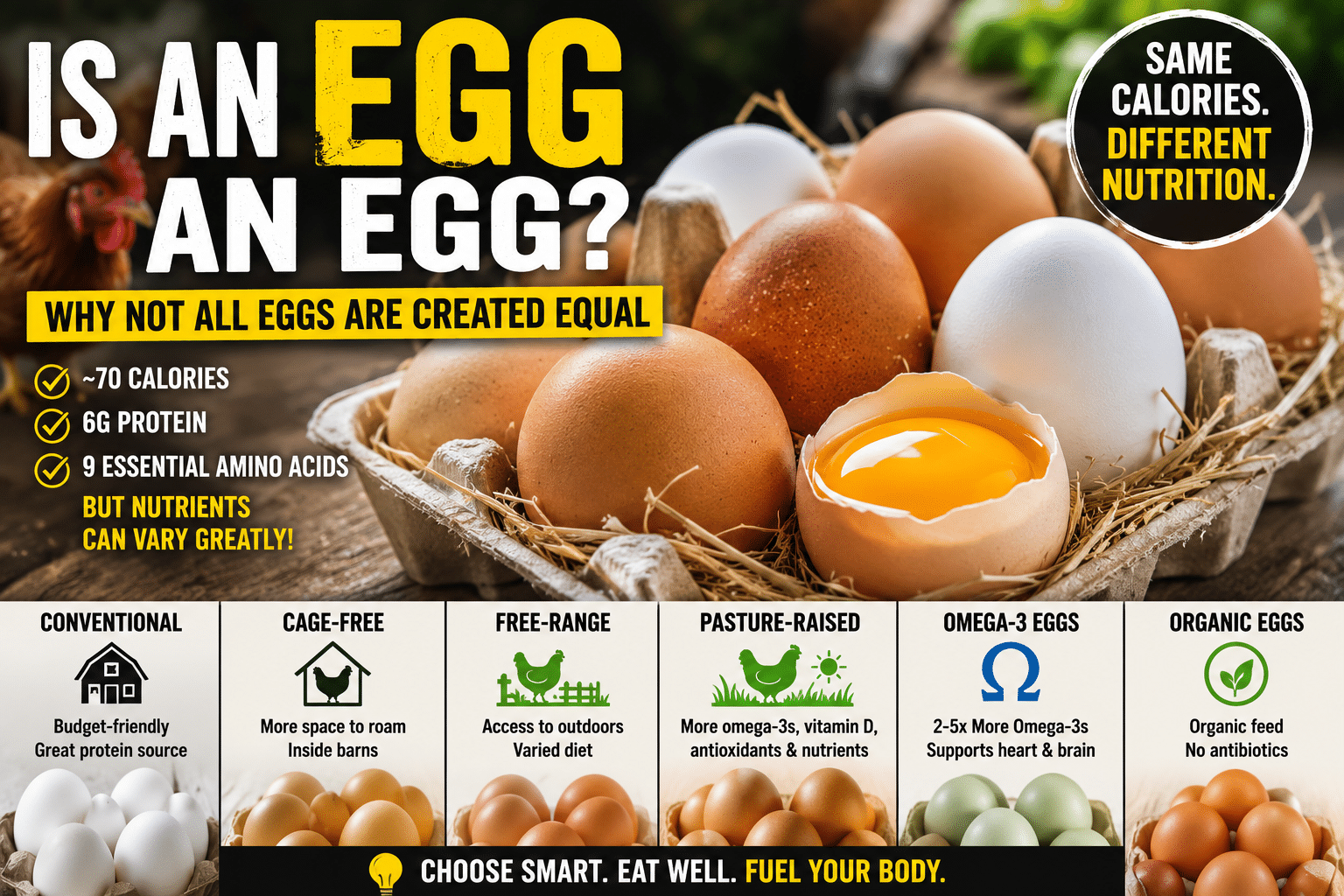
While every chicken egg begins the same way, the hen’s diet, environment, health, and living conditions can significantly affect the nutritional quality of the egg that ends up on your breakfast plate. Two eggs may each contain about 70 calories and 6 grams of protein, but one may deliver higher amounts of omega-3 fatty acids, vitamin D, antioxidants, and other nutrients than the other.
As I often tell clients, nutrition is a math problem. Calories tell only part of the equation. The nutrients inside those calories determine how effectively your body builds muscle, burns fat, recovers from exercise, and supports long-term health.
Understanding what separates one egg from another can help you spend your grocery dollars wisely while fueling your body for better results.
What Makes One Egg Different From Another?
The shell doesn’t determine an egg’s nutritional value.
Instead, several factors influence what’s inside:
- The hen’s diet
- Living conditions
- Stress level
- Access to sunlight
- Overall health
- Breed of chicken
- Age of the hen
Think of the egg as a nutritional report card. A healthier hen generally produces a more nutrient-rich egg.
For fitness enthusiasts, these differences may seem small, but small improvements repeated every day often create meaningful results over months and years.
Are Brown Eggs Healthier Than White Eggs?
One of the oldest nutrition myths is that brown eggs are healthier.
They aren’t.
The color of the shell depends almost entirely on the breed of the chicken.
For example:
- White Leghorn chickens lay white eggs.
- Rhode Island Reds lay brown eggs.
Inside, their nutrition is nearly identical.
The reason brown eggs often cost more has little to do with nutrition.
Brown-egg-laying hens are generally larger birds that eat more feed, increasing production costs.
Winner:
There is no meaningful nutritional advantage to choosing brown eggs over white eggs.
Does the Chicken’s Diet Matter?
Absolutely.
This may be the single biggest factor affecting egg nutrition.
A hen that eats a varied diet consisting of seeds, insects, grasses, and plants often produces eggs containing:
- More omega-3 fats
- Higher vitamin D
- Increased vitamin E
- More carotenoids
- Better antioxidant content
Conversely, hens consuming highly processed feed without dietary variety generally produce eggs with fewer of these beneficial nutrients.
This doesn’t make conventional eggs unhealthy.
It simply means some eggs offer more nutritional value for nearly the same calories.
What Do Cage-Free, Free-Range, and Pasture-Raised Really Mean?
This is where many shoppers become confused.
Cage-Free
Cage-free hens are not kept in cages.
However, they often remain inside large barns with limited space.
They can move around more than caged hens but may never step outdoors.
Free-Range
Free-range hens have access to the outdoors.
The important phrase is “access.”
Federal regulations don’t specify how much outdoor time the birds must receive.
Some birds may spend very little time outside despite the label.
Pasture-Raised
Pasture-raised chickens spend much more time outdoors with room to forage naturally.
They consume insects, grasses, seeds, and other foods that improve the nutritional quality of their eggs.
Research consistently finds pasture-raised eggs contain higher concentrations of:
- Omega-3 fatty acids
- Vitamin D
- Vitamin E
- Beta-carotene
If your budget allows, pasture-raised eggs generally provide the greatest nutritional value.
Are Organic Eggs Better?
Organic eggs come from hens fed certified organic feed that is free from genetically engineered ingredients and most synthetic pesticides.
The hens also cannot receive routine antibiotics or growth hormones.
Does this automatically make the eggs healthier?
Not necessarily.
Organic certification focuses primarily on production methods.
If organic hens are also pasture-raised, the nutritional benefits tend to be greater.
If they remain indoors with limited dietary variety, the differences may be relatively small.
The label tells you how the chickens were raised—not always how nutritious the eggs are.
What About Omega-3 Eggs?
Omega-3 enriched eggs are produced by feeding hens flaxseed, algae, or fish oil.
This changes the fat composition inside the egg.
Compared with conventional eggs, omega-3 eggs often contain:
- Two to five times more omega-3 fatty acids
- Similar protein
- Similar calories
- Similar cholesterol
For people who rarely eat fish, these eggs provide an easy way to increase omega-3 intake without changing the rest of their diet.
Omega-3 fats support:
- Heart health
- Brain function
- Reduced inflammation
- Exercise recovery
Are Egg Yolks Really Bad for You?
For years, many people threw away the yolk and ate only the whites.
Modern research paints a different picture.
The egg white contains most of the protein.
The yolk contains most of the nutrients.
Inside the yolk you’ll find:
- Vitamin A
- Vitamin D
- Vitamin E
- Vitamin K
- Choline
- Iron
- Selenium
- Healthy fats
- Lutein
- Zeaxanthin
Unless your physician has given specific dietary advice, most healthy people benefit from eating the entire egg rather than discarding half its nutrition.
Think of it this way:
Eating only egg whites is like buying a new smartphone and using it only to make phone calls.
You’re missing many of its best features.
Why Eggs Remain One of Nature’s Best Muscle-Building Foods
Regardless of which variety you choose, eggs remain one of the highest-quality protein sources available.
Each large egg provides approximately:
- 70 calories
- 6 grams of complete protein
- All nine essential amino acids
For muscle growth, that’s a powerful combination.
Protein provides the raw materials your body uses to repair muscle tissue after resistance training.
As I’ve often explained, building muscle isn’t complicated.
The equation looks like this:
Resistance Training + Protein + Recovery + Time = Muscle Growth
Eggs fit naturally into that formula because they deliver highly digestible protein in a relatively low-calorie package.
Whether your goal is fat loss, muscle gain, or simply eating healthier, eggs continue to be one of the best values in the grocery store.
Which Eggs Should Bodybuilders Buy?
If your goal is building muscle, improving recovery, or maintaining a lean physique, choosing the right eggs can give you a slight nutritional advantage.
Here’s how they compare.
Conventional Eggs
Best For: Budget-conscious shoppers
- Lowest price
- Excellent protein source
- Complete amino acid profile
- Widely available
If your grocery budget is tight, conventional eggs remain one of the best protein bargains available.
Cage-Free Eggs
Best For: People wanting improved animal welfare
- Similar nutrition to conventional eggs
- More room for hens to move
- Moderate price increase
Organic Eggs
Best For: Those avoiding pesticides and synthetic feed
- Organic feed
- No routine antibiotics
- Higher price
- Nutrition varies depending on the farm
Omega-3 Eggs
Best For: Heart health and reducing inflammation
These eggs provide additional omega-3 fatty acids that may support:
- Recovery after workouts
- Brain function
- Heart health
- Reduced inflammation
If you don’t regularly eat fatty fish like salmon, omega-3 eggs are an excellent alternative.
Pasture-Raised Eggs
Best Overall Choice
Pasture-raised eggs consistently provide:
- Excellent protein
- More omega-3 fats
- Higher vitamin D
- More antioxidants
- Better overall nutrient density
If your grocery budget allows, pasture-raised eggs offer the greatest nutritional value.
As I tell clients, don’t focus only on the cost per carton. Think about the cost per nutrient. Spending an extra dollar or two for significantly better nutrition can be a smart investment in your health.
Are Expensive Eggs Worth the Money?
The answer depends on your priorities.
If your goal is simply getting high-quality protein, conventional eggs are an excellent choice.
If you value:
- Better nutrition
- Animal welfare
- Environmental sustainability
- Higher omega-3 intake
then paying more for pasture-raised or omega-3 eggs may be worthwhile.
Think about your weekly coffee purchases.
Many people spend $7 every day on coffee without hesitation.
Yet they hesitate to spend an extra $2 on eggs that provide a week’s worth of high-quality nutrition.
Sometimes we value convenience more than health.
How Many Eggs Should You Eat?
For most healthy adults, eating one to three eggs daily fits comfortably within a balanced diet.
Active individuals and bodybuilders often consume even more as part of a high-protein eating plan.
Current research suggests that dietary cholesterol from eggs has much less impact on blood cholesterol than once believed for most healthy people.
Instead, factors such as:
- Overall diet quality
- Saturated fat intake
- Body weight
- Physical activity
- Genetics
play a much larger role in heart health.
If you have diabetes, familial hypercholesterolemia, or another medical condition affecting cholesterol metabolism, discuss your egg intake with your physician or registered dietitian.
Common Myths About Eggs
Myth 1: Brown Eggs Are Healthier
Fact: Shell color is determined by the breed of the chicken—not nutritional quality.
Myth 2: Egg Yolks Are Unhealthy
Fact: The yolk contains most of the egg’s vitamins, minerals, healthy fats, and antioxidants.
Myth 3: Eggs Raise Cholesterol Dangerous Levels
Fact: For most healthy people, moderate egg consumption has little effect on blood cholesterol. Overall dietary patterns matter much more.
Myth 4: You Need Egg Whites to Build Muscle
Fact: Egg whites are rich in protein, but whole eggs provide additional nutrients that support recovery, hormone production, and overall health.
Myth 5: Expensive Eggs Always Have More Protein
Fact: Nearly every large egg contains about 6 grams of protein. Higher-priced eggs generally provide better micronutrients—not significantly more protein.
Frequently Asked Questions
Are brown eggs healthier than white eggs?
No. Brown and white eggs have nearly identical nutritional profiles. The shell color depends on the breed of the hen.
Which eggs have the most nutrients?
Pasture-raised eggs generally contain more omega-3 fatty acids, vitamin D, vitamin E, and antioxidants because hens have access to a more varied natural diet.
Are organic eggs worth buying?
Organic eggs are a good option if you prefer food produced without synthetic pesticides or routine antibiotics. However, organic does not always mean more nutritious than pasture-raised eggs.
Should athletes eat whole eggs?
Yes. Whole eggs provide high-quality protein along with vitamins, minerals, healthy fats, and choline, all of which support muscle recovery and overall health.
How many eggs can I safely eat?
Most healthy adults can enjoy one to three eggs per day as part of a balanced diet. Individual needs may vary, so consult your healthcare provider if you have specific medical concerns.
💪 Build Muscle and Improve Your Nutrition
Support your health and fitness journey with these recommended products:
“Strong bodies are built with consistent choices, one meal at a time.”
Key Takeaways
Focus on the quality of your overall diet rather than a single food.
Not all eggs are nutritionally identical.
The hen’s diet and living conditions influence the nutrients inside the egg.
Brown eggs are not healthier than white eggs.
Pasture-raised eggs generally offer the greatest nutritional value.
Whole eggs provide complete protein plus vitamins, minerals, and healthy fats.
Eggs remain one of the most affordable, nutrient-dense foods available for building muscle and supporting overall health.
Read more: Is an Egg an Egg? Why Not All Eggs Are Created Equal- Staying Fit on the Go: How to Choose the Right Gym Bag for Your Active Lifestyle
- How Eggs Can Help You Lose Weight
- The Rice Debate: Brown vs. White to Build Muscle
- Why Brown Rice for Muscle Development and Growth?
- Why Do the Best Bodybuilders Eat Chicken and Rice?
🌿 Natural Daily Support for Men and Women
I like Divine Bounty supplements because they use natural ingredients instead of synthetic formulas. For people who want a cleaner option for everyday wellness support, Divine Bounty offers quality supplements designed to fit a healthy lifestyle.
Their lineup includes the popular Men’s Multivitamin, plus other supplements for men and women such as Vitamin B Complex, Digestive Enzymes, Berberine, Magnesium Citrate, Vitamin K2 + D3, and Acetyl L-Carnitine.
The Men’s Multivitamin features 24 essential vitamins and minerals plus 5 additional blends for men, all in convenient vegetarian capsules. It is also promoted as GMO free, soy free, dairy free, wheat free, and gluten free.
🛒 Shop Divine Bounty on AmazonSponsored by Terry Clark • Amazon Affiliate Partner