Estimated reading time: 9 minutes
You’ve been eating fewer calories. Maybe you’re hoping that losing weight will also target stubborn belly fat.
You’ve been walking every day.
The scale says you’ve lost 15 pounds.
But when you stand in front of the mirror, your stomach looks almost exactly the same.
Sound familiar?
If you’ve ever wondered, “Where is all the weight coming from if it isn’t my belly?” you’re asking one of the most misunderstood questions in fitness.
The answer will probably surprise you.
Your body doesn’t burn fat equally from every location. Instead, it follows a genetic blueprint influenced by hormones, blood flow, fat-cell receptors, and your overall body fat percentage.
That means your body—not your workout—decides where fat comes off first.
The good news?
If you’re consistently losing weight, your belly will eventually shrink.
The challenge is understanding why it often comes last.
Why Doesn’t Belly Fat Disappear First?
Many people believe abdominal exercises burn belly fat.
Unfortunately, science says otherwise.
Doing 500 crunches every day strengthens your abdominal muscles, but it does almost nothing to increase fat burning specifically around your stomach.
This concept is called spot reduction, and decades of research have shown it simply doesn’t work.
Instead, your body releases fat according to hormones and genetics.
Think of your fat cells like bank accounts.
Every fat cell stores energy.
When you create a calorie deficit, your body begins withdrawing energy from many of those accounts—but not equally.
Some accounts are easy to access.
Others require much more time before withdrawals begin.
Your lower abdomen is often one of those “locked savings accounts.”
The Weight You’re Losing May Surprise You
Here’s what usually happens.
As the scale drops, you’re often losing fat from areas you don’t measure every day.
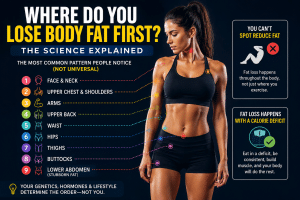
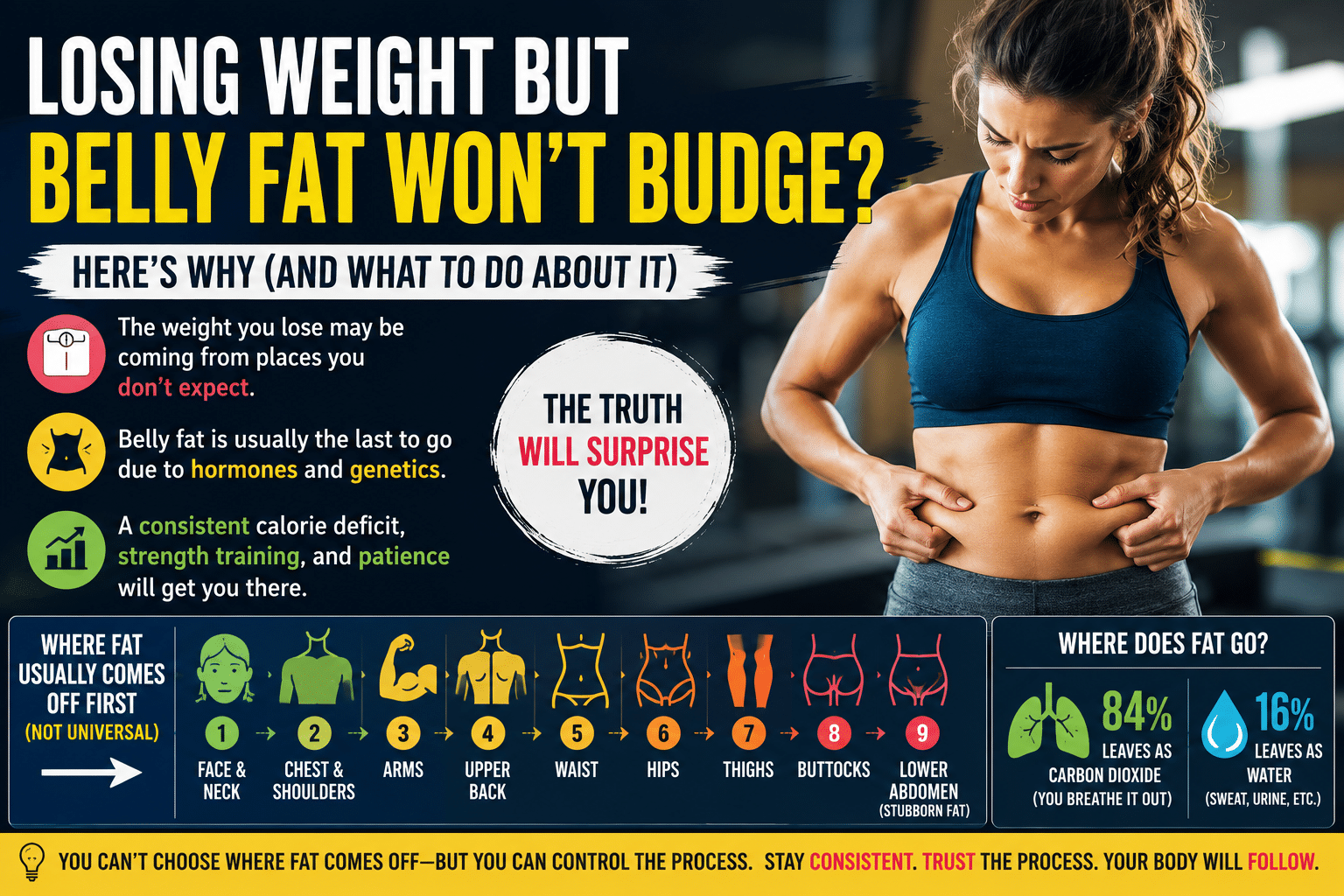
Many people lose fat in this general pattern:
Face
One of the first noticeable changes is a slimmer face.
Cheeks become leaner.
Jawlines become more defined.
Friends often notice this before you do.
Neck
As body fat decreases, the neck becomes thinner and collars begin fitting more comfortably.
Shoulders
The shoulders usually become more defined because they naturally carry less stored fat than the hips and abdomen.
Muscle definition becomes visible much earlier.
Chest
For many men, chest fat decreases before lower belly fat.
Women may notice changes in breast size because breast tissue contains a significant amount of body fat.
Arms
Sleeves begin fitting looser.
Veins may become more visible.
Resistance training makes these changes even more noticeable because the muscles underneath become larger while the fat layer becomes thinner.
Upper Back
Many people don’t realize they’re losing fat across their back until shirts begin fitting differently.
The muscles around the shoulder blades gradually become visible.
Bra-line fat often decreases before lower abdominal fat.
Waist
Eventually your waist measurement begins shrinking.
Notice something important.
Your waist may shrink before your lower belly does.
That’s because upper abdominal fat and lower abdominal fat don’t always behave the same way.
This is where many people become frustrated.
They’ve lost twenty pounds.
Their clothes fit better.
Their face looks thinner.
Their shoulders are more muscular.
But the small roll below their belly button seems determined to stay forever.
It isn’t.
It’s simply the last area your body wants to let go.
The Science Behind Stubborn Belly Fat
If all body fat stores energy, why doesn’t your body burn them equally?
The answer lies inside each fat cell.
Fat cells contain tiny receptors that control whether stored fat is released into the bloodstream.
Two of the most important are:
- Beta-2 receptors
- Alpha-2 receptors
Think of beta receptors as the accelerator.
Think of alpha receptors as the brake.
Areas like your face, arms, and shoulders generally contain more beta receptors.
These areas release fat relatively easily.
Your lower abdomen, hips, and thighs often contain more alpha-2 receptors.
These receptors slow fat release.
That’s why these areas are commonly called stubborn fat.
It’s not because you’re doing the wrong exercises.
It’s because your biology is protecting those energy reserves.
Your Hormones Are Also Involved
Several hormones influence where fat is stored and where it comes off first.
Insulin
High insulin levels encourage fat storage and reduce fat burning.
Improving insulin sensitivity through exercise, weight loss, and eating fewer refined carbohydrates helps your body access stored fat more efficiently.
Cortisol
Chronic stress raises cortisol.
Long-term elevated cortisol is associated with increased abdominal fat storage, poor sleep, and stronger cravings for calorie-dense foods.
Testosterone
Higher testosterone levels generally promote lean muscle while reducing fat storage around the abdomen.
This partly explains why men often lose upper-body fat faster than women.
Estrogen
Women naturally store more fat around the hips, thighs, and buttocks because estrogen prepares the body for pregnancy and breastfeeding.
Even after menopause, lifelong fat distribution patterns often remain.
Where Does the Fat Actually Go?
Here’s one of the biggest surprises in weight loss science.
Fat doesn’t simply “burn off.”
It doesn’t turn directly into energy.
It doesn’t magically disappear.
When your body burns stored fat, the triglycerides inside fat cells are broken into glycerol and fatty acids. Your cells use oxygen to convert these molecules into energy through metabolism.
The byproducts are:
- Carbon dioxide (CO₂)
- Water (H₂O)
Researchers estimate that approximately:
- 84% of lost fat leaves your body through your lungs as carbon dioxide.
- 16% leaves through water in your urine, sweat, tears, and other body fluids.
In other words…
You literally breathe most of your fat away.
Every workout, every walk, every night’s sleep, and every breath contributes to this process.
The more consistently you maintain a calorie deficit, the more stored fat your body converts into carbon dioxide and water.
Fat Cells Don’t Disappear—They Shrink
Many people believe losing weight means eliminating fat cells.
That’s usually not what happens.
Most adults have roughly the same number of fat cells throughout adulthood.
Instead of disappearing, fat cells become smaller as stored triglycerides are removed.
Think of a balloon.
A full balloon represents a fat cell packed with stored energy.
As you lose weight, you aren’t throwing the balloon away.
You’re simply letting the air out.
The balloon still exists.
That’s one reason regaining weight happens so easily.
Those empty fat cells are ready to store energy again if calorie intake exceeds calorie expenditure.
This is why maintaining healthy habits after reaching your goal weight is just as important as losing the weight in the first place.
Why Your Belly Seems to Stay the Same
One of the biggest mistakes people make is relying only on the bathroom scale.
Imagine you’ve lost twenty pounds.
Your body may have removed fat from:
- Your face
- Your neck
- Your arms
- Your upper back
- Around your organs (visceral fat)
- Your chest
Meanwhile, the lower abdominal fat may only have shrunk slightly.
Because you look at your stomach every day, you barely notice the small changes.
Psychologists call this the frequency illusion.
Small daily improvements become almost invisible because you’re seeing yourself every morning.
That’s why progress photos taken every four weeks are often far more encouraging than daily mirror checks.
The Belly Fat Math
As I tell clients, fat loss is a math problem—not a motivation problem.
Suppose you create a 500-calorie daily deficit.
500 calories × 7 days = 3,500 calories
Approximately 3,500 calories equals about one pound of stored body fat.
Now imagine you’ve maintained that deficit for 20 weeks.
20 pounds lost.
Your body has removed approximately 70,000 calories worth of stored fat.
That’s incredible progress.
The problem?
Your body never promised those 70,000 calories would come from your stomach first.
It simply removed fat according to your individual biology.
Consistency eventually wins because every pound lost reduces your total body fat percentage.
Eventually, even stubborn areas have nowhere left to hide.
Five Ways to Finally Lose Stubborn Belly Fat
1. Stay in a Moderate Calorie Deficit
Crash diets often lead to muscle loss, fatigue, and rebound weight gain.
Aim for a sustainable deficit of 300–500 calories per day.
Slow fat loss is far more likely to preserve muscle while gradually reducing stubborn fat.
2. Lift Weights
Resistance training doesn’t specifically burn belly fat.
It does something even better.
It preserves lean muscle.
More muscle helps maintain a higher metabolic rate while improving body composition as fat decreases.
Focus on:
- Squats
- Deadlifts
- Rows
- Pull-ups
- Bench press
- Overhead press
Large compound movements provide the greatest return.
3. Increase Your Daily Activity
NEAT (Non-Exercise Activity Thermogenesis) is one of the most overlooked fat-loss tools.
Walking.
Standing.
Housework.
Taking the stairs.
Yard work.
These small movements often burn hundreds of calories every day without feeling like formal exercise.
Ten thousand steps may burn more calories over time than an additional thirty minutes of cardio.
4. Eat More Protein
Protein helps preserve muscle while dieting.
It also increases satiety, making it easier to maintain your calorie deficit.
Most active adults benefit from approximately:
0.7–1.0 grams of protein per pound of goal body weight
Protein also has the highest thermic effect of food, meaning your body burns more calories digesting it than carbohydrates or fats.
5. Be Patient
This may be the hardest strategy of all.
Stubborn fat isn’t impossible.
It’s simply last in line.
Every week you stay consistent moves you one step closer.
The people who eventually reveal visible abs aren’t usually genetically gifted.
They’re simply the ones who refused to quit when progress slowed.
💪 FaithnFit Fat Loss Essentials
Build muscle, burn fat, and stay consistent with these recommended products.
“Consistency beats intensity when your goal is lasting fat loss.”
Key Takeaways
- Belly fat usually disappears later than fat stored in the face, arms, shoulders, and upper body.
- Spot reduction is a myth.
- Genetics and hormones determine where fat leaves first.
- Alpha-2 receptors make lower abdominal fat more resistant to release.
- Approximately 84% of body fat leaves through your lungs as carbon dioxide, while about 16% becomes water.
- Fat cells shrink rather than disappear.
- A calorie deficit, resistance training, high protein intake, and patience remain the most effective strategy for reducing stubborn belly fat.
Frequently Asked Questions
Why am I losing weight but not belly fat?
You’re likely losing fat from other parts of your body first. Genetics and hormone-related fat distribution determine where your body removes stored fat.
Can I target belly fat with ab exercises?
No. Ab exercises strengthen your abdominal muscles but do not specifically burn fat from your stomach.
Does walking burn belly fat?
Walking helps create a calorie deficit, which reduces total body fat over time—including belly fat. It just doesn’t determine where fat is lost first.
Why does belly fat come off last?
Lower abdominal fat contains more alpha-2 adrenergic receptors, making it more resistant to fat release than many other areas of the body.
How long does it take to lose stubborn belly fat?
There is no fixed timeline. The leaner you become overall and the more consistently you maintain a calorie deficit, the more likely your body will eventually mobilize stubborn fat stores.
Read more: Losing Weight but Belly Fat Won’t Budge? Here’s Why
- Does the Age of Body Fat Affect How Difficult It Is to Lose?
- Boost Gym Motivation for Stubborn Muscle Growth
- How To Burn Belly Fat Fast In 5 Simple Steps
- How Long Does It Take to Lose Belly Fat
- Top 5 Exercises to Burn Belly Fat Fast Without Cardio
🌿 Natural Daily Support for Men and Women
I like Divine Bounty supplements because they use natural ingredients instead of synthetic formulas. For people who want a cleaner option for everyday wellness support, Divine Bounty offers quality supplements designed to fit a healthy lifestyle.
Their lineup includes the popular Men’s Multivitamin, plus other supplements for men and women such as Vitamin B Complex, Digestive Enzymes, Berberine, Magnesium Citrate, Vitamin K2 + D3, and Acetyl L-Carnitine.
The Men’s Multivitamin features 24 essential vitamins and minerals plus 5 additional blends for men, all in convenient vegetarian capsules. It is also promoted as GMO free, soy free, dairy free, wheat free, and gluten free.
🛒 Shop Divine Bounty on AmazonSponsored by Terry Clark • Amazon Affiliate Partner