Estimated reading time: 5 minutes
Carbohydrates have become one of the most misunderstood nutrients in fitness. Understanding the role of carbohydrates for fitness goals is key to interpreting their place in your diet and training plan.
Some people avoid them completely because they believe carbohydrates make them fat. Others eat unlimited amounts believing more carbohydrates automatically produce more muscle.
Neither approach is correct.
The truth is much simpler.
Your carbohydrate intake should match your fitness goal.
Whether you’re trying to build muscle, lose body fat, or transform your body through recomposition, carbohydrates provide the fuel that helps determine your performance, recovery, and results.
The math isn’t complicated.
Your goal determines your calories.
Your calories determine your macronutrients.
Your macronutrients determine how much carbohydrate you should eat.
Why Are Carbohydrates Important?
Carbohydrates are your body’s preferred energy source.
After digestion, carbohydrates become glucose, which your body uses immediately or stores as glycogen inside your muscles and liver.
Muscle glycogen is especially important because it fuels:
- Weight training
- Sprinting
- High-intensity cardio
- Athletic performance
- Recovery between workouts
Think of glycogen as gasoline in your car.
Without fuel, even the best engine eventually stops.
Your muscles work the same way.
How Many Carbohydrates Do You Need to Build Muscle?
Building muscle requires two primary ingredients:
- Progressive resistance training
- A calorie surplus
Carbohydrates support both.
When glycogen stores are full, you can perform more repetitions, lift heavier weights, and recover faster between sets.
For muscle growth, most bodybuilders perform best with:
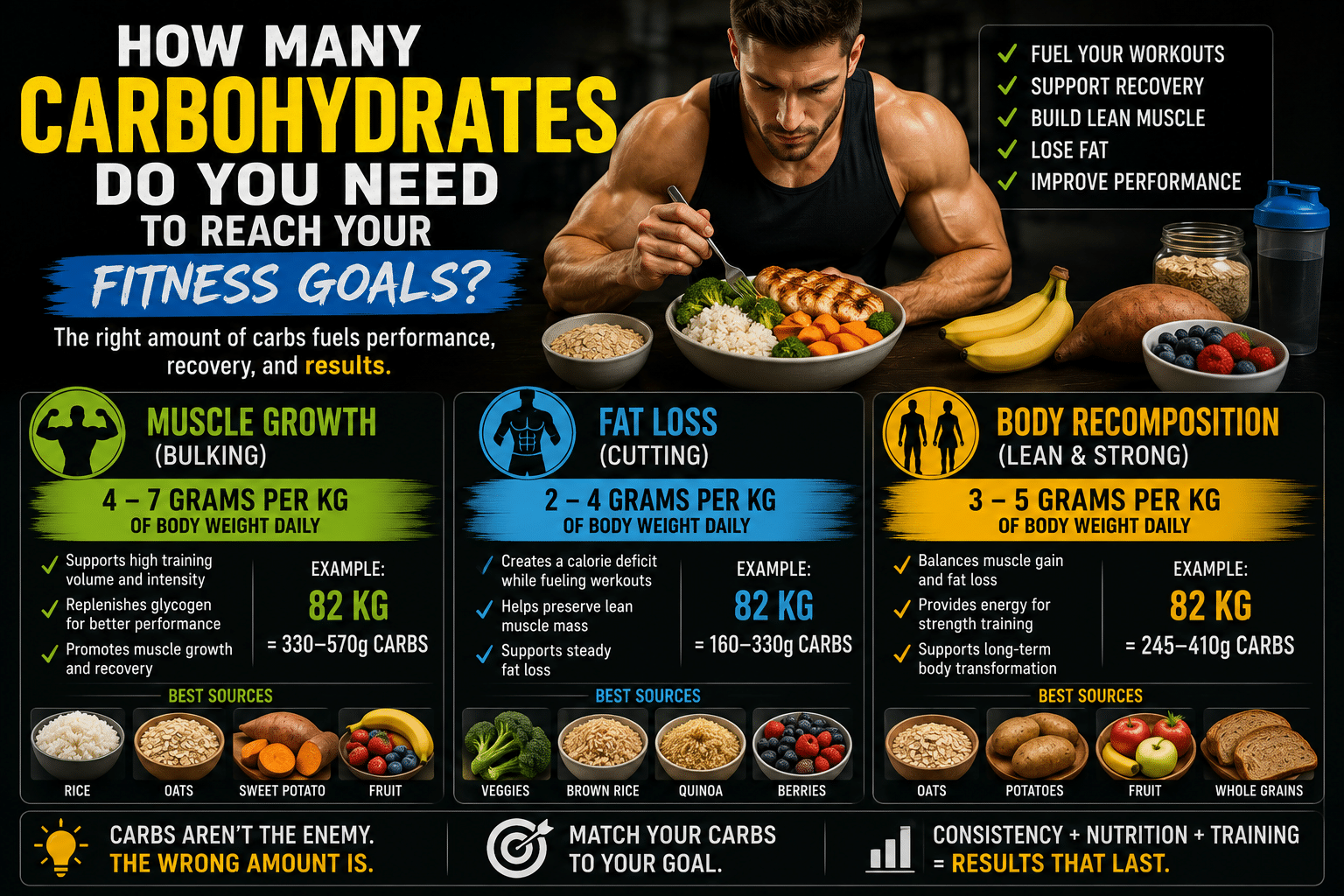
4 to 7 grams of carbohydrates per kilogram of body weight daily.
Example:
180-pound bodybuilder (82 kilograms)
82 × 5 grams = 410 grams of carbohydrates per day
Athletes with very high training volume may require even more.
The goal isn’t eating as many carbohydrates as possible.
The goal is consuming enough carbohydrates to maximize training performance.
How Many Carbohydrates Do You Need for Fat Loss?
Fat loss changes the equation.
Your priority becomes maintaining a calorie deficit while preserving lean muscle.
This usually means lowering carbohydrate intake without eliminating it.
Most people achieve excellent results with:
2 to 4 grams of carbohydrates per kilogram of body weight daily.
Example:
180-pound person
82 × 3 grams = 246 grams daily
Some individuals may need fewer carbohydrates depending on:
- Activity level
- Training volume
- Personal preference
- Total calorie intake
Remember:
Carbohydrates do not prevent fat loss.
Excess calories do.
What About Body Recomposition?
Body recomposition means simultaneously losing body fat while gaining muscle.
This requires balancing calories carefully.
Most successful recomposition plans include:
- High protein intake
- Moderate carbohydrates
- Moderate healthy fats
- Progressive strength training
Carbohydrate recommendations typically fall between:
3 to 5 grams per kilogram of body weight daily.
This provides enough fuel to support resistance training while maintaining a slight calorie deficit or maintenance intake.
Body recomposition rewards patience.
Results occur more slowly than traditional bulking or cutting but often produce excellent long-term improvements.
Does Activity Level Change Carbohydrate Needs?
Absolutely.
Consider these examples.
Sedentary Individual
Walks occasionally.
Exercises twice weekly.
Needs fewer carbohydrates.
Recreational Lifter
Strength trains four times weekly.
Moderate carbohydrate needs.
Competitive Bodybuilder
Trains six days weekly.
High training volume.
Requires substantially more carbohydrates to replenish glycogen stores.
The harder you train, the more fuel your muscles require.
What Are the Best Carbohydrate Sources?
Quality matters.
Choose mostly nutrient-dense carbohydrates such as:
- Oatmeal
- Rice
- Potatoes
- Sweet potatoes
- Fruit
- Beans
- Whole-grain pasta
- Quinoa
- Whole-grain bread
- Vegetables
These foods provide fiber, vitamins, minerals, antioxidants, and sustained energy.
Highly processed foods can fit occasionally but shouldn’t make up the majority of your carbohydrate intake.
Should You Eat Carbohydrates Before a Workout?
Yes.
Eating carbohydrates before training helps increase muscle glycogen and improve performance.
Aim for:
30 to 60 grams of carbohydrates
plus
20 to 40 grams of protein
one to three hours before your workout.
Examples include:
- Chicken and rice
- Oatmeal with protein powder
- Greek yogurt with fruit
- Turkey sandwich on whole-grain bread
Should You Eat Carbohydrates After Training?
Absolutely.
After exercise, your muscles are primed to replace glycogen.
Combining carbohydrates with protein after training may improve recovery and prepare you for your next workout.
A simple post-workout meal could include:
- Lean chicken breast
- White rice
- Vegetables
- Fruit
Recovery begins with nutrition.
Do Low-Carb Diets Work?
They can.
Some people successfully lose body fat using lower-carbohydrate diets.
However, individuals performing high-volume resistance training often experience:
- Reduced performance
- Lower training volume
- Slower recovery
- Increased fatigue
The best diet is the one you can consistently follow while supporting your training.
How Do You Calculate Your Carbohydrates?
Follow these steps.
Muscle Growth
Calories: Surplus
Protein: 1.6–2.2 grams per kilogram
Fat: 20–30% of calories
Remaining calories: Carbohydrates
Fat Loss
Calories: Deficit
Protein: Higher to preserve muscle
Fat: Moderate
Remaining calories: Carbohydrates
Body Recomposition
Calories: Maintenance or slight deficit
High protein
Moderate fats
Moderate carbohydrates
Your carbohydrate intake should adapt as your goals change.
Common Carbohydrate Mistakes
Many people make these mistakes:
- Eliminating carbohydrates entirely
- Eating too few carbohydrates to support workouts
- Consuming most carbohydrates late at night instead of around training
- Ignoring total calorie intake
- Choosing processed foods over whole-food carbohydrates
Balance always beats extremes.
💪 FaithnFit Nutrition & Training Essentials
Support your fitness goals with these recommended products:
“Fuel your goals with the right amount of carbohydrates—not too little, not too much, but exactly what your body needs.”
Key Takeaways
Carbohydrates are neither your enemy nor your magic solution.
They are fuel.
Your body needs different amounts depending on your fitness goals.
Muscle Growth: 4–7 g/kg
Fat Loss: 2–4 g/kg
Body Recomposition: 3–5 g/kg
The equation is simple:
Goal → Calories → Macronutrients → Carbohydrates
Stop asking whether carbohydrates are good or bad.
Instead, ask:
“How many carbohydrates does my goal require?”
When your nutrition matches your objective, your body performs better, recovers faster, and moves more efficiently toward the results you want.
Read more: How Much Carbohydrates Do You Need to Reach Your Fitness Goals?- Build Muscle While Losing Fat for a Better Body Recomposition
- How to Build Muscle and Lose Fat Simultaneously
- How to Build Muscle and Burn Fat at the Same Time
- Why You’re Losing Inches But Not Weight (And Why That’s a GOOD Thing)
- Are Carbohydrates Bad for Your Health and Fitness Goals?
🌿 Natural Daily Support for Men and Women
I like Divine Bounty supplements because they use natural ingredients instead of synthetic formulas. For people who want a cleaner option for everyday wellness support, Divine Bounty offers quality supplements designed to fit a healthy lifestyle.
Their lineup includes the popular Men’s Multivitamin, plus other supplements for men and women such as Vitamin B Complex, Digestive Enzymes, Berberine, Magnesium Citrate, Vitamin K2 + D3, and Acetyl L-Carnitine.
The Men’s Multivitamin features 24 essential vitamins and minerals plus 5 additional blends for men, all in convenient vegetarian capsules. It is also promoted as GMO free, soy free, dairy free, wheat free, and gluten free.
🛒 Shop Divine Bounty on AmazonSponsored by Terry Clark • Amazon Affiliate Partner