Estimated reading time: 5 minutes
If your clothes are fitting better…
Your waist is shrinking…
Your arms and legs look tighter…
But the scale hasn’t moved — or worse, it went up —
You are not failing.
You are likely doing something very right.
Most people misunderstand what real fat loss looks like. The scale measures total body mass, not body composition. And when your body is changing in the right direction, the scale can become the most misleading tool in your fitness journey.
Let’s break down what’s actually happening.
The Scale Measures Everything — Not Just Fat
Your body weight includes:
- Fat
- Muscle
- Water
- Glycogen (stored carbs)
- Food in your digestive system
- Bone density
- Inflammation
When you step on a scale, it doesn’t know the difference between fat loss and muscle gain. It simply gives you a number.
That number can stay the same while your body dramatically improves.
What’s Really Happening: Body Recomposition
Body recomposition means:
You’re losing fat while gaining muscle at the same time.
This is common when:
- You start strength training
- You increase protein intake
- You return to training after time off
- You tighten your nutrition
- You improve sleep
Muscle is denser than fat.
That means it takes up less space.
So even if your weight stays at 175 pounds, your body can look completely different at 175 with more muscle and less fat.
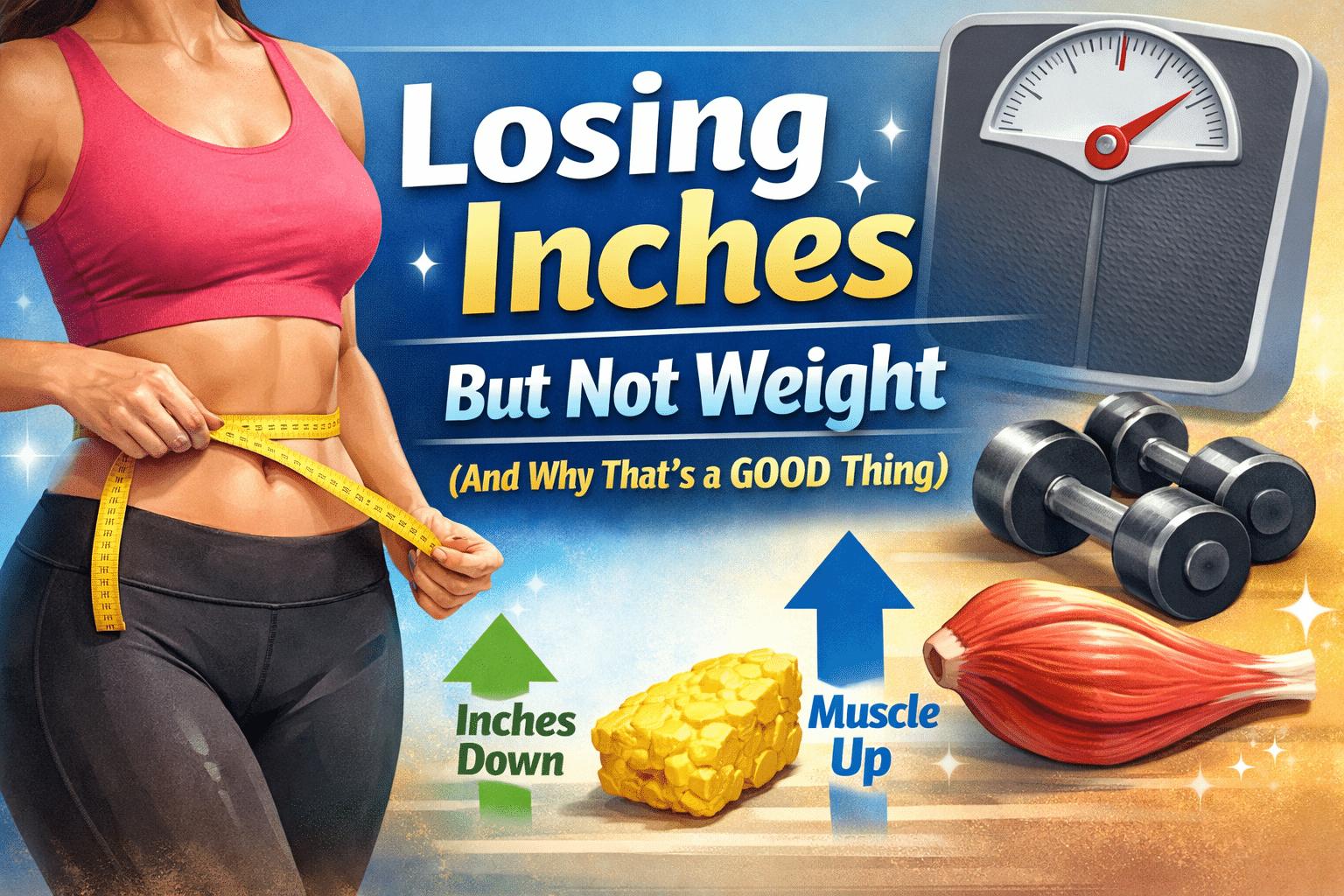
That’s why you’re losing inches.
Muscle vs Fat: Same Weight, Different Look
Five pounds of muscle and five pounds of fat weigh the same — but they look very different.


4
Muscle is compact and firm.
Fat is softer and takes up more volume.
When you gain muscle and lose fat simultaneously, your measurements shrink even though the scale stays steady.
That is progress.
Glycogen and Water: The Hidden Variable
When you begin lifting weights, your muscles store more glycogen.
Glycogen binds with water.
For every gram of glycogen stored, your body holds approximately 3–4 grams of water.
This means:
- You can gain 2–5 pounds of water quickly
- Your muscles look fuller
- You feel stronger
This is not fat gain.
It’s your body adapting to training.
Strength Training Changes the Game
Cardio burns calories.
Strength training reshapes your body.
Resistance training stimulates muscle growth and increases metabolic demand. The more lean mass you carry, the more calories your body burns at rest.
Over time, this improves insulin sensitivity and resting metabolic rate — making long-term fat loss easier.
The irony?
When you lift consistently, the scale may move slower…
But your physique improves faster.
The Role of Protein
If you’ve increased protein intake, you’ve likely improved muscle preservation and growth.
Protein:
- Preserves lean tissue during fat loss
- Increases satiety
- Boosts thermogenesis
- Supports recovery
Higher protein + resistance training = ideal recomposition environment.
That’s when inches drop before pounds.
Why the Scale Can Stall for Weeks
Here’s what many people don’t realize:
Your body resists change.
When you diet:
- Your metabolism adapts
- NEAT (non-exercise activity thermogenesis) can drop
- Stress hormones may increase
- Water retention can mask fat loss
If you’re training hard, cortisol can temporarily hold water in tissues.
That means:
You may lose fat, but inflammation and water retention hide it.
Then suddenly…
The scale drops all at once.
This is often called a “whoosh effect.”
Signs You’re Actually Making Progress
Instead of obsessing over the scale, track:
- Waist measurement
- Hip measurement
- Progress photos
- Strength improvements
- How clothes fit
- Energy levels
- Recovery speed
If your lifts are increasing and your waist is shrinking, you are winning.
When It’s NOT a Good Thing
To be honest — sometimes no scale change can signal issues:
- You’re overeating unknowingly
- Liquid calories are creeping in
- Portion sizes increased
- Sleep is poor
- Stress is chronically high
If inches are not dropping and strength isn’t improving, then adjustments are needed.
But if inches are shrinking?
Stay consistent.
The Psychological Trap of the Scale
The scale is emotionally powerful.
It can:
- Ruin your mood
- Make you quit early
- Convince you nothing is working
But body recomposition doesn’t show up immediately in scale weight.
That’s why physique athletes rarely judge progress by scale alone.
Even in competitions like Mr. Olympia, competitors focus on conditioning and muscle definition — not just weight.
Appearance and composition matter more than total pounds.
Why This Is Actually a Great Sign
If you’re losing inches but not weight, it likely means:
- You’re building lean muscle
- You’re improving insulin sensitivity
- You’re increasing metabolic rate
- You’re reducing visceral fat
- You’re strengthening your frame
That’s long-term success.
Fat loss that preserves muscle creates a tighter, stronger, more athletic look.
Crash dieting may drop weight fast — but it often sacrifices muscle.
And that slows metabolism.
The Long-Term Advantage
People who focus only on the scale often:
- Lose muscle
- Regain fat
- End up “skinny fat”
- Slow their metabolism
People who focus on recomposition:
- Look better at the same weight
- Maintain muscle
- Burn more calories daily
- Keep results longer
The scale rewards speed.
Your body rewards strategy.
What You Should Do Now
If you’re losing inches but not weight:
- Keep lifting
- Prioritize protein
- Sleep 7–9 hours
- Stay hydrated
- Manage stress
- Measure weekly — not daily
- Take progress photos every 2–4 weeks
Give your body time to adapt.
Final Perspective
Weight is just a number.
Body composition is what people see.
If your waist is shrinking, your shoulders look broader, your clothes fit better, and your strength is increasing — you are not stuck.
You are transforming.
And that is far more powerful than a lower number on the scale.
Read Next…
🌿 Natural Daily Support for Men and Women
I like Divine Bounty supplements because they use natural ingredients instead of synthetic formulas. For people who want a cleaner option for everyday wellness support, Divine Bounty offers quality supplements designed to fit a healthy lifestyle.
Their lineup includes the popular Men’s Multivitamin, plus other supplements for men and women such as Vitamin B Complex, Digestive Enzymes, Berberine, Magnesium Citrate, Vitamin K2 + D3, and Acetyl L-Carnitine.
The Men’s Multivitamin features 24 essential vitamins and minerals plus 5 additional blends for men, all in convenient vegetarian capsules. It is also promoted as GMO free, soy free, dairy free, wheat free, and gluten free.
🛒 Shop Divine Bounty on AmazonSponsored by Terry Clark • Amazon Affiliate Partner