Ever finish a cardio workout only to feel hungrier than before you started?
You’re not imagining it.
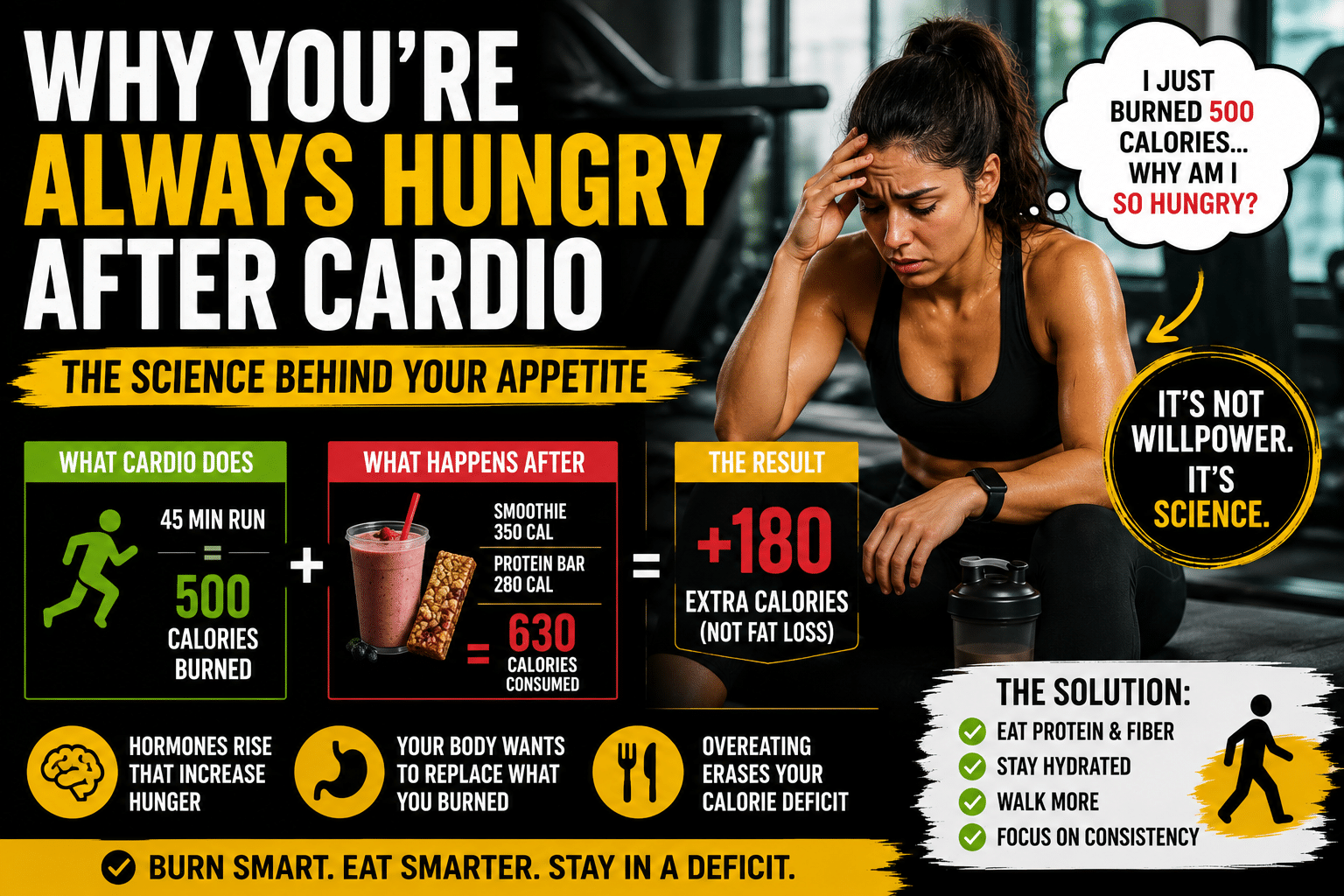
Many people spend 45 minutes on the treadmill, burn 400 calories, and then unknowingly eat 600 calories because their appetite skyrockets.
Instead of creating a calorie deficit, cardio can accidentally create a calorie surplus.
The problem isn’t cardio itself.
The problem is understanding how your body responds to exercise.
If your goal is fat loss, learning why you’re hungry after cardio may save you months of frustration.
Why Does Cardio Make You Hungry?
Your body is designed for survival.
When you burn a large amount of energy, your brain receives signals that encourage you to replace those calories.
Several hormones are involved.
Levels of ghrelin, often called the hunger hormone, can rise after exercise in some individuals, increasing appetite.
Meanwhile, your body recognizes that its stored energy has decreased.
Its natural response?
Encourage you to eat.
This response helped our ancestors survive food shortages.
Today, it can work against your fat-loss goals.
Cardio Burns Calories—But Appetite Can Replace Them
Let’s do the math.
Imagine you complete a 45-minute run.
Calories burned:
450
Afterward, you’re extremely hungry.
You stop for:
- Large smoothie = 350 calories
- Protein bar = 280 calories
Total consumed:
630 calories
Your workout burned 450 calories.
You ate 630.
Instead of creating a deficit, you’ve added 180 calories.
The workout wasn’t wasted.
But it didn’t move you closer to fat loss.
Why Walking Is Different
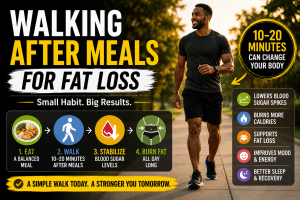
This is one reason walking has become one of my favorite fat-loss tools.
Walking burns fewer calories per minute.
But it also tends to produce much less hunger.
That’s important.
Suppose you burn:
- Walking: 250 calories
- Running: 500 calories
If running causes you to eat an extra 600 calories while walking causes no increase in appetite, which one creates the larger calorie deficit?
Walking.
Sometimes the slower approach produces better long-term results.
High-Intensity Exercise Doesn’t Always Mean Better Fat Loss
Many people believe harder workouts automatically burn more fat.
The reality is more complicated.
Fat loss depends on maintaining a calorie deficit over weeks and months.
If hard workouts consistently increase your calorie intake, the extra effort may not produce extra results.
Intensity has tremendous value for improving fitness, endurance, and cardiovascular health.
But when fat loss is the goal, appetite matters just as much as calories burned.
Protein Helps Control Hunger
One of the easiest ways to reduce post-cardio hunger is by eating enough protein.
Protein increases satiety more than carbohydrates or fat.
Aim to include a protein-rich meal within a couple of hours after training.
Examples include:
- Greek yogurt with berries
- Chicken breast and rice
- Cottage cheese
- Eggs and whole-grain toast
- Protein smoothie with fruit
Protein supports recovery while helping control appetite.
Fiber Keeps You Full Longer
Protein isn’t the only tool.
Fiber slows digestion and increases fullness.
Combine lean protein with foods such as:
- Vegetables
- Oatmeal
- Beans
- Apples
- Berries
- Potatoes
This combination makes it easier to stay in a calorie deficit without constantly feeling hungry.
Hydration Matters More Than You Think
After cardio, many people mistake thirst for hunger.
Sweating reduces body water.
Before grabbing a snack, drink water and wait 15 to 20 minutes.
Sometimes your hunger decreases once you’re properly hydrated.
The Fat-Loss Formula
Think about fat loss like balancing a budget.
Calories burned are income.
Calories eaten are expenses.
You don’t become wealthy simply by earning more.
You become wealthy by managing both sides of the equation.
Fat loss works the same way.
Fat Loss = Calories Burned − Calories Consumed
Exercise increases one side.
Nutrition controls the other.
Both matter.
Cardio Isn’t the Enemy
Cardio remains one of the best ways to improve:
- Heart health
- Endurance
- Blood pressure
- Mood
- Energy
- Longevity
The mistake is assuming cardio alone guarantees fat loss.
The most successful people combine:
- Resistance training
- Walking
- High-protein meals
- Plenty of fiber
- Adequate sleep
- A sustainable calorie deficit
That combination works because it controls hunger while increasing calorie expenditure.
Common Questions
Should I eat after cardio?
Yes.
Choose a balanced meal with protein, fiber, and carbohydrates instead of high-calorie processed snacks.
Is fasted cardio better?
Not necessarily.
Research generally shows little difference in long-term fat loss when calories and protein are matched.
Should I stop doing cardio?
Absolutely not.
Cardio provides tremendous health benefits.
Simply understand how it affects your appetite and plan accordingly.
Key Takeaways
If you’re hungry after cardio, your body is behaving exactly as it was designed.
The goal isn’t to fight hunger.
The goal is to manage it intelligently.
Remember this equation:
Fat Loss = Calorie Deficit + Protein + Fiber + Walking + Strength Training + Consistency
The best workout isn’t always the one that burns the most calories.
It’s the one that helps you stay consistent long enough to reach your goal.
Read more: Why You’re Always Hungry After Cardio- Cravings vs. Hunger: Understanding the Difference and Responding Wisely
- Mindful Eating: How to Improve Your Diet and Enjoy Your Food
- The Right Balance of Strength Training and Cardio for Your Goals
- Health Benefits of Cardio Exercises and the Best Moves to Reach Fitness Goals
- Cardio Fitness in Gym Life: Maximizing Benefits
🌿 Natural Daily Support for Men and Women
I like Divine Bounty supplements because they use natural ingredients instead of synthetic formulas. For people who want a cleaner option for everyday wellness support, Divine Bounty offers quality supplements designed to fit a healthy lifestyle.
Their lineup includes the popular Men’s Multivitamin, plus other supplements for men and women such as Vitamin B Complex, Digestive Enzymes, Berberine, Magnesium Citrate, Vitamin K2 + D3, and Acetyl L-Carnitine.
The Men’s Multivitamin features 24 essential vitamins and minerals plus 5 additional blends for men, all in convenient vegetarian capsules. It is also promoted as GMO free, soy free, dairy free, wheat free, and gluten free.
🛒 Shop Divine Bounty on AmazonSponsored by Terry Clark • Amazon Affiliate Partner