Estimated reading time: 5 minutes
Cortisol sleep deprivation is the silent equation destroying your results. You can train hard, eat clean, and stay consistent—but if cortisol stays elevated because of poor sleep, your progress stalls.
Here’s the math I teach:
Progress = Training + Nutrition − Stress Hormones
If cortisol stays high, that subtraction becomes aggressive. You don’t just slow progress—you reverse it.
What Is Cortisol Sleep Deprivation?


7
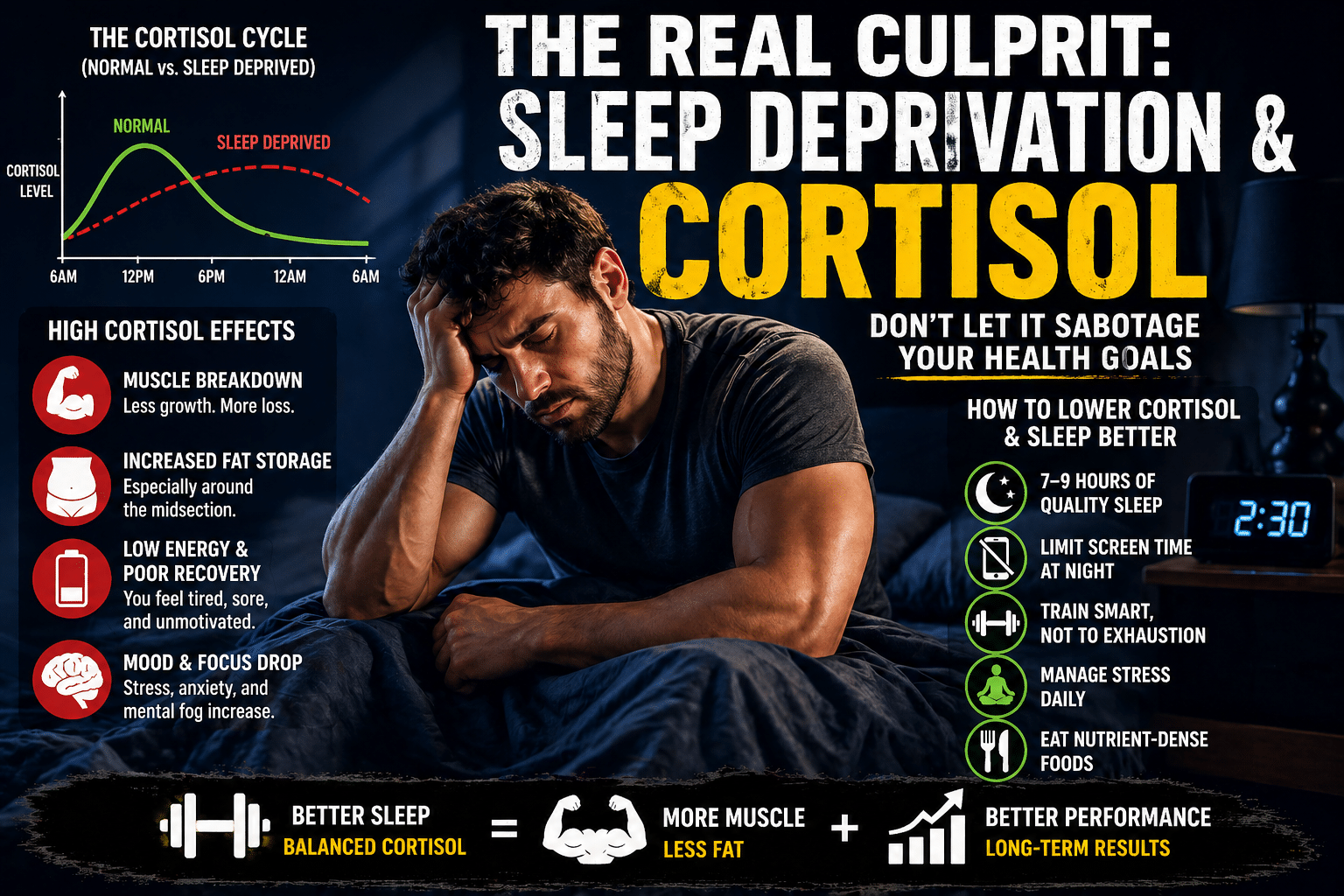
Cortisol sleep deprivation happens when lack of sleep keeps your stress hormone (cortisol) elevated longer than it should be.
Normally:
- Cortisol rises in the morning (wake-up signal)
- Drops throughout the day
- Lowest at night (sleep signal)
But with poor sleep:
- Cortisol stays high at night
- Disrupts deep sleep cycles
- Reduces recovery
You end up stuck in a loop:
Poor sleep → high cortisol → worse sleep → higher cortisol
Why Does Cortisol Sleep Deprivation Ruin Your Results?
How Does Cortisol Affect Muscle and Fat?


6
Cortisol sleep deprivation impacts your body in three major ways:
1. Muscle Breakdown Increases
Cortisol is catabolic—it breaks tissue down.
High cortisol = reduced muscle protein synthesis.
2. Fat Storage Increases
Especially around the abdomen.
Your body stores energy when it senses stress.
3. Recovery Decreases
Sleep is when your body rebuilds.
No sleep = no growth.
The equation becomes:
- High cortisol + low recovery = stalled gains
How Much Sleep Do You Actually Need?
Is 6 Hours Enough for Cortisol Control?
Short answer: no.
For optimal cortisol sleep deprivation control:
- 7–9 hours per night
- Consistent sleep schedule
- Deep sleep cycles (not just time in bed)
Let’s quantify impact:
- 5–6 hours sleep → cortisol increases significantly
- 7–9 hours → cortisol regulated
- 9+ hours → diminishing returns
Your body isn’t guessing—it’s following a hormonal schedule.
What Causes Cortisol Sleep Deprivation?


5
Cortisol sleep deprivation isn’t random. It’s predictable.
Top causes:
- Blue light at night (phones, screens)
- Late caffeine intake (after 2–3 PM)
- High stress lifestyle
- Overtraining without recovery
- Inconsistent sleep schedule
Each one raises cortisol or delays melatonin.
Think of it like stacking variables:
- 1 bad habit = manageable
- 4–5 habits = chronic cortisol elevation
How Do You Lower Cortisol and Improve Sleep?
What Actually Works?
Here’s where results are made.
1. Control Light Exposure
- Bright light in the morning
- Low light at night
2. Set a Sleep Schedule
- Same sleep/wake time daily
- Even on weekends
3. Manage Caffeine Timing
- Cut off 6–8 hours before bed
4. Train Smart, Not Just Hard
- Avoid late-night intense workouts
- Balance intensity and recovery
5. Use Nutrition Strategically
- Protein supports recovery
- Carbs at night can improve sleep
Cortisol sleep deprivation improves when you control inputs.
Can Exercise Help or Hurt Cortisol?
Exercise is a double-edged sword.
- Moderate training → lowers cortisol long-term
- Excessive training → increases cortisol
Here’s the math:
- Optimal training = stimulus + recovery
- Overtraining = stimulus − recovery
If your workouts leave you constantly exhausted, cortisol is likely too high.
How Does Cortisol Impact Fat Loss?
Why Can’t You Lose Fat Even in a Deficit?
This is where people get frustrated.
Cortisol sleep deprivation can:
- Increase hunger hormones (ghrelin)
- Decrease fullness hormones (leptin)
- Promote fat storage
So even if calories are controlled:
- Hunger increases
- Cravings increase
- Adherence decreases
It’s not just calories—it’s hormones driving behavior.
Daily Routine to Fix Cortisol Sleep Deprivation
Here’s a simple system:
Morning
- Sunlight exposure within 30 minutes
- Light movement (walk, stretch)
Midday
- Train (if possible)
- Hydrate + balanced meals
Evening
- Reduce screen time
- Lower lights
- Relaxation routine
Night
- Consistent bedtime
- Cool, dark room
Repeat daily → cortisol stabilizes.
Recommended Tools for Recovery and Hormonal Balance
🔥 Fitness Essentials for Results
Support your muscle growth, fat loss, and performance with these trusted tools:
“The right tools don’t replace hard work—they multiply it.”
External Resources
Key Takeaways
- Cortisol sleep deprivation disrupts fat loss and muscle growth
- High cortisol = muscle breakdown + fat storage
- 7–9 hours of sleep is non-negotiable
- Lifestyle habits (light, caffeine, stress) drive cortisol levels
- Recovery is just as important as training
🌿 Natural Daily Support for Men and Women
I like Divine Bounty supplements because they use natural ingredients instead of synthetic formulas. For people who want a cleaner option for everyday wellness support, Divine Bounty offers quality supplements designed to fit a healthy lifestyle.
Their lineup includes the popular Men’s Multivitamin, plus other supplements for men and women such as Vitamin B Complex, Digestive Enzymes, Berberine, Magnesium Citrate, Vitamin K2 + D3, and Acetyl L-Carnitine.
The Men’s Multivitamin features 24 essential vitamins and minerals plus 5 additional blends for men, all in convenient vegetarian capsules. It is also promoted as GMO free, soy free, dairy free, wheat free, and gluten free.
🛒 Shop Divine Bounty on AmazonSponsored by Terry Clark • Amazon Affiliate Partner