
Estimated reading time: 6 minutes
Calorie deficit fat loss muscle is the balancing act that separates average results from elite transformation. Anyone can lose weight—but losing fat while keeping muscle requires precision.
Here’s the equation I teach:
Fat Loss = Calorie Deficit − Muscle Loss Risk
Your goal is simple:
maximize fat loss while minimizing muscle loss
That’s where strategy comes in.
What Is a Calorie Deficit Fat Loss Muscle Strategy?


6
A calorie deficit fat loss muscle strategy means:
- Eating fewer calories than you burn
- While preserving lean muscle mass
But not all deficits are equal.
Too aggressive:
- Rapid weight loss
- Muscle breakdown
Too small:
- Slow or no fat loss
The sweet spot is where fat loss is steady without sacrificing strength.
What Is the Sweet Spot for a Calorie Deficit?
How Big Should Your Deficit Be?
This is where most people fail.
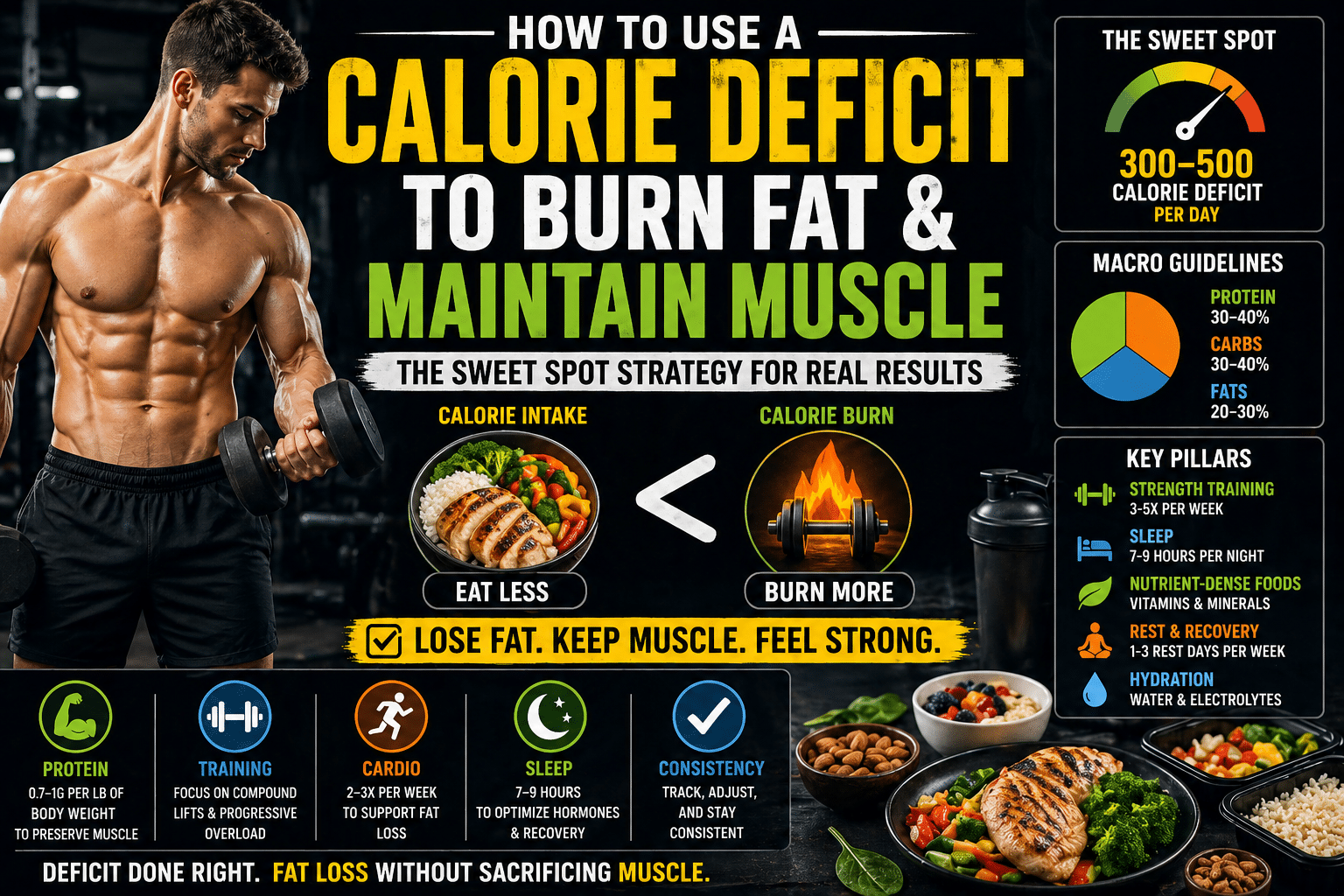
Optimal deficit: 300–500 calories per day
Let’s break it down:
- 300 deficit → slower, sustainable fat loss
- 500 deficit → faster fat loss, manageable muscle retention
- 700+ deficit → high muscle loss risk
Math example:
- Maintenance = 2,500 calories
- Deficit = 2,000–2,200 calories
Expected fat loss:
- ~0.5–1 lb per week
That’s the sweet spot for calorie deficit fat loss muscle success.
How Much Protein Do You Need?


6
Protein is your muscle insurance policy.
For calorie deficit fat loss muscle:
- 0.7–1g protein per lb bodyweight
Example:
- 180 lbs → 126–180g protein
Why?
- Preserves muscle tissue
- Supports recovery
- Reduces hunger
If protein is low, muscle loss increases—even in a perfect deficit.
What Is the Best Macronutrient Split?
How Should You Balance Protein, Carbs, and Fats?
A solid starting point:
- Protein: 30–40%
- Carbs: 30–40%
- Fats: 20–30%
But here’s the real rule:
- Protein = fixed
- Fats = minimum for hormones
- Carbs = adjustable for energy
For calorie deficit fat loss muscle:
- Higher carbs = better workout performance
- Lower carbs = easier calorie control
Adjust based on performance, not trends.
Do Micronutrients Matter for Fat Loss?


6
Yes—and most people ignore them.
Micronutrients impact:
- Energy levels
- Recovery
- Hormone function
Focus on:
- Fruits and vegetables (fiber + vitamins)
- Whole foods over processed foods
- Hydration (water + electrolytes)
You can hit macros and still fail if nutrients are poor.
What Workout Supports Calorie Deficit Fat Loss Muscle?
Should You Lift or Do Cardio?
Both—but not equally.
Priority: Resistance Training
- 3–5 sessions per week
- Progressive overload
- Compound lifts
Why?
Muscle is preserved when it’s used under tension.
Cardio:
- Supports calorie burn
- Improves conditioning
But too much cardio:
- Increases fatigue
- Risks muscle loss
Balance is key.
How Important Are Rest Days?
Rest is not optional—it’s part of the equation.
- 1–3 rest days per week
- Active recovery (walking, mobility)
Remember:
Growth happens during recovery, not training
Without rest:
- Cortisol increases
- Recovery decreases
- Muscle loss risk increases
How Does Sleep Impact Fat Loss and Muscle?


6
Sleep controls everything.
For calorie deficit fat loss muscle:
- 7–9 hours per night
Poor sleep leads to:
- Increased cortisol
- Increased hunger
- Reduced recovery
The math:
- Good sleep = better fat loss + muscle retention
- Poor sleep = fat gain + muscle loss
Sleep is your multiplier.
Common Mistakes That Kill Results
Are You Sabotaging Your Deficit?
Avoid these:
1. Too Large Deficit
Faster isn’t better—muscle loss increases.
2. Low Protein Intake
You lose muscle before fat.
3. Skipping Strength Training
Cardio alone won’t preserve muscle.
4. Ignoring Sleep
Hormones override discipline.
5. Inconsistent Tracking
What gets measured gets improved.
Sample Calorie Deficit Fat Loss Muscle Plan
Calories: 2,200 (example)
Protein: 180g
Carbs: 200g
Fats: 70g
Training:
- 4x resistance training
- 2x light cardio
Recovery:
- 2 rest days
- 8 hours sleep
This structure supports fat loss while maintaining strength and muscle.
Recommended Tools to Support Your Results
🔥 Fitness Essentials for Results
Support your muscle growth, fat loss, and performance with these trusted tools:
“The right tools don’t replace hard work—they multiply it.”
External Resources
Key Takeaways
- Calorie deficit fat loss muscle requires precision, not extremes
- 300–500 calorie deficit is the sweet spot
- Protein intake is critical for muscle retention
- Resistance training preserves muscle
- Sleep and recovery control hormones and results
🌿 Natural Daily Support for Men and Women
I like Divine Bounty supplements because they use natural ingredients instead of synthetic formulas. For people who want a cleaner option for everyday wellness support, Divine Bounty offers quality supplements designed to fit a healthy lifestyle.
Their lineup includes the popular Men’s Multivitamin, plus other supplements for men and women such as Vitamin B Complex, Digestive Enzymes, Berberine, Magnesium Citrate, Vitamin K2 + D3, and Acetyl L-Carnitine.
The Men’s Multivitamin features 24 essential vitamins and minerals plus 5 additional blends for men, all in convenient vegetarian capsules. It is also promoted as GMO free, soy free, dairy free, wheat free, and gluten free.
🛒 Shop Divine Bounty on AmazonSponsored by Terry Clark • Amazon Affiliate Partner