Estimated reading time: 4 minutes
Your body has memory.
Not emotional memory.
Not trauma memory.
Energy memory.
And that memory was built long before grocery stores, Uber Eats, or protein bars existed.
To understand why your body can quickly retrace old weight baselines, we have to go back thousands of years.
Your Body Was Designed for Scarcity, Not Stability
For most of human history, survival looked like this:
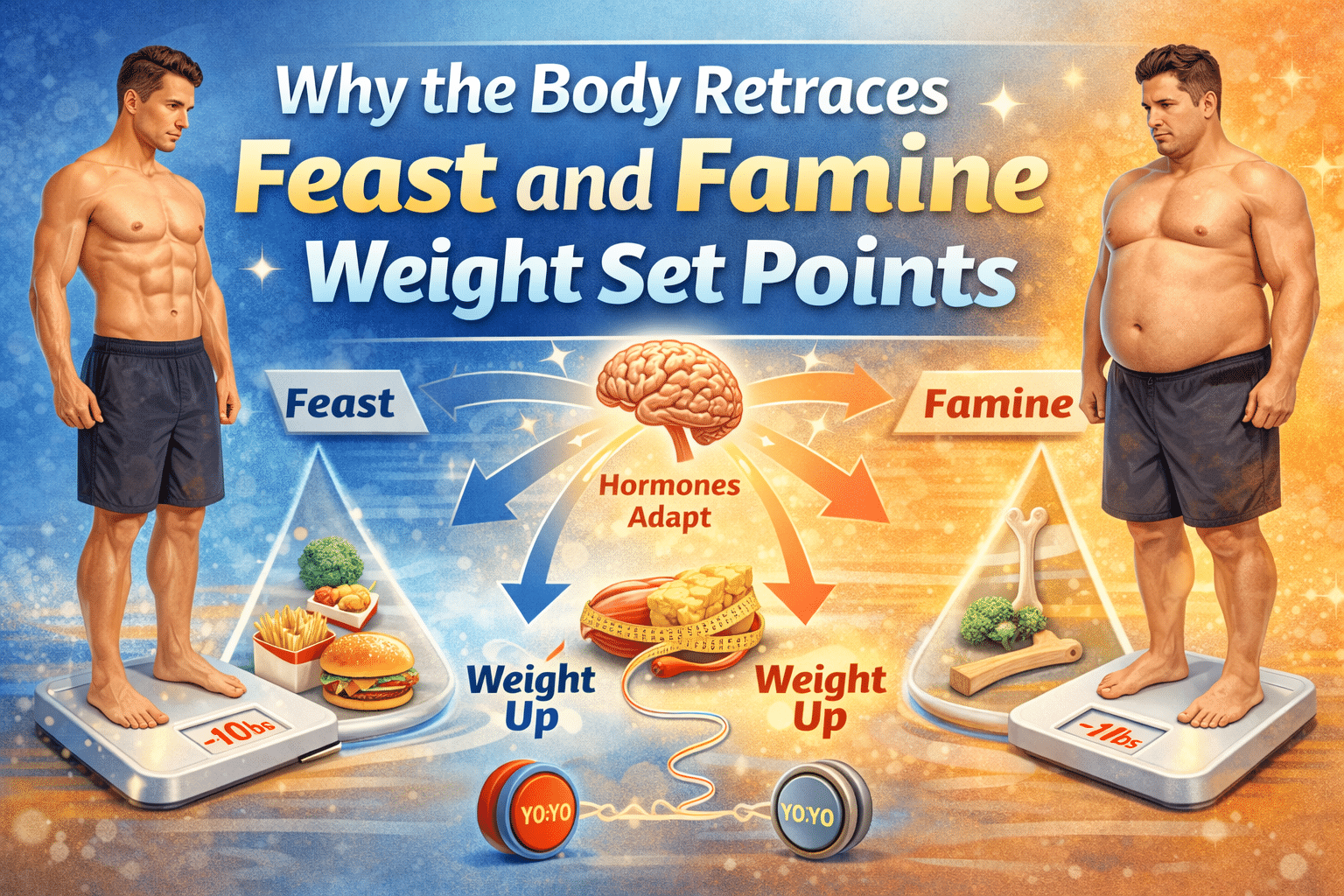
- Feast when food was available
- Famine when food disappeared
- Store aggressively during abundance
- Conserve aggressively during scarcity
Your ancestors who survived weren’t the ones who burned calories recklessly.
They were the ones whose bodies:
- Stored fat efficiently
- Lowered metabolism during food shortages
- Regained weight quickly after refeeding
That wiring still exists inside you.
What Is a Weight “Baseline”?
A weight baseline (often called a “set point”) is the range your body naturally defends.
It’s not just a number on the scale.
It’s influenced by:
- Hormones
- Nervous system signaling
- Fat cell size and number
- Metabolic rate
- Hunger signals
Your body actively tries to return to familiar territory.
That’s why weight regain after dieting feels fast and automatic.
The Role of Leptin: The Fat Mass Messenger
Leptin is a hormone produced by fat cells.
It signals to your brain how much energy is stored.
When you lose fat:
- Leptin drops
- Hunger increases
- Metabolism slows
- Thyroid output decreases
- Energy conservation rises
Your brain interprets fat loss as potential famine.
The hypothalamus acts quickly to protect you.
It doesn’t care about aesthetics.
It cares about survival.
Ghrelin: The Hunger Amplifier
Ghrelin rises during dieting.
After weight loss, ghrelin levels often remain elevated for months.
That means:
- You feel hungrier than before you started dieting
- Satiety signals weaken
- Food becomes more rewarding
Your body is trying to restore lost energy reserves.
Metabolic Adaptation Is Real
When calories drop:
- Resting metabolic rate declines
- Non-exercise movement (NEAT) drops
- Spontaneous activity decreases
- Muscle efficiency improves (you burn fewer calories doing the same work)
This is called adaptive thermogenesis.
Your body becomes more efficient at surviving on less.
Then when you increase food again?
Calories overshoot a slowed metabolism.
And weight retraces quickly.
Fat Cells Don’t Disappear Easily
When you lose weight:
- Fat cells shrink
- They don’t vanish
Shrunken fat cells are biologically “hungry.”
They produce signals encouraging refilling.
This is one reason rapid weight regain after aggressive dieting is common.
The body remembers its previous fullness.
The Feast Response
After restriction, your body prioritizes restoration:
- Glycogen refills (bringing water with it)
- Insulin sensitivity in fat tissue increases
- Fat storage enzymes upregulate
- Appetite remains elevated
Even moderate overeating can lead to rapid scale jumps.
Not because you failed.
Because your body is efficient.
The Famine Response
When intake drops again:
- Hunger intensifies faster than before
- Energy drops quicker
- Fatigue sets in earlier
- Mood changes become noticeable
The body anticipates the pattern.
It adapts more rapidly each cycle.
Why Weight Cycling Makes Baselines Sticky
Repeated cycles of:
Lose weight → regain → lose → regain
Can gradually increase defended body weight.
Some research suggests repeated severe dieting may:
- Increase fat cell number (hyperplasia in some cases)
- Strengthen metabolic adaptation
- Heighten hunger hormone sensitivity
Your body learns the pattern and becomes more protective.
The Brain’s Role: The Hypothalamus
The hypothalamus monitors:
- Body fat levels
- Blood glucose
- Hormone levels
- Energy availability
It adjusts:
- Thyroid output
- Reproductive hormones
- Cortisol
- Appetite
- Body temperature
All to maintain stability.
Your body loves stability more than leanness.
Why Maintenance Is Harder Than Losing
Losing weight requires discipline.
Maintaining weight requires hormonal stability.
After fat loss:
- Hunger remains higher
- Metabolism remains slightly suppressed
- Reward response to food increases
Your body hasn’t yet accepted the new baseline.
It takes time — sometimes months to years — for the body to adapt to a lower defended weight.
The Good News
Baselines can shift.
But not through extreme swings.
They shift through:
- Slow fat loss
- Resistance training
- High protein intake
- Sleep optimization
- Stress management
- Gradual reverse dieting
- Long maintenance phases
Consistency teaches your body safety.
Safety reduces defense.
The Real Strategy
If you want to lower your baseline sustainably:
- Avoid aggressive crashes.
- Prioritize muscle retention.
- Diet slower than your ego wants.
- Spend as much time maintaining as cutting.
- Reduce stress and sleep deprivation.
- Keep protein high.
- Keep lifting heavy.
Muscle mass changes the equation.
It improves insulin sensitivity and increases energy expenditure.
The Deep Truth
Your body isn’t sabotaging you.
It’s protecting you.
Feast-and-famine wiring kept humans alive.
Now we live in constant feast environments with occasional self-imposed famine.
Your body responds exactly as it was designed to.
The goal isn’t to fight biology.
It’s to work with it.
Final Perspective
It’s easy for the body to retrace weight baselines because:
- Hormones defend stored energy.
- Metabolism adapts downward.
- Hunger rises disproportionately.
- Fat cells signal refilling.
- The brain prioritizes survival.
This isn’t failure.
It’s evolutionary intelligence.
The win isn’t rapid weight loss.
The win is teaching your body that stability — not scarcity — is the new normal.
Read Next…
- How to Meal Retrace with Positive Results
- Best Fitness Expert – 3 Ways a Doctor Can Help You
- Body Fat Percentage – Thank You
- Basal Metabolic Rate – Thank You
- Can Exercise Really Make You Smarter and Younger?
🌿 Natural Daily Support for Men and Women
I like Divine Bounty supplements because they use natural ingredients instead of synthetic formulas. For people who want a cleaner option for everyday wellness support, Divine Bounty offers quality supplements designed to fit a healthy lifestyle.
Their lineup includes the popular Men’s Multivitamin, plus other supplements for men and women such as Vitamin B Complex, Digestive Enzymes, Berberine, Magnesium Citrate, Vitamin K2 + D3, and Acetyl L-Carnitine.
The Men’s Multivitamin features 24 essential vitamins and minerals plus 5 additional blends for men, all in convenient vegetarian capsules. It is also promoted as GMO free, soy free, dairy free, wheat free, and gluten free.
🛒 Shop Divine Bounty on AmazonSponsored by Terry Clark • Amazon Affiliate Partner