Estimated reading time: 6 minutes
Body fat is often treated like a single, uniform thing. When people talk about losing weight, they imagine fat melting away exactly where they want it to—usually the stomach. However, it’s important to understand that body fat loss patterns vary for everyone. Unfortunately, the human body doesn’t work that way.
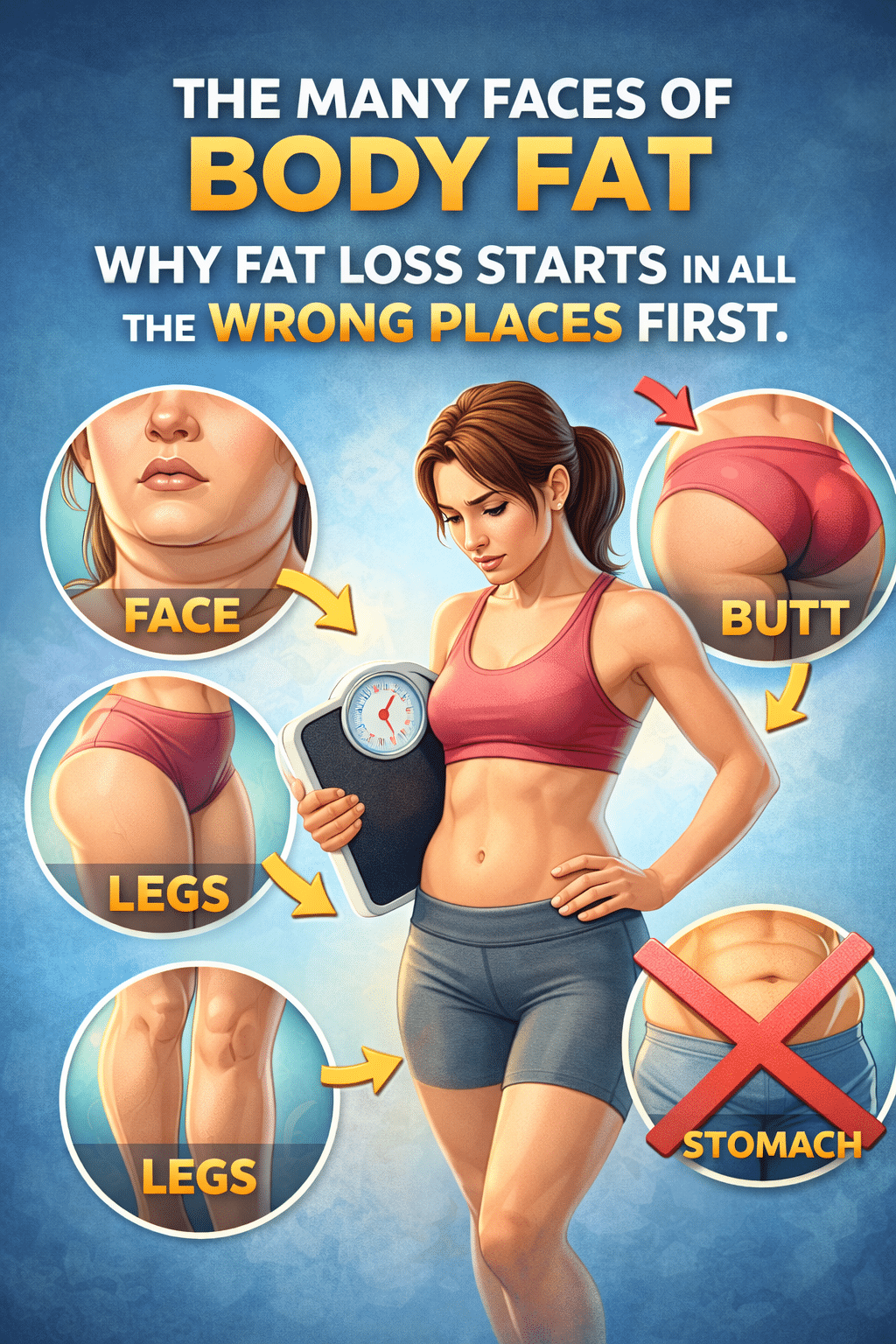
Fat loss is rarely predictable, and it often feels unfair. Many people notice the same frustrating pattern: fat disappears from the face, legs, or butt first while the stomach seems to hold on for dear life.
This phenomenon is one of the biggest reasons people become discouraged during a fitness journey. They may be doing everything right—eating well, exercising consistently, and maintaining a calorie deficit—yet the mirror and the scale don’t seem to reward them where they want it most.
Understanding the many faces of body fat can help explain why this happens and why patience is one of the most important tools in any fat-loss journey.
Body Fat Is Not Stored Equally
Body fat is stored in different regions throughout the body, and each region behaves differently. These differences are influenced by genetics, hormones, blood flow, and the density of fat cell receptors.
Some areas of the body release fat easily. Other areas resist fat loss and serve as long-term storage reserves.
Common fat storage regions include:
- Facial fat
- Arm fat
- Leg fat
- Buttocks fat
- Back fat
- Stomach fat
Each area responds differently when the body begins burning stored energy.
Facial Fat: The First to Go
One of the earliest changes many people notice during weight loss happens in the face.
Cheeks become slimmer, the jawline becomes more defined, and the overall face may appear smaller. For some people this is a welcome change. For others, it can make them feel like they are losing youthfulness or looking tired.
Facial fat tends to disappear quickly because it is metabolically active and well supplied with blood flow. This means fat in the face is easier for the body to mobilize and use for energy.
While a leaner face may indicate progress, it can also create a strange psychological effect. People may think they are losing weight everywhere except the place they want most—the stomach.
Leg Fat: Often Lost Early
The legs are another area where fat may begin to disappear early during a calorie deficit.
For athletes or individuals who train regularly, leg fat may reduce quickly because the muscles in the lower body are used frequently for movement. Walking, running, cycling, and daily activities all increase blood flow to this region.
Because fat mobilization depends heavily on circulation and muscle activity, the body may burn fat from the legs before targeting more stubborn regions.
This can sometimes frustrate people who like the shape of their legs but want to reduce fat elsewhere.
Butt Fat: A Desirable Loss for Some, Not for Others
The buttocks are a unique fat storage area because they are influenced heavily by hormones—especially estrogen.
For many individuals, especially women, fat stored in the hips and butt can create curves that are often considered aesthetically desirable.
However, during weight loss, fat may leave this area earlier than expected. When that happens, people sometimes feel like their body shape is changing in ways they did not intend.
Instead of losing the stomach fat they wanted gone, they notice:
- Smaller hips
- Reduced glute volume
- Less lower-body fullness
This can make the body look flatter even while overall body fat is decreasing.
The Most Stubborn Fat: Stomach Fat
The stomach is usually the last place many people see results.
This area tends to be the most frustrating because it holds stubborn fat cells that resist release. These fat cells contain a higher number of receptors that slow fat breakdown and reduce blood flow to the area.
As a result, when the body needs energy, it often pulls fat from other places first.
That means someone can lose several pounds of body fat while the stomach still appears almost unchanged.
Eventually, if the calorie deficit continues long enough, the body will be forced to tap into these stubborn reserves—but it may take far longer than most people expect.
Why the Body Takes Fat From the “Wrong” Places
The body does not burn fat based on appearance goals. It burns fat based on biological efficiency.
When energy is needed, the body releases fatty acids from areas that are easiest to access first.
These areas usually include:
- The face
- Arms
- Upper chest
- Legs
- Buttocks
The more resistant areas—like the stomach and lower back—are often the last to shrink.
This can make fat loss feel backward.
People often feel like the body is taking fat from places they want to keep while protecting fat from places they want to lose.
But this is simply the body’s survival mechanism at work.
The Psychological Trap of the Scale
Because fat loss occurs unevenly, relying too heavily on the scale can create a dangerous psychological trap.
Many people step on the scale every day expecting confirmation that their efforts are working. But the scale only measures total body weight, not where fat is leaving the body.
A person could lose fat in the face, legs, or arms while gaining muscle in other areas, causing the scale to barely move.
When people don’t see the number they expect, they may feel like nothing is happening.
This can lead to:
- Frustration
- Over-dieting
- Excessive cardio
- Obsessive weighing
- Abandoning healthy habits
Ironically, these reactions can damage long-term progress.
Fat Loss Is Often Invisible at First
One of the hardest realities about body fat reduction is that the first changes often happen where we cannot easily see them.
The body may be shrinking fat stores internally before visible changes appear externally.
For example:
- Fat around organs may decrease
- Fat in the upper body may reduce slightly
- Water weight may fluctuate
All of these changes can occur before stomach fat visibly shrinks.
This is why people often experience a sudden moment where the body seems to change quickly after weeks of slow progress.
In reality, the process was happening all along.
Why Patience Is the Real Secret
Fat loss is rarely linear.
The body prioritizes survival over aesthetics. That means stubborn fat will hold on until the body is confident that energy intake is consistently lower than energy needs.
Eventually, the body has no choice but to release stored fat from the areas it protected earlier.
But reaching that point requires patience.
Consistent habits over time will always outperform aggressive short-term dieting.
A Better Way to Track Progress
Instead of obsessing over the scale, it helps to track progress using multiple indicators.
Some useful measurements include:
- Waist circumference
- Body measurements
- Progress photos
- Strength improvements
- Energy levels
- Clothing fit
These indicators often reveal progress that the scale alone cannot show.
When people shift their focus from a single number to overall health and performance, their relationship with fat loss becomes much healthier.
The Truth About Body Fat
Body fat is not the enemy. It serves important roles in protecting organs, regulating hormones, and storing energy.
The challenge comes when modern lifestyles cause excess fat accumulation, especially around the abdomen.
Understanding how the body distributes and releases fat can reduce frustration and improve expectations.
Fat loss rarely happens exactly where we want it first. The body will often take fat from places we prefer to keep before addressing the areas we most want to change.
But with consistency, patience, and realistic expectations, the body eventually begins to release even the most stubborn fat stores.
The key is not letting impatience—or the scale—convince you that progress isn’t happening.
Read Next…
- Where Bodybuilders Get Their Supplements
- Muscle Growth – How Does It Affect Your Emotional Health
- Smart Eating: Weighing Your Food on a Scale for Health Benefits
- Lower Stomach Exercises – How to Get a Flatter Stomach
- How to Lose Weight Fast – The Best Three Diets
🌿 Natural Daily Support for Men and Women
I like Divine Bounty supplements because they use natural ingredients instead of synthetic formulas. For people who want a cleaner option for everyday wellness support, Divine Bounty offers quality supplements designed to fit a healthy lifestyle.
Their lineup includes the popular Men’s Multivitamin, plus other supplements for men and women such as Vitamin B Complex, Digestive Enzymes, Berberine, Magnesium Citrate, Vitamin K2 + D3, and Acetyl L-Carnitine.
The Men’s Multivitamin features 24 essential vitamins and minerals plus 5 additional blends for men, all in convenient vegetarian capsules. It is also promoted as GMO free, soy free, dairy free, wheat free, and gluten free.
🛒 Shop Divine Bounty on AmazonSponsored by Terry Clark • Amazon Affiliate Partner