Estimated reading time: 7 minutes
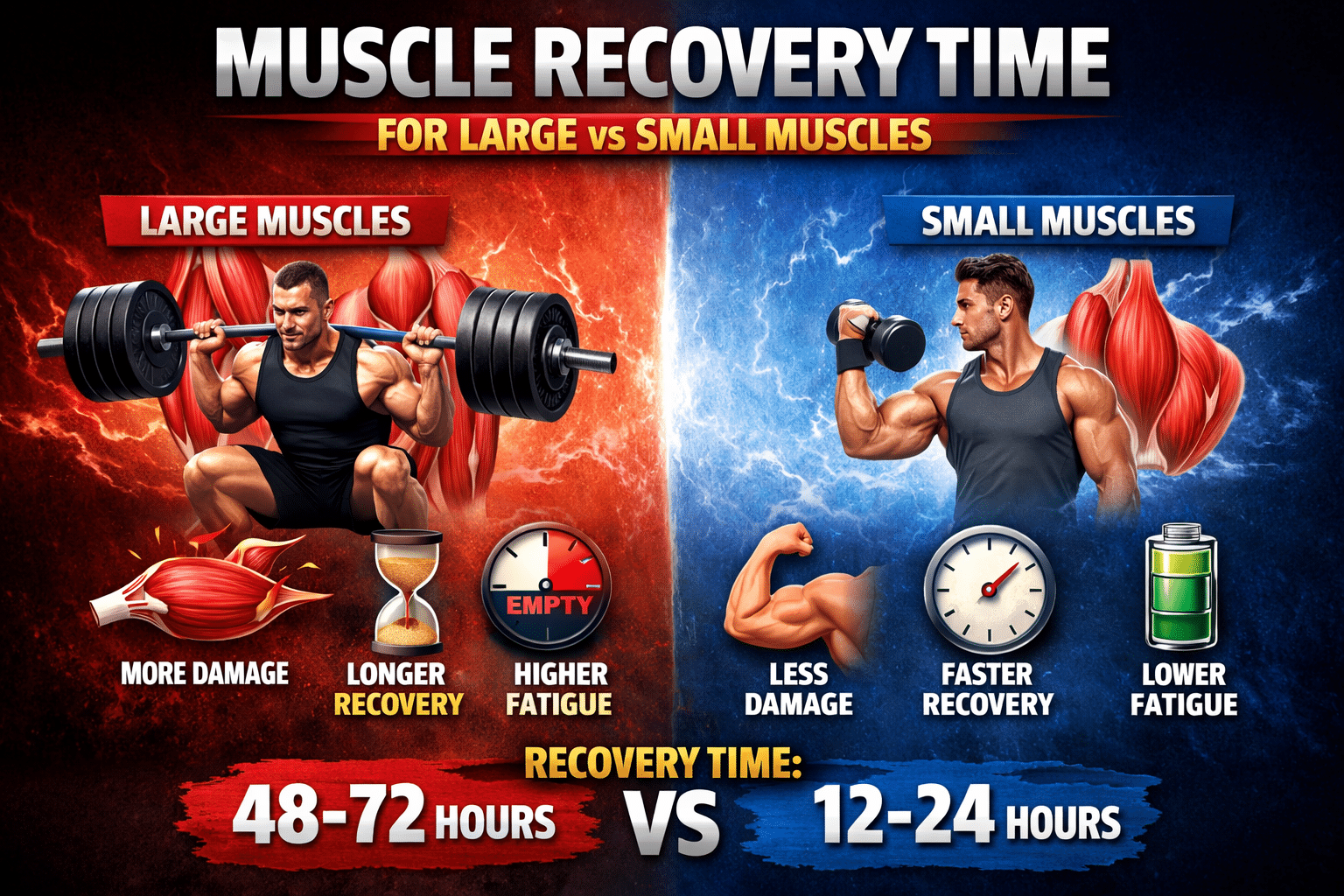
Anyone who trains seriously—whether lifting weights, performing bodyweight exercises, or competing in athletics—eventually notices an interesting pattern. Workouts that heavily involve large muscle groups like the legs, chest, or back often leave the body feeling fatigued for days, while exercises targeting smaller muscles such as the biceps or calves tend to recover much faster. This difference can be explained by considering muscle recovery time for large vs small muscles.
This is not just perception—it is rooted in physiology. The size of a muscle directly affects the amount of mechanical stress it experiences during exercise, the degree of microscopic damage that occurs, the metabolic demands placed on the body, and the time required for repair.
Understanding why larger muscles require longer recovery periods can help athletes structure smarter workouts, avoid overtraining, and maximize muscle growth.
Muscle Recovery: What Actually Happens After a Workout
To understand recovery differences, it helps to understand what occurs inside the muscle after training.
During resistance exercise, muscle fibers undergo three major processes:
- Mechanical tension
- Metabolic stress
- Microscopic muscle damage
These factors stimulate muscle adaptation.
The body responds by:
- Repairing damaged muscle fibers
- Replenishing glycogen stores
- Reducing inflammation
- Strengthening the muscle to handle future stress
This rebuilding process is known as muscle protein synthesis.
Recovery time depends on how much repair the body must complete.
Bigger Muscles Contain More Muscle Fibers
The most obvious reason large muscles take longer to recover is simply scale.
Large muscles contain significantly more fibers than smaller muscles.
Examples of large muscles include:
- Quadriceps
- Hamstrings
- Glutes
- Latissimus dorsi
- Pectorals
Smaller muscles include:
- Biceps
- Triceps
- Forearms
- Calves
When a workout stresses a large muscle group, thousands more fibers are activated and damaged compared to smaller muscles.
More damage means:
- More inflammation
- More protein repair
- More metabolic cleanup
This naturally extends recovery time.
Large Muscles Produce More Metabolic Stress
Large muscles also consume far more energy during exercise.
When performing compound movements such as:
- Squats
- Deadlifts
- Bench press
- Pull-ups
the body recruits multiple muscle groups simultaneously.
This creates massive metabolic demand, leading to:
- Glycogen depletion
- Lactate accumulation
- Increased cortisol response
- Nervous system fatigue
Because larger muscles burn more glycogen during training, the body must spend additional time restoring energy stores.
Glycogen replenishment alone can take 24–48 hours after a hard session.
Compound Exercises Damage More Tissue
Another major factor is the type of exercises used for large muscles.
Large muscle groups are typically trained using compound movements, which recruit multiple joints and muscle groups.
Examples include:
- Squats
- Deadlifts
- Rows
- Bench press
- Pull-ups
These exercises place high mechanical stress across large areas of muscle tissue.
In contrast, smaller muscles are often trained with isolation exercises such as:
- Bicep curls
- Tricep extensions
- Lateral raises
Isolation movements stress a much smaller region of muscle fibers.
Because compound lifts create more widespread muscle damage, recovery time increases.
The Nervous System Plays a Major Role
Recovery is not only about muscles—it also involves the central nervous system (CNS).
Heavy compound lifts place enormous stress on the nervous system because the brain must coordinate the firing of many muscle fibers simultaneously.
Exercises that heavily tax the CNS include:
- Deadlifts
- Squats
- Olympic lifts
- Heavy presses
When the nervous system becomes fatigued, signals between the brain and muscles weaken temporarily.
Symptoms of nervous system fatigue include:
- Reduced strength
- Slower reaction time
- Poor coordination
- Mental fatigue
Large muscle workouts require longer recovery because both muscles and the nervous system must recover.
Blood Flow and Inflammation
Large muscles experience greater inflammation after intense workouts.
Inflammation is part of the healing process.
After training, the body sends:
- Immune cells
- Nutrients
- Oxygen
to damaged tissues.
Because larger muscles contain more tissue, the inflammatory response is greater.
This can produce delayed onset muscle soreness (DOMS), which typically peaks:
- 24–48 hours after exercise
- Sometimes lasting up to 72 hours
Smaller muscles experience less widespread damage and therefore produce a milder inflammatory response.
Hormonal Response to Large Muscle Training
Training large muscle groups triggers a much larger hormonal response.
Exercises involving the legs and back can stimulate increases in:
- Testosterone
- Growth hormone
- Insulin-like growth factor (IGF-1)
While these hormones support muscle growth, they also reflect the intensity of systemic stress placed on the body.
Greater hormonal shifts require additional recovery time for the body to return to baseline.
Energy Expenditure and Whole-Body Fatigue
Training large muscle groups burns significantly more calories.
For example:
- A heavy squat session may burn hundreds of calories
- A bicep workout burns far fewer
Because large muscle workouts drain more energy reserves, the body requires more time to restore balance.
This includes:
- Rehydration
- Electrolyte balance
- Glycogen restoration
- Hormonal stabilization
These systemic recovery processes extend the recovery window.
Training Volume Is Usually Higher for Big Muscles
Another practical reason for longer recovery times is training volume.
Athletes usually perform more sets and exercises for large muscle groups.
A typical leg workout may include:
- Squats
- Lunges
- Leg press
- Romanian deadlifts
- Leg curls
- Calf raises
In contrast, a bicep workout may include only:
- Barbell curls
- Dumbbell curls
- Hammer curls
More exercises mean more total work performed, which increases recovery time.
The Role of Muscle Fiber Types
Muscles contain different fiber types:
Type I Fibers (Slow-Twitch)
Characteristics:
- High endurance
- Resistant to fatigue
- Faster recovery
Type II Fibers (Fast-Twitch)
Characteristics:
- Produce more force
- Fatigue faster
- Require longer recovery
Large muscle groups often contain a higher proportion of fast-twitch fibers, especially in powerful muscles like the glutes and quadriceps.
Because fast-twitch fibers experience more damage during heavy training, they require longer recovery.
How Age Affects Recovery
Recovery time increases with age due to changes in:
- Hormone levels
- Protein synthesis rates
- Circulation
- Nervous system resilience
However, consistent training can maintain strong recovery capacity.
Many athletes in their 50s and beyond—especially those who maintain disciplined nutrition, hydration, and sleep—can recover effectively even after intense workouts.
Recovery strategies become more important with age.
Strategies to Improve Recovery
While larger muscles naturally require longer recovery, several strategies can accelerate the process.
Sleep
Sleep is the most powerful recovery tool.
During deep sleep:
- Growth hormone is released
- Muscle repair accelerates
- Nervous system recovery occurs
Athletes should aim for 7–9 hours of quality sleep.
Nutrition
Muscle recovery requires adequate nutrients.
Important components include:
Protein
Supports muscle repair and growth.
Carbohydrates
Restore glycogen stores.
Healthy fats
Support hormone production.
Hydration
Improves circulation and nutrient delivery.
Active Recovery
Light activity can improve blood flow and reduce soreness.
Examples include:
- Walking
- Light cycling
- Stretching
- Mobility work
Active recovery helps deliver nutrients to healing tissues.
Cold and Heat Therapy
Athletes often use contrast therapy to manage inflammation.
Options include:
- Cold baths
- Ice packs
- Sauna
- Heat therapy
These methods can reduce soreness and improve circulation.
Smart Training Splits
Proper workout scheduling allows muscles to recover.
Common training splits include:
Upper body / lower body split
Push / pull / legs split
Full body workouts with rest days
Rotating muscle groups ensures no single area is overworked.
Signs a Muscle Has Not Fully Recovered
Training a muscle before it has recovered can increase injury risk.
Common warning signs include:
- Persistent soreness
- Reduced strength
- Joint pain
- Fatigue
- Poor performance
When these symptoms appear, additional rest may be necessary.
Why Recovery Is Essential for Muscle Growth
Many people believe muscles grow during workouts.
In reality, muscles grow during recovery.
Exercise only creates the stimulus.
The body builds stronger muscle fibers during rest.
Skipping recovery time can lead to:
- Overtraining
- Reduced progress
- Increased injury risk
Understanding recovery is therefore essential for long-term fitness success.
Conclusion
Larger muscles take longer to recover because they experience greater mechanical stress, more microscopic damage, larger metabolic demands, and increased nervous system fatigue during training. Their greater size means more fibers must be repaired, more glycogen must be restored, and more inflammation must resolve before the muscle can perform at full capacity again.
Smaller muscles, while still capable of fatigue and soreness, simply require less repair work and therefore bounce back faster.
For athletes and fitness enthusiasts, respecting recovery time is not a sign of weakness—it is a key component of progress. Strategic training, proper nutrition, quality sleep, and smart scheduling ensure that large muscles rebuild stronger, allowing the body to continue improving over time.
Read Next…
- How to Increase Natural Testosterone Levels
- How Bodybuilders Use Strength Training to Cause Muscle Growth
- How To Build a Balanced Post-Workout Recovery Routine
- Tips for Relaxing and Recovering Between Workouts
- 7 Signs You’re Not Recovering From Your Workouts
🌿 Natural Daily Support for Men and Women
I like Divine Bounty supplements because they use natural ingredients instead of synthetic formulas. For people who want a cleaner option for everyday wellness support, Divine Bounty offers quality supplements designed to fit a healthy lifestyle.
Their lineup includes the popular Men’s Multivitamin, plus other supplements for men and women such as Vitamin B Complex, Digestive Enzymes, Berberine, Magnesium Citrate, Vitamin K2 + D3, and Acetyl L-Carnitine.
The Men’s Multivitamin features 24 essential vitamins and minerals plus 5 additional blends for men, all in convenient vegetarian capsules. It is also promoted as GMO free, soy free, dairy free, wheat free, and gluten free.
🛒 Shop Divine Bounty on AmazonSponsored by Terry Clark • Amazon Affiliate Partner