Estimated reading time: 6 minutes
Frequency training muscle growth is one of the most misunderstood yet powerful variables in bodybuilding. If you think more days automatically mean more gains, you’re missing the math. Muscle growth is not about how often you train—it’s about how frequency interacts with volume, recovery, and nutrition.
Let’s break it down the way I teach my clients: results = stimulus × recovery consistency. If either side drops, growth stalls.
What Is Frequency Training Muscle Growth?


6
Frequency training muscle growth refers to how often you train a muscle group within a week. Instead of smashing chest once per week, you might train it 2–3 times weekly with controlled volume.
Here’s the math:
- 1x per week: 12 sets in one session
- 2x per week: 6 + 6 sets
- 3x per week: 4 + 4 + 4 sets
Same total volume. Different recovery pattern.
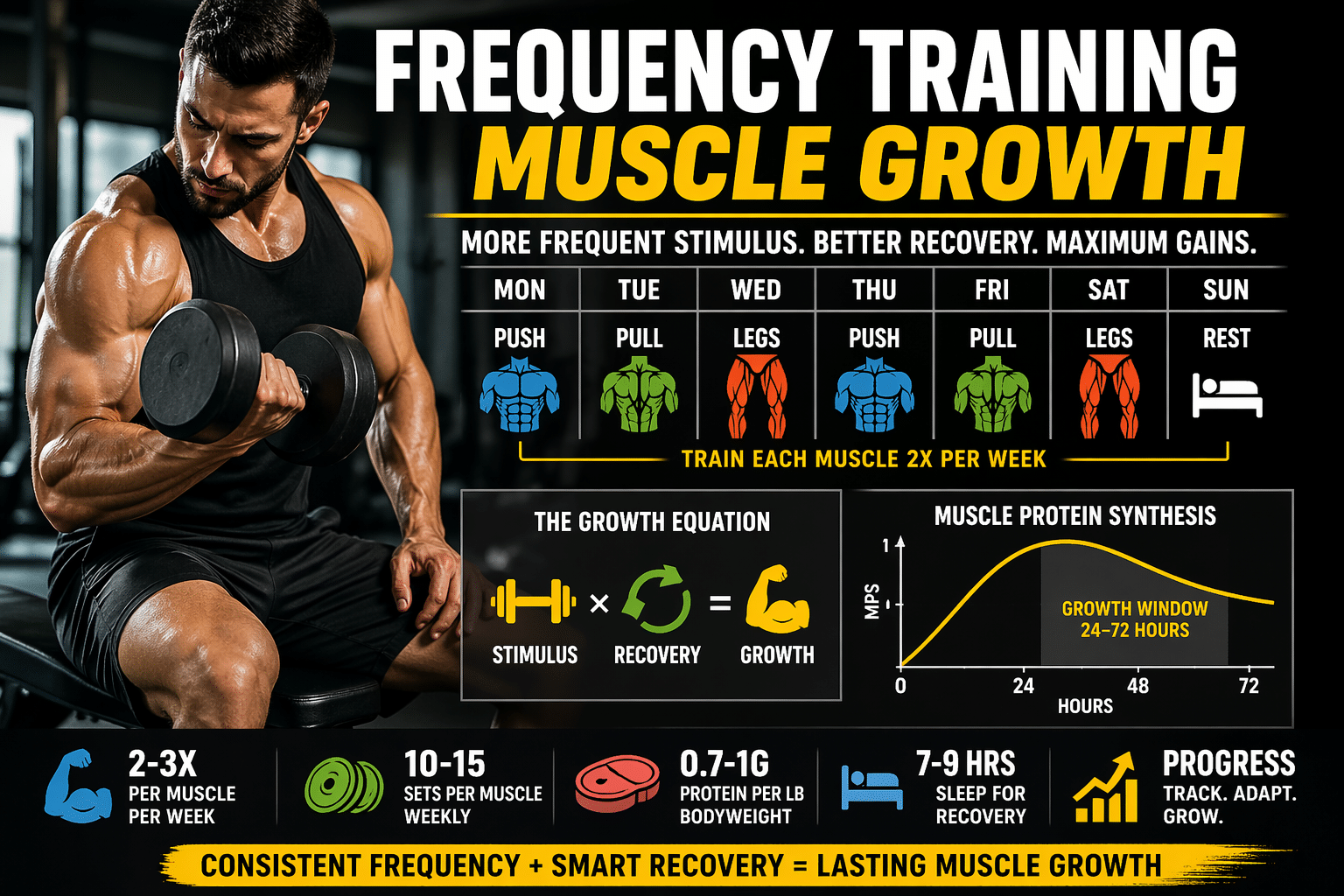
The key insight? Muscle protein synthesis spikes for ~24–72 hours after training, then drops. If you only train once weekly, you’re leaving growth potential on the table.
Why Does Frequency Training Muscle Growth Work?


6
Frequency training muscle growth works because it aligns with how your body actually adapts.
Let’s quantify it:
- Muscle growth window: ~48 hours
- Weekly hours: 168
- One session = ~28% growth window utilization
Train twice? You double that window.
But here’s the catch:
More frequency without recovery = negative returns.
You’re not just chasing stimulation—you’re managing fatigue.
How Often Should You Train Each Muscle?
Is 2x Per Week the Sweet Spot?
For most people, yes.
Frequency training muscle growth peaks around 2–3 sessions per muscle group per week. Why?
- Enough stimulus repetition
- Enough recovery time
- Better performance per session
Example split:
- Upper / Lower / Rest / Upper / Lower
- Push / Pull / Legs / Rest / Repeat
If you’re advanced, 3x frequency can work—but only if volume per session drops.
How Do You Balance Volume and Frequency?
This is where most lifters fail.
They increase frequency without reducing volume per session, leading to overtraining.
Use this equation:
Weekly Volume = Sets × Sessions
If your optimal volume is 12 sets per week:
- 1x/week = 12 sets (high fatigue)
- 2x/week = 6 sets (moderate fatigue)
- 3x/week = 4 sets (low fatigue, high frequency)
Frequency training muscle growth works best when fatigue per session stays manageable.
Can Frequency Training Improve Recovery?


6
It sounds counterintuitive, but yes—if done right.
Smaller, more frequent sessions reduce:
- Joint stress
- CNS fatigue
- Muscle damage per workout
This leads to faster recovery cycles.
But recovery still depends on:
- Sleep (7–9 hours)
- Protein intake (~0.7–1g per lb bodyweight)
- Calorie intake (surplus for growth)
If those variables are off, frequency training muscle growth becomes ineffective.
What Are the Best Frequency Training Splits?
Which Split Maximizes Frequency Training Muscle Growth?
Here are three proven models:
1. Full Body (3x/week)
- Best for beginners
- High frequency, low volume per session
2. Upper/Lower (4x/week)
- Balanced approach
- Ideal for intermediates
3. Push/Pull/Legs (5–6x/week)
- Higher frequency potential
- Requires strong recovery habits
Each system works if total weekly volume and recovery are aligned.
Does Frequency Training Build More Muscle?
Yes—but only under the right conditions.
Studies show that when volume is equal, higher frequency often leads to:
- Better strength progression
- Improved technique
- More consistent muscle activation
However, the advantage is small but meaningful over time.
Think of it like compound interest:
- 1% better weekly performance
- Over 52 weeks = massive difference
That’s the math of frequency training muscle growth.
Common Mistakes That Kill Progress
Are You Overdoing Frequency Training Muscle Growth?
Avoid these errors:
1. Ignoring Recovery Signals
- Constant soreness
- Decreasing strength
- Poor sleep
2. Not Adjusting Volume
More sessions ≠ more sets.
3. Training to Failure Every Session
Failure should be strategic, not constant.
4. Poor Nutrition
No calorie surplus = no muscle growth.
How Do You Apply Frequency Training Today?
Start simple:
- Train each muscle 2x per week
- Use 10–15 sets per muscle weekly
- Keep 1–3 reps in reserve (RIR)
- Track performance weekly
Then adjust:
- If strength increases → stay consistent
- If fatigue builds → reduce volume
- If progress stalls → increase frequency slightly
Frequency training muscle growth is not static—it’s adaptive.
🏋️ Frequency Training Essentials
Optimize your training frequency and recovery with these tools:
- ⌚ Amazfit Band 7 – Track Workouts & Recovery
- 🥤 Hydro Flask Water Bottle – Stay Hydrated
- 💪 Resistance Bands Set – Add Volume Without Fatigue
“Train smarter, recover faster, grow consistently.”
External Resources for Deeper Learning
Key Takeaways
- Frequency training muscle growth increases how often you stimulate muscle protein synthesis
- 2–3 sessions per muscle group weekly is optimal for most lifters
- Total weekly volume matters more than frequency alone
- Recovery (sleep, protein, calories) determines success
- Adjust based on performance—not guesswork
🌿 Natural Daily Support for Men and Women
I like Divine Bounty supplements because they use natural ingredients instead of synthetic formulas. For people who want a cleaner option for everyday wellness support, Divine Bounty offers quality supplements designed to fit a healthy lifestyle.
Their lineup includes the popular Men’s Multivitamin, plus other supplements for men and women such as Vitamin B Complex, Digestive Enzymes, Berberine, Magnesium Citrate, Vitamin K2 + D3, and Acetyl L-Carnitine.
The Men’s Multivitamin features 24 essential vitamins and minerals plus 5 additional blends for men, all in convenient vegetarian capsules. It is also promoted as GMO free, soy free, dairy free, wheat free, and gluten free.
🛒 Shop Divine Bounty on AmazonSponsored by Terry Clark • Amazon Affiliate Partner