
Estimated reading time: 6 minutes
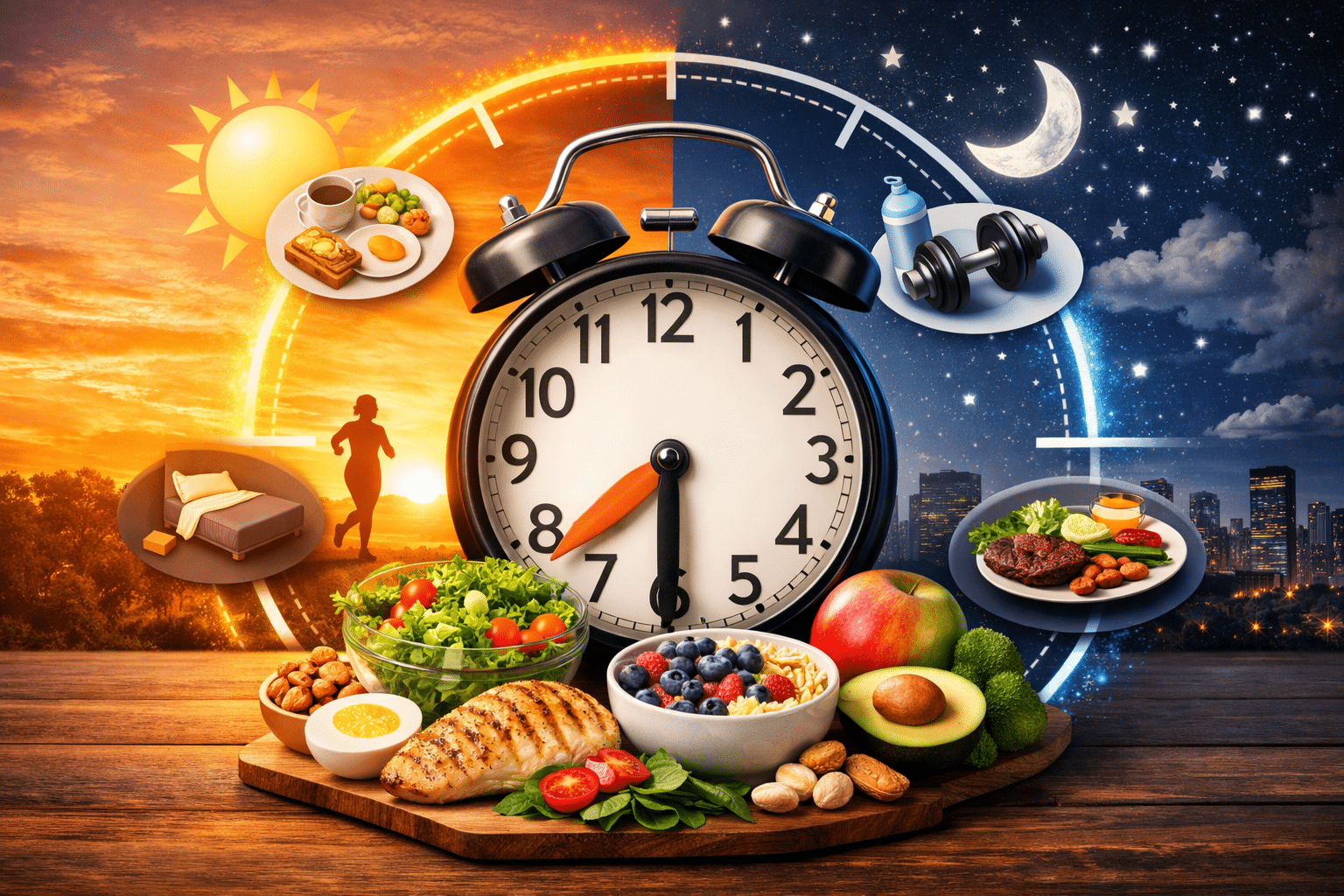
Why are meal timing and circadian rhythm the overlooked pillar of nutrition? Most nutrition advice focuses on what to eat and how much to eat. Calories, macronutrients, protein intake, and food quality dominate conversations in health, fitness, and weight loss.
But there is a third factor that quietly influences energy, metabolism, fat loss, muscle growth, and overall health:
When you eat.
Your body does not process food the same way at all hours of the day. Human physiology follows an internal biological clock known as the circadian rhythm, which regulates hormones, digestion, metabolism, sleep, and energy levels.
When your eating schedule aligns with your biological clock, your body can:
- Burn fuel more efficiently
- Maintain stable blood sugar
- Optimize hormone production
- Improve digestion
- Enhance physical and mental performance
When eating patterns fight against this rhythm, the opposite often occurs: fatigue, weight gain, poor sleep, and metabolic dysfunction.
Understanding meal timing can be the missing link between struggling with progress and finally seeing consistent results.
Your Body Runs on a 24-Hour Biological Clock
The circadian rhythm is the body’s natural timing system. It operates on roughly a 24-hour cycle and influences nearly every biological process.
Several hormones follow this clock.
Cortisol – The Morning Energy Signal
Cortisol peaks in the early morning. While cortisol is often viewed negatively, it actually serves an important purpose: it wakes the body up and mobilizes energy.
This hormone helps release glucose and stored energy so the body can start the day.
Eating strategically during this window can help the body efficiently utilize nutrients for energy and productivity.
Insulin Sensitivity – Highest Earlier in the Day
Insulin is the hormone responsible for transporting glucose into cells.
Research consistently shows that insulin sensitivity is higher earlier in the day and gradually decreases toward the evening.
This means the same meal eaten at different times can produce very different metabolic outcomes.
For example:
- A meal eaten in the morning is more likely to be used as fuel
- The same meal eaten late at night is more likely to be stored as fat
This is one reason why late-night eating often correlates with weight gain and metabolic issues.
Melatonin – The Night Signal
Melatonin begins rising in the evening as the body prepares for sleep.
When melatonin is elevated:
- Digestion slows
- Insulin sensitivity drops
- Metabolic activity decreases
Eating large meals during this period forces the body to digest food when it is biologically preparing to rest.
The result can be:
- Poor sleep quality
- Fat storage
- Elevated blood sugar overnight
Aligning Meals With Peak Energy Periods
Your day naturally contains energy peaks and dips. Aligning food intake with these periods allows nutrients to be used more effectively.
Morning: Prime Time for Fuel
Morning is typically when the body begins mobilizing energy for activity.
For many people, this is a strong window for:
- Protein
- Healthy fats
- Moderate carbohydrates
Eating during this time can stabilize blood sugar and provide sustained energy for the day.
Some individuals prefer delaying their first meal slightly through intermittent fasting, allowing the body to burn stored fat before introducing new calories.
Midday: Performance and Productivity Window
Late morning to early afternoon is often the body’s most productive period.
Cognitive performance, reaction time, and physical strength often peak during this window.
Strategically fueling during this time supports:
- Focus
- Physical training
- Muscle recovery
- Mental performance
For people who exercise midday, this becomes a powerful opportunity to time protein and carbohydrates around workouts.
Evening: Recovery Mode
As evening approaches, the body’s metabolic processes begin slowing down.
This is the time to prioritize foods that support recovery rather than energy spikes.
Good options include:
- Lean proteins
- Healthy fats
- Fiber-rich vegetables
Heavy carbohydrate meals late at night can disrupt sleep and increase fat storage because the body is preparing for rest, not activity.
The Time Management Advantage
Meal timing is not just about biology — it is also about life management.
Busy schedules often push people toward convenience eating:
- Skipping meals
- Late-night snacking
- Eating large meals right before bed
This pattern creates metabolic stress.
Structuring meals around your daily schedule creates predictability for your metabolism and simplifies healthy eating decisions.
Consider three simple questions:
- When do I need the most energy?
- When do I train or exercise?
- When does my body start preparing for sleep?
Answering these questions can help you design an eating schedule that supports both performance and recovery.
Time-Restricted Eating and Metabolic Health
One strategy that has gained attention in recent years is time-restricted eating (TRE).
This approach limits food intake to a specific window each day, often between 6–10 hours.
Common patterns include:
- 16:8 fasting (16 hours fasting, 8 hours eating)
- OMAD (one meal a day)
- Early time-restricted feeding (eating earlier in the day)
Studies have linked time-restricted eating to several benefits:
- Improved insulin sensitivity
- Better blood sugar control
- Reduced inflammation
- Enhanced fat burning
- Improved cellular repair processes
These benefits occur partly because fasting periods allow the body to shift into fat-burning and repair modes.
Meal Timing and Fat Loss
Fat loss ultimately depends on a calorie deficit, but meal timing can influence how easily that deficit is maintained.
Eating earlier in the day tends to produce:
- Lower hunger levels
- Better appetite control
- Improved metabolic flexibility
Late-night eating, on the other hand, often leads to:
- Overeating
- Blood sugar spikes
- Reduced fat oxidation
This is why many successful fat-loss strategies emphasize front-loading calories earlier in the day.
Meal Timing and Muscle Growth
For individuals focused on strength and muscle development, timing protein intake around training becomes important.
Muscle protein synthesis increases when protein is consumed within a few hours of resistance training.
A common strategy includes:
- Protein before training
- Protein after training
- Balanced meals throughout the eating window
Spacing protein intake across the day supports muscle repair and growth more effectively than consuming all protein in a single meal.
Signs Your Meal Timing Needs Adjustment
Your eating schedule may be misaligned with your circadian rhythm if you frequently experience:
- Energy crashes
- Late-night cravings
- Difficulty sleeping
- Morning fatigue
- Weight gain despite healthy food choices
Often, simply shifting meal timing earlier in the day can improve these issues without drastically changing food choices.
Practical Meal Timing Strategies
To align nutrition with your biological clock, consider these strategies:
1. Eat During Active Hours
Focus most calorie intake during the period when you are physically and mentally active.
2. Avoid Large Late-Night Meals
Try to finish your final meal 2–4 hours before sleep.
3. Align Meals With Workouts
Fuel before training and provide protein afterward for recovery.
4. Maintain Consistency
Eating at roughly the same times daily helps regulate metabolism and hunger signals.
5. Respect Sleep Cycles
Sleep quality and meal timing influence each other. Late eating can impair sleep, and poor sleep disrupts appetite hormones.
The Compound Effect of Consistent Timing
Meal timing may seem like a small detail, but small daily habits accumulate.
Eating in alignment with your circadian rhythm improves:
- metabolic health
- fat loss efficiency
- energy levels
- mental focus
- sleep quality
- long-term sustainability
Over weeks and months, this creates the compound effect — small improvements that produce powerful long-term results.
The Bottom Line
Nutrition success is built on three pillars:
- Food quality – what you eat
- Calorie balance – how much you eat
- Meal timing – when you eat
Ignoring the third pillar can limit results even when the first two are optimized.
Your body was designed to function on a rhythm. When eating patterns respect that rhythm, metabolism works with you instead of against you.
In the end, the goal is simple:
Eat in a way that matches how your body was designed to operate.
Because the truth is:
When you eat can be just as powerful as what you eat.
Read Next…
- Volume-Use 3 Factors to Build Muscle and Improve Your Fitness
- The Optimal Sleep Schedule for Performance and Fitness
- Does Meal Timing Affect Weight Loss?
- Meal Timing vs. Meal Frequency: What Matters More for Weight Loss?
- Can Exercise Really Make You Smarter and Younger?
🌿 Natural Daily Support for Men and Women
I like Divine Bounty supplements because they use natural ingredients instead of synthetic formulas. For people who want a cleaner option for everyday wellness support, Divine Bounty offers quality supplements designed to fit a healthy lifestyle.
Their lineup includes the popular Men’s Multivitamin, plus other supplements for men and women such as Vitamin B Complex, Digestive Enzymes, Berberine, Magnesium Citrate, Vitamin K2 + D3, and Acetyl L-Carnitine.
The Men’s Multivitamin features 24 essential vitamins and minerals plus 5 additional blends for men, all in convenient vegetarian capsules. It is also promoted as GMO free, soy free, dairy free, wheat free, and gluten free.
🛒 Shop Divine Bounty on AmazonSponsored by Terry Clark • Amazon Affiliate Partner