Estimated reading time: 4 minutes
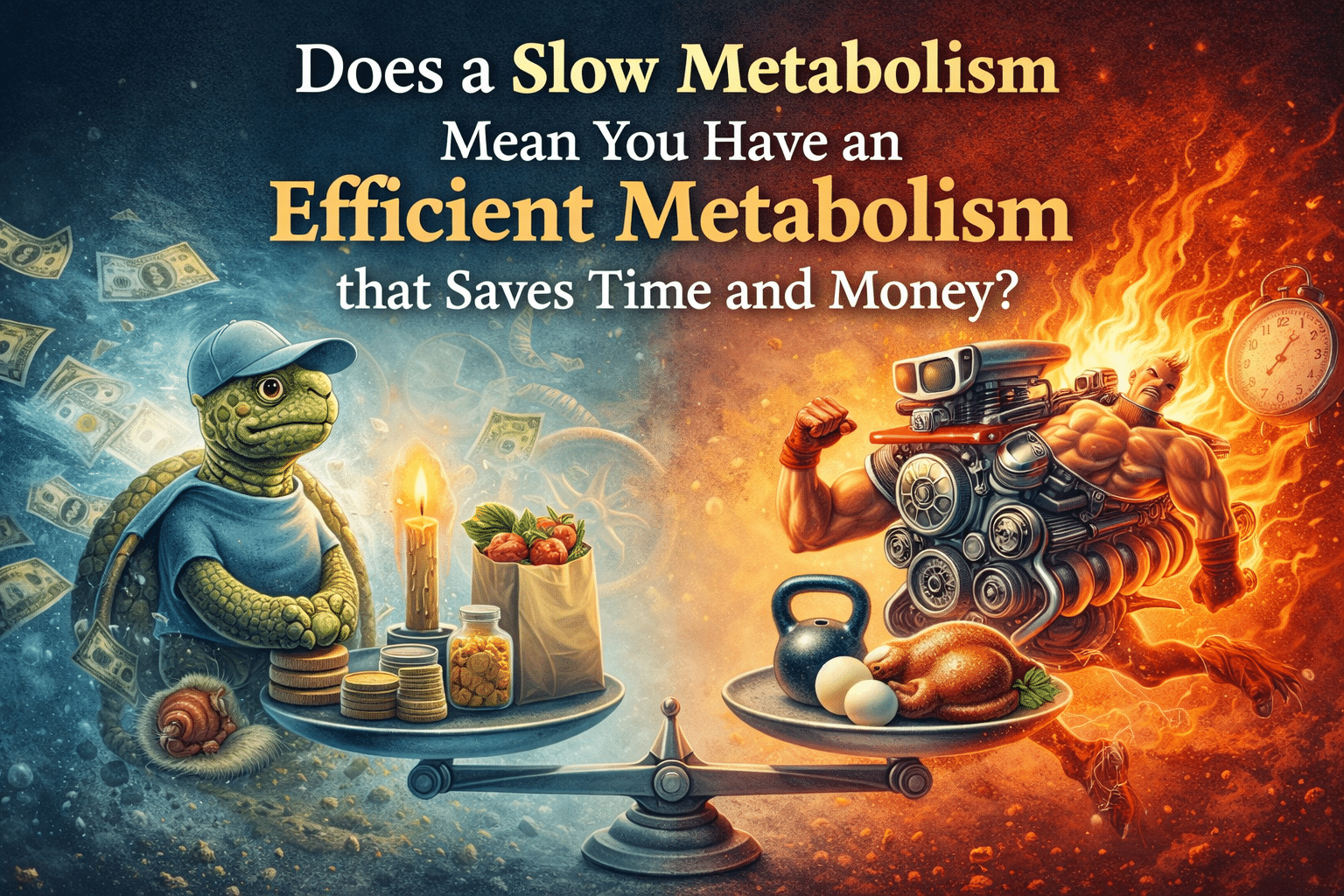
For years, people have blamed weight gain on a “slow metabolism.”
It’s become the villain of fat loss conversations.
But here’s the real question:
If your body burns fewer calories…
Doesn’t that technically mean it’s more efficient?
And if it uses less energy…
Doesn’t that save food, time, and even money?
The answer isn’t as simple as yes or no — but it’s fascinating.
What Is Metabolism, Really?
Your metabolism is the total amount of energy your body uses to:
- Keep your heart beating
- Power your brain
- Repair tissues
- Digest food
- Move your muscles
- Regulate hormones
Your Basal Metabolic Rate (BMR) is the number of calories you burn at rest just to stay alive.
A “slow metabolism” usually means a lower BMR.
But lower compared to what?
Body size matters. Muscle mass matters. Hormones matter. Age matters.
Slow vs Efficient: Not the Same Thing
Here’s where people get confused.
Slow metabolism = burns fewer calories per day.
Efficient metabolism = produces more usable energy with less waste.
Those are not identical.
An efficient engine converts fuel into movement with minimal waste heat.
A slow engine simply runs at lower RPMs.
They can overlap — but they are not automatically the same.
When a Slow Metabolism Is Efficient
In certain situations, a slower metabolism is actually adaptive and smart.
1. Survival Conditions
Historically, humans who could:
- Conserve calories
- Store energy easily
- Burn fewer calories at rest
…were more likely to survive famine.
This is sometimes called the “thrifty gene” hypothesis.
From an evolutionary standpoint, conserving energy = efficiency.
2. Smaller Bodies Require Less Fuel
If someone weighs less or has less muscle, they burn fewer calories.
That’s not dysfunction. That’s physics.
A compact system simply requires less fuel to operate.
That absolutely saves food costs over a lifetime.
3. Metabolic Adaptation After Dieting
When someone loses weight, their metabolism slows slightly.
The body becomes more energy-efficient to prevent starvation.
That’s not broken. That’s protective biology.
When a Slow Metabolism Is Not Efficient
Here’s the other side.
A truly suppressed metabolism can be problematic.
Signs of metabolic dysfunction:
- Chronic fatigue
- Low thyroid function
- Hormonal imbalance
- Low body temperature
- Muscle loss
- Brain fog
In this case, the body isn’t optimizing — it’s underperforming.
There’s a difference between:
- Conserving energy
- Lacking metabolic power
The Role of Muscle Mass
Muscle tissue burns more calories than fat tissue.
People with more lean mass:
- Burn more calories at rest
- Process glucose more efficiently
- Handle stress better
- Age better metabolically
A higher metabolism often correlates with metabolic flexibility — the ability to switch between carbs and fat for fuel.
That’s efficiency in a modern environment.
The Time and Money Angle
Now let’s answer the original question directly.
Does a slower metabolism save money?
Technically, yes.
If you burn 1,800 calories per day instead of 2,600:
- You need less food.
- Your grocery bill is lower.
- You may require fewer calories to maintain weight.
Over decades, that adds up.
But here’s the catch:
In a world of food abundance, a slower metabolism may also:
- Make fat loss harder
- Store excess calories more easily
- Reduce dietary flexibility
So while it may save calories, it may cost you effort when trying to lean down.
The Greenland Shark Effect
Take the Greenland shark for example.
It lives in freezing Arctic waters and can live 400+ years.
Why?
- Extremely slow metabolism
- Cold environment
- Slow growth
But it also:
- Moves slowly
- Reproduces slowly
- Takes over 100 years to mature
Slow metabolism increases lifespan in some species.
But humans don’t live in Arctic oceans.
We live in a high-performance world.
What Actually Matters More Than “Slow”
The real gold standard isn’t slow.
It’s metabolic flexibility.
That means:
- You can burn fat efficiently.
- You can process carbs efficiently.
- You can increase calorie burn when active.
- You can conserve energy when resting.
- You can recover quickly.
That’s adaptive efficiency.
Can You Improve Metabolic Efficiency?
Yes — and it’s not about slowing it down.
1. Strength Training
Build muscle.
Muscle is metabolically active tissue.
2. Protein Intake
Higher protein increases thermic effect of food.
3. Sleep Optimization
Poor sleep suppresses metabolic health.
4. Cold Exposure (mild)
Stimulates brown fat activity.
5. Movement Throughout the Day
NEAT (non-exercise activity thermogenesis) adds up massively.
The Real Takeaway
A slow metabolism does not automatically mean you have an efficient metabolism.
It might mean:
- You’re smaller.
- You’ve dieted.
- Your body adapted.
- Or you’re under-fueled.
Efficiency isn’t about burning fewer calories.
It’s about:
- Burning the right fuel at the right time.
- Repairing damage effectively.
- Maintaining muscle.
- Regulating hormones.
- Staying metabolically flexible.
The most powerful metabolism isn’t the slowest.
It’s the most adaptable.
Read Next…
- The Science of Efficient Workouts: Revealing the Ideal Gym Time
- Nutrition Efficiency for Growth: Maximizing Your Diet for Optimal Muscle Gain
- How To Save Money with a Healthy Lifestyle
- A Comprehensive Guide to the Barbell Front Squat
- Boost Metabolism – How to Best Use Your Diet to Get Results
🌿 Natural Daily Support for Men and Women
I like Divine Bounty supplements because they use natural ingredients instead of synthetic formulas. For people who want a cleaner option for everyday wellness support, Divine Bounty offers quality supplements designed to fit a healthy lifestyle.
Their lineup includes the popular Men’s Multivitamin, plus other supplements for men and women such as Vitamin B Complex, Digestive Enzymes, Berberine, Magnesium Citrate, Vitamin K2 + D3, and Acetyl L-Carnitine.
The Men’s Multivitamin features 24 essential vitamins and minerals plus 5 additional blends for men, all in convenient vegetarian capsules. It is also promoted as GMO free, soy free, dairy free, wheat free, and gluten free.
🛒 Shop Divine Bounty on AmazonSponsored by Terry Clark • Amazon Affiliate Partner