

Corporate wellness ROI (return on investment) is about proving that employee health programs don’t just cost money—they make money. Just like in fitness, where every rep and calorie adds up to results, every dollar invested in wellness multiplies into productivity, lower healthcare costs, and reduced turnover.
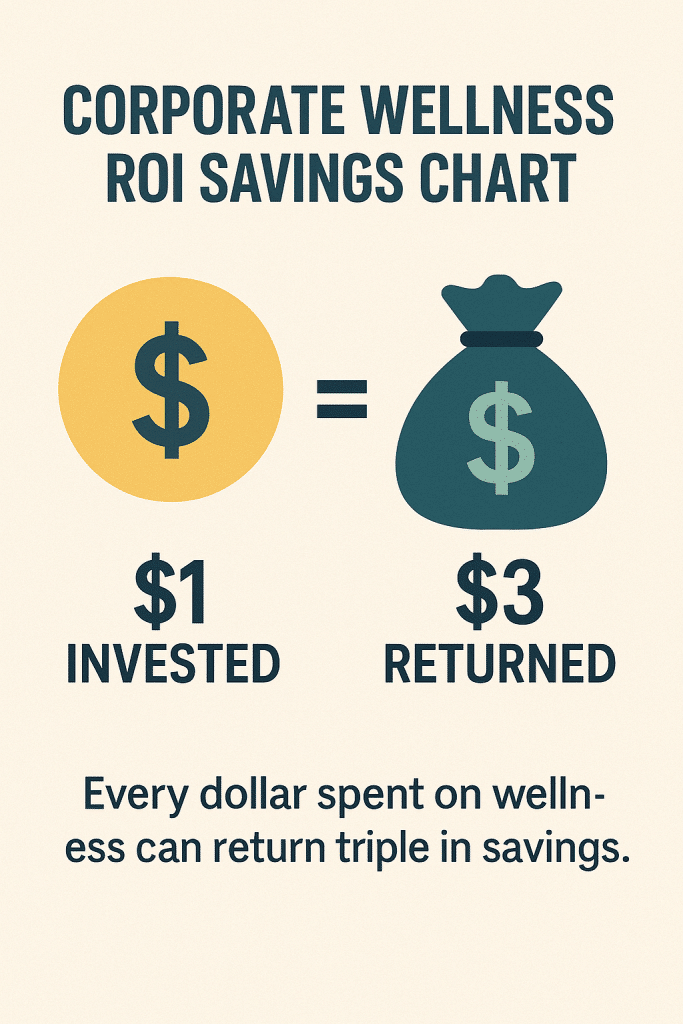
According to Harvard research, workplace wellness programs return an average of $3 in healthcare savings for every $1 spent. That’s a 300% ROI.
What Is Corporate Wellness ROI?
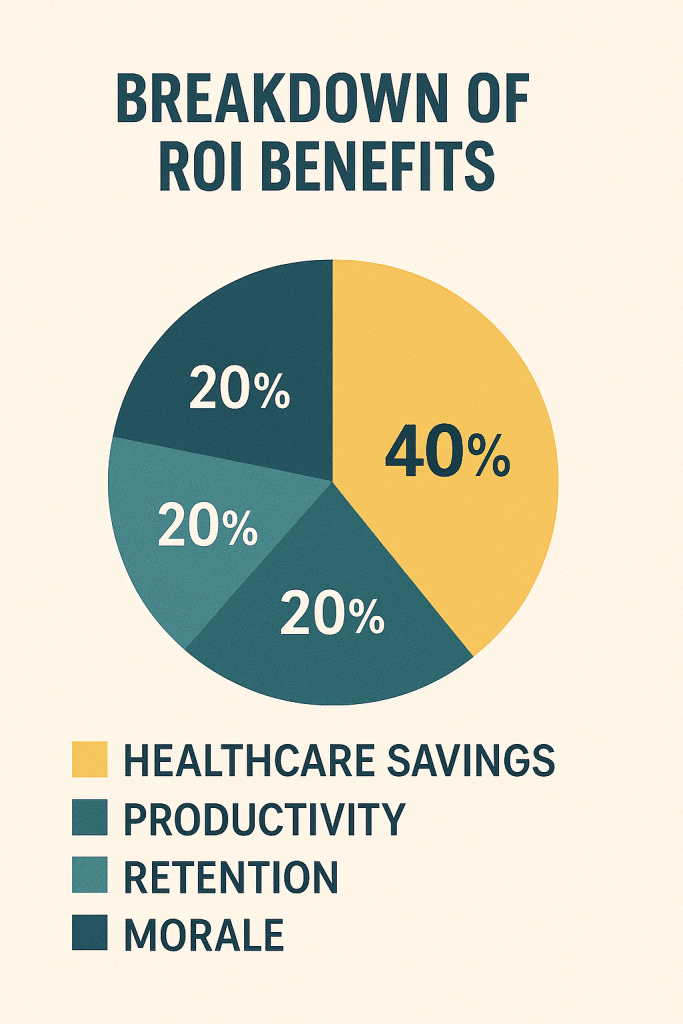
Corporate wellness ROI measures the financial impact of health initiatives. This includes:
- Reduced absenteeism – fewer sick days
- Lower healthcare costs – fewer claims
- Higher productivity – more output per hour
- Retention benefits – reduced hiring/training expenses
Think of it like calories in and calories out: invest in health inputs, get measurable performance outputs.
How Do Companies Measure ROI in Wellness?
- Healthcare claims data – track reductions in chronic conditions
- Absenteeism records – fewer sick days per employee
- Turnover rates – retention boosts from happy employees
- Engagement surveys – measure stress, focus, and job satisfaction
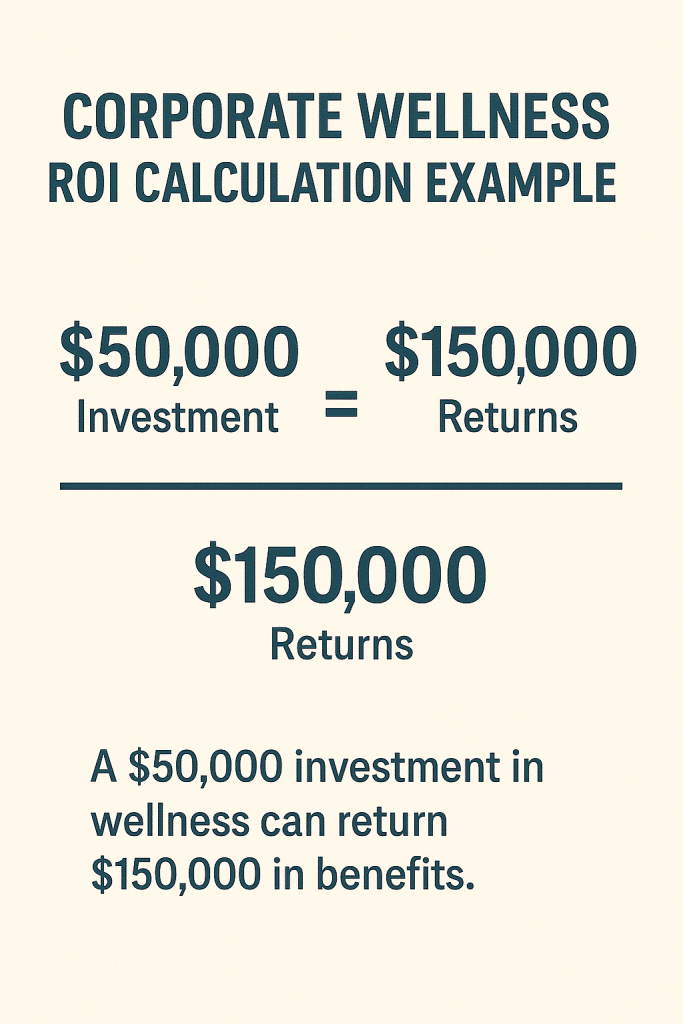
Mathematically: ROI=Program Benefits−Program CostsProgram Costs×100ROI = \frac{\text{Program Benefits} – \text{Program Costs}}{\text{Program Costs}} \times 100ROI=Program CostsProgram Benefits−Program Costs×100
If a $50,000 program saves $150,000 in healthcare costs and lost productivity, ROI = 200%.
When Should a Company Invest in Wellness?
- When healthcare costs are rising
- When absenteeism exceeds industry average
- When turnover drains profit margins
- When employee surveys show stress and burnout
Wellness programs act like preventative training: they’re cheaper than rehab after injury.
Top Corporate Wellness Strategies That Deliver ROI
- Onsite or virtual fitness programs
- Healthy cafeteria and snack options
- Mental health resources (therapy, mindfulness apps)
- Standing desks and ergonomic chairs
- Incentives for healthy behaviors
Each strategy compounds results like progressive overload in weight training—the longer you stay consistent, the bigger the returns.
Downsides of Ignoring Corporate Wellness ROI
Companies that ignore wellness face:
- Higher insurance premiums
- Rising employee burnout
- Lower engagement and productivity
- Difficulty attracting top talent
It’s like skipping warm-ups: short-term savings, long-term injuries.
🛒 Affiliate Block
🏢 Corporate Wellness Essentials
Boost ROI by equipping employees with tools that support daily wellness:
- 💺 Ergonomic Office Chair – Improve Posture and Focus
- 🥤 Hydro Flask – Encourage Hydration at Work
- 📱 Mindfulness App Subscription – Reduce Stress in Minutes
“Healthy employees equal profitable companies.”
Key Takeaways
- Corporate wellness ROI proves health programs generate profits, not just costs.
- Average ROI = $3 saved for every $1 spent.
- Companies measure ROI via healthcare claims, productivity, and retention.
- Wellness programs should be viewed like fitness training: small, consistent efforts = massive returns.
🌿 Natural Daily Support for Men and Women
I like Divine Bounty supplements because they use natural ingredients instead of synthetic formulas. For people who want a cleaner option for everyday wellness support, Divine Bounty offers quality supplements designed to fit a healthy lifestyle.
Their lineup includes the popular Men’s Multivitamin, plus other supplements for men and women such as Vitamin B Complex, Digestive Enzymes, Berberine, Magnesium Citrate, Vitamin K2 + D3, and Acetyl L-Carnitine.
The Men’s Multivitamin features 24 essential vitamins and minerals plus 5 additional blends for men, all in convenient vegetarian capsules. It is also promoted as GMO free, soy free, dairy free, wheat free, and gluten free.
🛒 Shop Divine Bounty on AmazonSponsored by Terry Clark • Amazon Affiliate Partner