
Estimated reading time: 4 minutes
If active rest is your daily recovery strategy, then a deload week muscle recovery plan is your long-term insurance policy. You can’t keep pushing volume, intensity, and frequency forever. At some point, your body stops adapting and starts resisting.
That’s where the deload comes in—not as a step back, but as a calculated move forward. In simple math terms: if fatigue > recovery, progress = zero. A deload flips that equation back in your favor.


5
What Is a Deload Week Muscle Recovery Strategy?
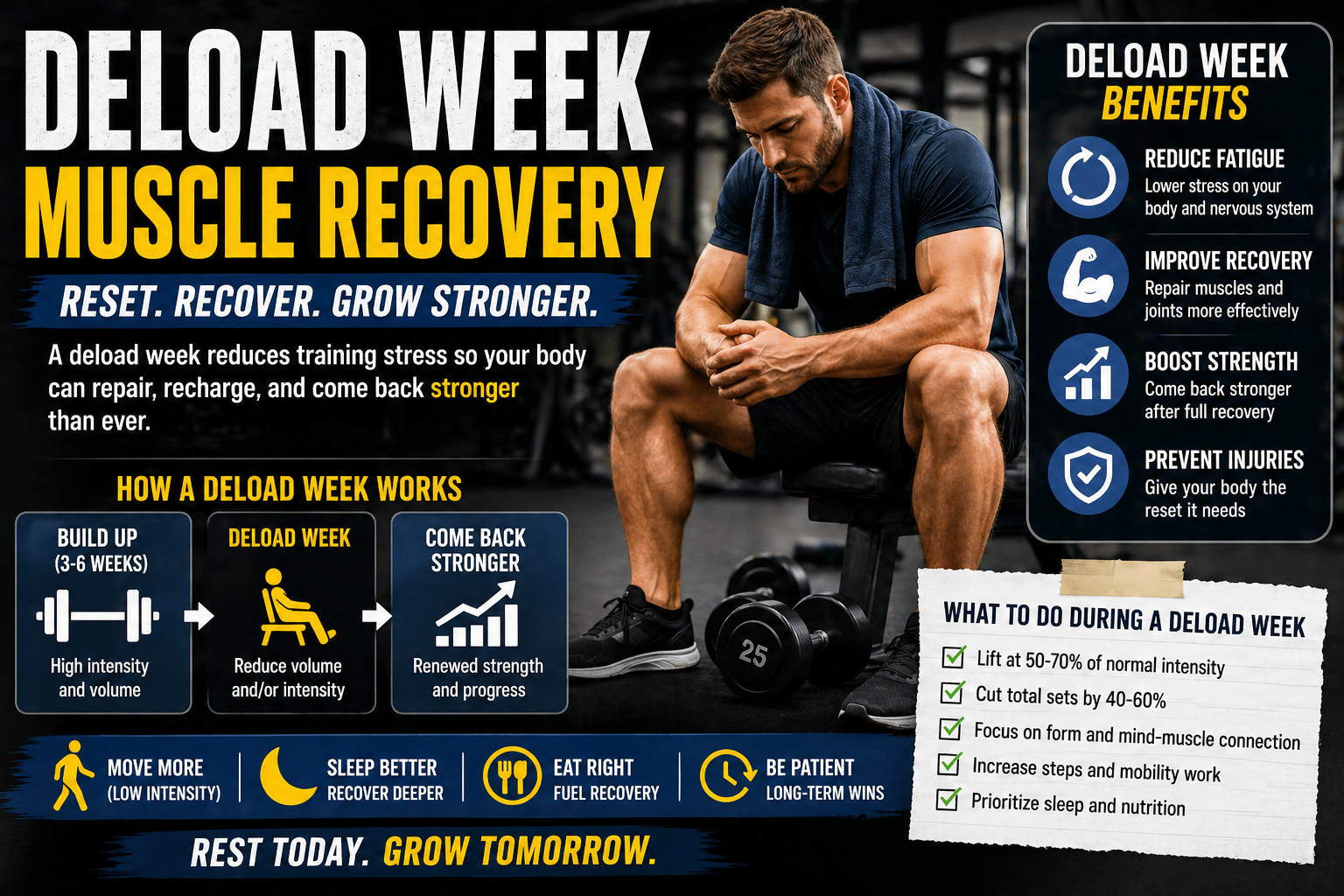
A deload week muscle recovery strategy is a planned reduction in training stress—volume, intensity, or both—for 5–7 days.
Instead of training at 100%, you drop to:
- 50–70% of normal weights
- 50–60% of normal volume
The goal is simple: reduce fatigue while maintaining movement patterns so your body can finally catch up and grow.
Why Do You Need a Deload Week Muscle Recovery Plan?
Let’s break this down like a formula:
- Weeks 1–3: Fatigue accumulates (+10, +20, +30)
- Week 4: Performance drops (-10)
- Week 5: Plateau (0 growth)
Without a deload week muscle recovery, you stay stuck in a loop of diminishing returns.
Benefits include:
Most importantly, it enhances your active rest recovery muscle system by giving it a full reset window.
How Does a Deload Support Active Rest Recovery Muscle?
Your active rest article handles daily recovery. This article builds the next layer.
- Active rest = daily recovery
- Deload = systemic recovery
During a deload week muscle recovery, increase:
- Walking (8,000–12,000 steps)
- Mobility sessions
- Light cardio
This keeps calorie burn high while allowing muscles and your nervous system to fully recover.
When Should You Schedule a Deload Week Muscle Recovery?
Two proven approaches:
1. Time-Based
- Every 4–8 weeks
2. Biofeedback-Based
- Strength decreasing
- Soreness lasting 4+ days
- Poor sleep
- Lack of motivation
If 2–3 of these show up, your body is telling you it needs a deload week muscle recovery.
What Does a Deload Week Look Like?
You have three options:
Volume Deload
- Keep weights
- Cut sets by 50%
Intensity Deload
- Reduce weight by 20–40%
- Keep sets
Full Deload (Best Option)
- Reduce both
Example:
- Squats: 2 sets (instead of 4–5)
- Leg Press: 2 sets
- Hamstring Curl: 2 sets
- Calves: 2 sets
Total volume drops from ~20 sets to ~8 sets.
Can You Build Muscle During a Deload Week Muscle Recovery?
Not directly—but this is where most people misunderstand the process.
Muscle growth equation:
- Stimulus (training) + Recovery = Growth
A deload week muscle recovery increases your future stimulus capacity. That means heavier lifts, more volume, and ultimately more muscle after the deload.
Can You Burn Fat During a Deload?
Yes—and often more efficiently.
Here’s why:
- Lower cortisol = better fat metabolism
- Increased NEAT = more calories burned
- Improved recovery = better future workouts
Strategy:
- Keep protein high
- Maintain slight calorie deficit
- Increase daily movement
This turns your deload week muscle recovery into a fat-loss accelerator.
What Mistakes Kill Your Deload Week Muscle Recovery?
Let’s be direct—most people mess this up.
Avoid:
- “Ego deloading” (still training hard)
- Adding extra cardio
- Dropping calories too low
- Skipping deloads entirely
If it feels too easy, you’re finally doing it right.
🛠️ Deload & Recovery Toolkit
Support your deload week muscle recovery with these essentials:
- 💪 Muscle Growth Supplements – Support Recovery and Strength Gains
- 🔥 Fat Loss Supplements – Burn More Calories During Deload
- 🏋️ Fitness Gear – Train Smarter with the Right Equipment
- 🏠 Home Gym Equipment – Stay Consistent During Recovery Weeks
“A strategic deload resets your body so you can push harder, grow faster, and recover smarter.”
What Does Science Say About Deloading?
Research supports structured recovery phases for long-term hypertrophy and performance.
External sources:
These findings validate the effectiveness of a deload week muscle recovery strategy.
How Does This Fit Into Your Full System?
Here’s the complete formula:
- Daily: Active rest recovery muscle
- Weekly: Structured training
- Monthly: Deload week muscle recovery
When you stack these together, you create:
- Consistent muscle growth
- Sustainable fat loss
- Long-term progression
Key Takeaways
- Deload every 4–8 weeks
- Reduce volume and/or intensity
- Increase active recovery during deload
- Maintain protein and smart nutrition
- Use deloads to extend long-term gains
🌿 Natural Daily Support for Men and Women
I like Divine Bounty supplements because they use natural ingredients instead of synthetic formulas. For people who want a cleaner option for everyday wellness support, Divine Bounty offers quality supplements designed to fit a healthy lifestyle.
Their lineup includes the popular Men’s Multivitamin, plus other supplements for men and women such as Vitamin B Complex, Digestive Enzymes, Berberine, Magnesium Citrate, Vitamin K2 + D3, and Acetyl L-Carnitine.
The Men’s Multivitamin features 24 essential vitamins and minerals plus 5 additional blends for men, all in convenient vegetarian capsules. It is also promoted as GMO free, soy free, dairy free, wheat free, and gluten free.
🛒 Shop Divine Bounty on AmazonSponsored by Terry Clark • Amazon Affiliate Partner