
Estimated reading time: 4 minutes
If you train hard but ignore recovery, you’re solving the wrong equation. Muscle growth and fat loss don’t happen during workouts—they happen during recovery. That’s where active rest recovery muscle strategies come in.
Active rest isn’t about doing nothing. It’s about doing the right amount of movement to accelerate recovery while keeping your metabolism elevated. When done correctly, it becomes a multiplier for both muscle growth and fat loss.


6
What Is Active Rest Recovery Muscle Training?
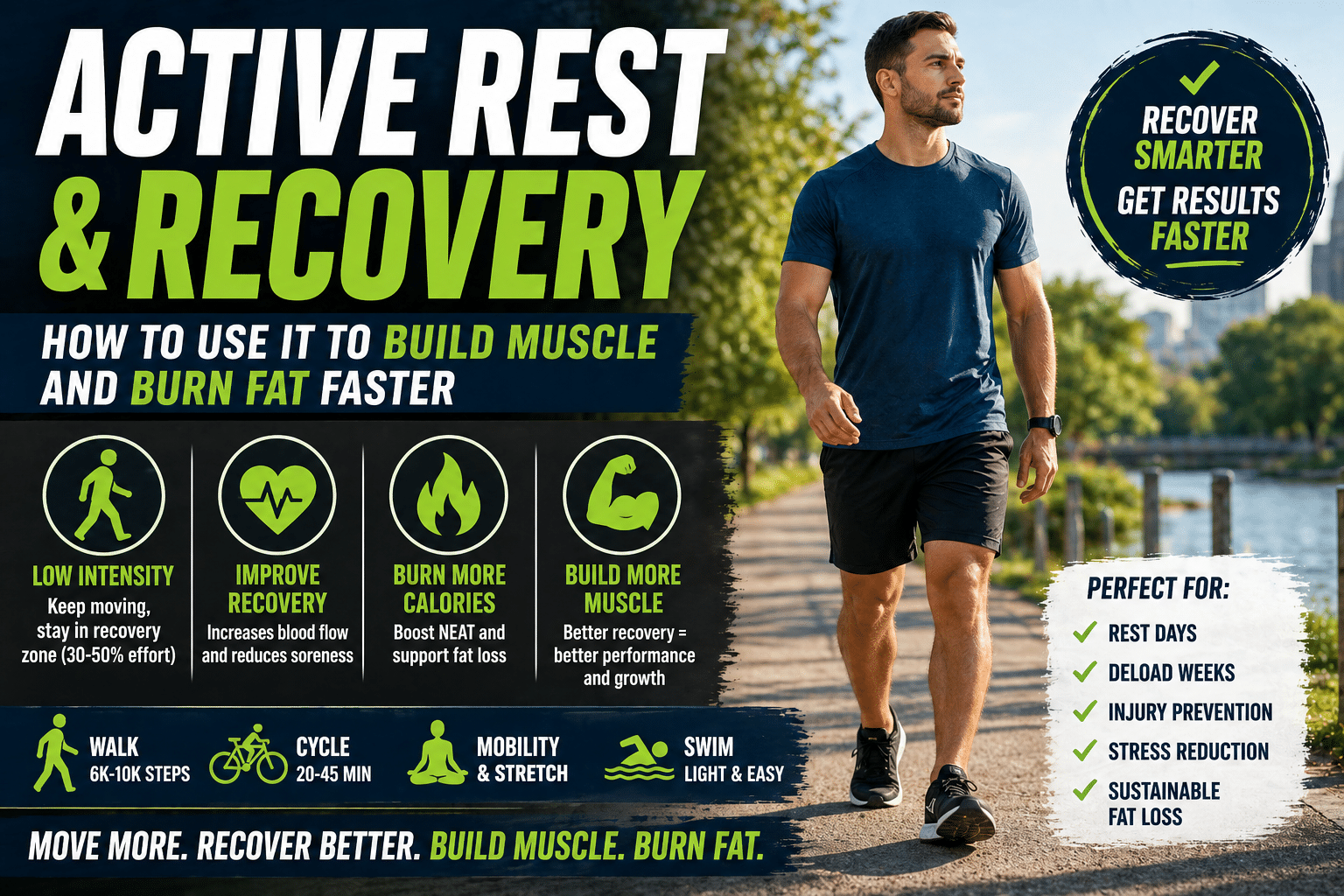
Active rest recovery muscle refers to low-intensity physical activity performed between intense training sessions to enhance recovery without adding fatigue.
Examples include:
- Walking (6,000–10,000 steps)
- Light cycling
- Swimming
- Mobility work and stretching
Instead of complete rest, you keep your body moving at 30–50% effort, which improves circulation and speeds up recovery.
Why Does Active Rest Help Build Muscle?
Here’s the math behind it:
- Training = muscle damage
- Recovery = muscle repair
- Active rest = faster repair rate
When you use active rest recovery muscle strategies, you increase blood flow to the muscles. That means more nutrients, more oxygen, and faster removal of waste products like lactic acid.
The result:
- Reduced soreness
- Faster recovery between workouts
- More frequent training opportunities
And more training = more growth.
How Does Active Rest Burn Fat?
Fat loss is driven by a calorie deficit, but active rest recovery muscle gives you an edge.
Here’s how:
- Increases daily calorie burn (NEAT)
- Keeps metabolism elevated
- Prevents inactivity on rest days
Let’s break it down:
- 8,000 steps = ~300–400 calories burned
- 3 active rest days = 900–1,200 extra calories/week
That’s the equivalent of an extra fat-loss workout—without the stress on your body.
How Often Should You Use Active Rest Recovery Muscle?
If you’re training 3–5 days per week, you should include 2–4 active rest days.
Example weekly structure:
- Day 1: Leg Day
- Day 2: Active Rest
- Day 3: Upper Body
- Day 4: Active Rest
- Day 5: Full Body
- Day 6: Active Rest
- Day 7: Rest or Light Activity
This structure supports recovery while maintaining consistent calorie burn.
What Are the Best Active Rest Exercises?
Not all movement qualifies. The key is low intensity, high consistency.
Top options for active rest recovery muscle:
- Walking (best overall)
- Cycling (low joint stress)
- Swimming (full-body recovery)
- Yoga (mobility + relaxation)
- Foam rolling (muscle release)
Avoid:
- High-intensity cardio
- Heavy lifting
- Long-duration endurance sessions
If it feels like a workout, it’s not recovery.
How Long Should Active Rest Sessions Be?
Keep it simple:
- 20–45 minutes per session
- Heart rate: 50–60% max
- Effort level: You should be able to hold a conversation
This ensures you’re enhancing recovery—not interfering with it.
Can Active Rest Replace Complete Rest?
No—and this is where people get it wrong.
You still need at least one full rest day per week. Active rest supports recovery, but your nervous system also needs complete downtime.
Think of it like this:
- Active rest = physical recovery
- Full rest = neurological recovery
Both are essential for maximizing active rest recovery muscle benefits.
How Does Nutrition Support Active Rest?
Active rest works best when paired with proper nutrition.
Follow these guidelines:
- Protein: 0.8–1g per lb bodyweight
- Calories: Slight deficit (fat loss) or surplus (muscle gain)
- Hydration: 3–4 liters daily
On active rest days, don’t drastically cut calories. Your body is still recovering and rebuilding.
🧘 Active Recovery Toolkit
Boost your active rest recovery muscle routine with these essentials:
- 🌀 Foam Roller – Release Tight Muscles Faster
- ⌚ Fitness Tracker – Monitor Steps & Recovery
- 🧘 Yoga Mat – Improve Mobility and Flexibility
“Recovery isn’t rest—it’s preparation for your next breakthrough.”
What Happens If You Skip Active Rest?
Skipping active rest recovery muscle can lead to:
- Increased soreness
- Slower recovery
- Reduced training performance
- Lower calorie burn
In simple terms, you’re leaving results on the table.
What Does Science Say About Active Recovery?
Research shows that low-intensity activity:
- Improves blood lactate clearance
- Enhances muscle recovery
- Reduces delayed onset muscle soreness (DOMS)
External sources:
These findings support the effectiveness of active rest recovery muscle strategies.
Key Takeaways
- Active rest accelerates muscle recovery and growth
- It increases calorie burn without adding fatigue
- Aim for 20–45 minutes of low-intensity movement
- Combine with proper nutrition for best results
- Use 2–4 active rest days per week
🌿 Natural Daily Support for Men and Women
I like Divine Bounty supplements because they use natural ingredients instead of synthetic formulas. For people who want a cleaner option for everyday wellness support, Divine Bounty offers quality supplements designed to fit a healthy lifestyle.
Their lineup includes the popular Men’s Multivitamin, plus other supplements for men and women such as Vitamin B Complex, Digestive Enzymes, Berberine, Magnesium Citrate, Vitamin K2 + D3, and Acetyl L-Carnitine.
The Men’s Multivitamin features 24 essential vitamins and minerals plus 5 additional blends for men, all in convenient vegetarian capsules. It is also promoted as GMO free, soy free, dairy free, wheat free, and gluten free.
🛒 Shop Divine Bounty on AmazonSponsored by Terry Clark • Amazon Affiliate Partner